

China Mobile eSIM Review: Best Network Option for Travelers in China?
Apr
Most travelers land in Shanghai or Beijing with either a grossly overpriced “Global Asia” eSIM or a domestic Chinese SIM like China Mobile eSIM — and spend half the trip fighting VPN dropouts. There is a third path almost nobody talks about: an international roaming eSIM running on China Mobile’s network. It solves the price, coverage, and Great Firewall problem in a single activation.
The $30 Mistake Most China Travelers Make Before They Board
It usually goes like this. A traveler picks up a generic “Asia Regional” eSIM from a popular aggregator — $35 for 10 days, looks reasonable. They land, get signal, and everything seems fine. It is only after a few hours in a hotel elevator in Chengdu or in the mountains of Zhangjiajie that they notice: speeds are crawling, coverage patches in and out, and their VPN keeps disconnecting.
The reason is not the eSIM format. It is the underlying carrier. Generic regional plans frequently roam on secondary Chinese networks — often China Unicom or China Telecom — because those carriers have cheaper international wholesale agreements. For coastal megacities, the difference is barely noticeable. For inland China, rural corridors, or High-Speed Rail between secondary cities, the gap is significant.
The real question to ask is not “does it work in China?” — it is “which carrier owns the towers in the places I am actually visiting?” For the overwhelming majority of mainland itineraries, the answer is China Mobile.
Why China Mobile Dominates Mainland Coverage
China is 9.6 million square kilometres. While China Unicom and China Telecom focused their early infrastructure on dense coastal provinces, China Mobile built the backbone that connects inland China. That strategic difference still shows up in signal quality today.
Rural and remote destination advantage
If your itinerary includes Zhangjiajie’s glass bridges, Jiuzhaigou’s turquoise lakes, Yunnan’s highland villages, or the Silk Road corridor through Gansu and Xinjiang — China Mobile wins by default. These are regions where competitor towers thin out dramatically, and where China Mobile’s rural rollout is years ahead.
High-Speed Rail (HSR) network coverage
China operates the world’s largest high-speed rail network, and China Mobile holds dedicated corridor coverage agreements along it. The Beijing–Shanghai, Beijing–Xi’an, and Guangzhou–Shenzhen lines all have consistent 4G signal on China Mobile — a notable advantage for travelers working or navigating during a three-hour train journey.
The market share signal
China Mobile holds approximately 60% of China’s mobile subscriber base and operates the world’s largest 5G deployment by tower count. That market share is not just a marketing statistic. It translates into denser tower placement, more redundant infrastructure in elevators and basements, and faster resolution of coverage gaps — because more customers means stronger financial incentive to fix problems.
Pricing Reality Check: What Are You Actually Paying For?
Comparing eSIM prices by raw cost per gigabyte misses the point. The more useful frame is: what does each dollar actually buy a traveler in China?
| Your Trip Type | Recommended Plan | Est. Cost | Daily Cost Breakdown |
| 7-day city hopper (Beijing + Shanghai) | 7-day / 1GB daily | ~$15 – $20 | ~$2 – $2,9 |
| 2-week mixed city + rural | 15-day / 1GB daily | ~$30 – $35 | ~$2 – $2,4 |
| 1-month slow travel | 30-day unlimited | ~$100 – $141 | ~$3 – $4,7 |
Most China travel eSIM plans from providers like Twise fall in these ranges when running on the China Mobile network. For reference, a comparable domestic Chinese SIM might cost $8–15 for seven days — but that price conceals a significant hidden cost.
Hidden cost most reviews skip: A domestic Chinese SIM requires a paid, reliable VPN to access Google, WhatsApp, YouTube, or Instagram. Quality VPN subscriptions run $5–15 per month, and even premium VPNs drop connections unpredictably inside China. That hidden cost often eliminates the price advantage of a domestic SIM for a one-to-two week trip.
What happens when you run out of data mid-trip?
This is the question most reviews ignore. With domestic Chinese SIMs like China Mobile eSIM, topping up requires either WeChat Pay or Alipay — both of which require a Chinese bank card or a pre-setup international payment method. The process works, but it takes setup time before you leave. International roaming eSIM providers typically allow top-ups or get new one through the same foreign card you used at purchase, with no in-country setup required.
The Destinations That Will Break Your China Mobile eSIM
No coverage solution is universal, and intellectual honesty about limitations is more useful than marketing language. Here are the exact scenarios where a mainland China Mobile travel eSIM quietly fails.
Hong Kong
A jurisdictional boundary, not a technical one. Hong Kong operates as a separate telecom regulatory zone. Mainland eSIM plans either go dark or switch to expensive international roaming the moment you cross the border.
Macau
Same regulatory separation as HK. Many travelers discover this at the Cotai Strip or on the ferry from Zhuhai when navigation stops loading. Macau has its own licensed carrier environment.
If your itinerary includes Hong Kong or Macau alongside mainland stops, look for a “Greater China” or “Global” eSIM pack from your provider rather than the mainland-only plan. These cost slightly more but route correctly across all three jurisdictions.
The Great Firewall: Why an eSIM China Mobile Roaming Plan Bypasses It
This is the most misunderstood part of China connectivity, and getting it right changes everything about how you plan your trip.
How a domestic SIM routes data
When you buy a SIM card inside mainland China — from a China Mobile store, a convenience store, or even a local reseller — your data follows this path: China Mobile tower → Great Firewall inspection → filtered internet. Google, YouTube, Instagram, WhatsApp, and thousands of other services are blocked at that inspection layer. A VPN attempts to tunnel past it, with varying success depending on VPN quality and current GFW enforcement intensity.
How an international roaming eSIM routes data
An international roaming eSIM — like China Mobile eSIM for travelers sold by Twise or similar providers — uses a different data path: China Mobile tower → international roaming gateway → open global internet. Your device connects to the same physical towers and gets the same coverage, but the data exits China’s network through an international exchange point before the firewall can inspect it. You get China Mobile’s mainland coverage without the Great Firewall applying to your traffic.
Legality note: This routing is 100% legal. International roaming is governed by ITU protocols that predate the Great Firewall’s architecture. Foreign visitors using international roaming eSIMs like Twise China Mobile eSIM are not violating any Chinese law — they are using the same infrastructure that foreign business travelers on corporate roaming plans have used for decades.
| Feature | International Roaming eSIM (China Mobile towers) | China Mobile eSIM (Domestic) |
| Network tower | China Mobile | China Mobile |
| Great Firewall | Not applied | Full GFW enforcement |
| Google / YouTube | Free access | Blocked |
| WhatsApp / Instagram | Free access | Blocked |
| VPN needed | No | Yes (paid, unreliable) |
| Real-name registration | Not required | Passport required in-store |
| Purchase process | Online, before trip | In-country only |
| Mainland coverage quality | 5/5 | 5/5 |
| Price (7 days) | ~$15–20 | ~$8–15 (+ VPN cost) |
Read more: Best eSIM Provider for China | Compare Local Carriers
Coverage on the Ground: Where China Mobile Towers Actually Take You
Because an international roaming eSIM uses China Mobile’s physical tower network, coverage is identical to what a domestic China Mobile subscriber experiences. The routing difference is in the data path, not in the radio signal. This means you can evaluate coverage entirely based on China Mobile’s own infrastructure map.
Tier-1 cities: Beijing, Shanghai, Shenzhen, Guangzhou
All three domestic carriers perform at essentially equal levels in these cities. Dense tower placement means near-ubiquitous 4G and growing 5G. A China Mobile eSIM for travelers (international roaming eSIM) has no disadvantage here relative to any competitor.
Tier-2/3 cities and tourist destinations
This is where the carrier choice starts to matter. Destinations like Zhangjiajie, Jiuzhaigou, Lijiang, Dali, Guilin, and Xi’an all fall in regions where China Mobile’s coverage density exceeds that of Unicom and Telecom. For scenic areas specifically — national parks, gorge trails, mountain viewpoints — China Mobile’s rural investment provides noticeably more consistent signal.
The Silk Road and western China
The Gansu corridor (Dunhuang, Jiayuguan), Xinjiang’s major cities, and Qinghai’s Tibetan plateau regions are areas where many budget regional eSIMs quietly fail. China Mobile built the primary infrastructure in these provinces well before competitors, and that lead remains relevant for travelers going off the most beaten paths.
High-Speed Rail corridors
China Mobile eSIM holds dedicated HSR corridor coverage agreements, meaning signal is engineered specifically for passengers moving at 300+ km/h. The Beijing–Shanghai, Beijing–Xi’an, and Guangzhou–Shenzhen lines all deliver consistent 4G connectivity throughout. If you plan to work or navigate during long train journeys, this is a meaningful practical advantage.
Read more: Steps to Check Carrier Compatibility for Unlocked Phones
When a Domestic China Mobile eSIM Still Makes Sense
A fair guide acknowledges that the international roaming eSIM is not always the optimal choice. There are specific situations where a domestic China Mobile eSIM wins:
| Choose roaming eSIM when | Consider domestic China Mobile eSIM when |
| Trip is 1–30 days
No existing VPN subscription Planning before departure (no in-country setup) Need access to Google, WhatsApp, Instagram Visiting rural or inland destinations Device is eSIM compatible |
Stay exceeds 60+ days
Already have a reliable VPN Need a Chinese phone number (WeChat, Didi) Traveling with locals who can assist setup Frequent China visitor with established setup |
The break-even point shifts with trip duration. For trips of one to four weeks — which covers the vast majority of tourist and short business travel — the international roaming eSIM wins on total cost of ownership (plan cost + zero VPN cost + zero setup friction). Beyond 30 days, domestic unlimited plans begin offering better per-day rates even after factoring in VPN subscriptions.
How to Choose the Right eSIM China Mobile Plan
The market for China travel eSIMs has grown significantly, and not every product marketed as “China Mobile” actually delivers international roaming routing. Here is what to verify before purchasing.
What to confirm before buying
First, check that the plan explicitly states it uses the China Mobile network — not just “works in China.” Many aggregators bundle cheaper Unicom or Telecom-based plans without highlighting the carrier difference. Second, verify whether the plan is genuinely international roaming or a resold domestic eSIM. The plan description or FAQ should mention international roaming gateway routing. Third, confirm the provider accepts foreign credit cards and delivers the eSIM QR code by email — ideally before departure so you can activate mid-flight or the moment you land.
Red flags to watch for
Plans priced at $2–4 for a full week are almost certainly reselling domestic SIM access rather than international roaming — the wholesale cost structure makes genuine international roaming at that price point impossible. Plans that use vague language like “China network” without specifying routing type warrant further investigation. And any provider that cannot clearly explain whether the Great Firewall applies to their China plans should be avoided.
Recommended approach: Twise China Mobile plans
Providers like Twise tick every verification box: confirmed China Mobile network, explicit international roaming routing (meaning no Great Firewall), foreign card acceptance at purchase, and QR code delivery by email for pre-trip activation. For mainland China travel, their plans represent the clearest available recommendation in the international roaming eSIM category.
Quick checklist before buying any China Mobile travel eSIM: (1) Carrier specified as China Mobile? (2) International roaming routing confirmed? (3) Foreign card accepted? (4) Email QR delivery before departure? (5) Greater China option available if your trip touches HK or Macau?
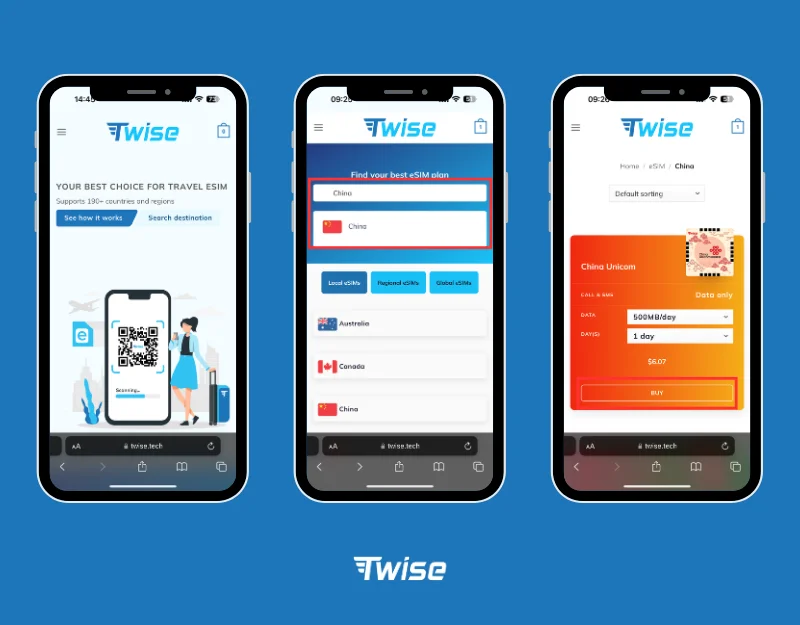
For mainland China travel, the connectivity calculus has a clear answer. An international roaming China Mobile eSIM gives you the best-in-class mainland coverage of the country’s dominant carrier, zero Great Firewall restrictions, no VPN cost or reliability gamble, and no airport setup scramble.
The only scenario where this recommendation changes is if your itinerary crosses into Hong Kong or Macau — in which case a Greater China or global plan from the same provider solves the jurisdictional gap. For everything else on the mainland, from Beijing’s hutongs to Yunnan’s rice terraces to bullet trains in between, a China Mobile travel eSIM is the cleanest solution available to foreign travelers now.
Ready to skip the VPN juggle? Runs on China Mobile’s mainland network. No firewall. No setup at the airport. Activate before you board. Get Twise China Mobile eSIM.
