Tiếng Việt
An Indonesia travel eSIM lets a compatible, unlocked phone add mobile data without replacing your physical SIM. It’s convenient for arrival, maps, ride-hailing, and hotel communication, but actual performance depends on which local network your plan connects to and where your itinerary takes you. Most Twise Indonesia plans are data-only, and Indonesia remains a 4G-first, route-dependent country rather than one uniform coverage area.
Indonesia’s Mobile Network Landscape: The Big Three
Indonesia’s mobile market is now concentrated around three major network groups: Telkomsel, Indosat Ooredoo Hutchison and XLSmart. This matters to eSIM users because Twise and other travel eSIM providers rely on one or more of these local networks to deliver coverage.
| Mobile network group | Main consumer brands | Network profile | What travelers should know |
| Telkomsel | Telkomsel and SIMPATI | Telkomsel recorded the fastest overall download speeds and the strongest performance across many regional categories in Opensignal’s December 2025 report. It also maintains an extensive national infrastructure footprint. | Often worth prioritizing for broad itineraries and travel beyond major cities. However, coverage can still weaken indoors, offshore or in sparsely populated areas. |
| Indosat Ooredoo Hutchison | IM3 and Tri | Indosat’s IM3 network won Opensignal’s national Reliability Experience category in December 2025 and remained competitive for app use, gaming and consistent service. | Can be a practical option in cities and populated travel areas. Travelers should still check the specific partner network and route instead of assuming identical performance across Indonesia. |
| XLSmart | XL, AXIS and Smartfren | XLSmart has been combining and expanding the former XL and Smartfren networks. Opensignal found that XL led Indonesia’s Voice App Experience category, which measures apps such as WhatsApp and Messenger. | Relevant for travelers who rely heavily on internet calls and messaging, but performance still depends on the destination, network integration and exact accommodation location. |
What Is the Best eSIM for Indonesia?
For a short Bali or Jakarta trip: a prepaid travel eSIM is usually the simplest setup if you mainly need maps, ride-hailing apps, messaging, and booking access.
For travel across Southeast Asia: compare a regional plan against a country-only one. If Indonesia is one stop in a Thailand, Singapore, Malaysia, or Vietnam itinerary, a regional eSIM can save you from switching profiles at every border.
For island-hopping or remote routes: prioritize which local partner network actually reaches your route over which plan offers the most gigabytes.
For a local phone number: an Indonesian tourist SIM or eSIM registered directly with a carrier is the better fit — registration requirements apply, covered below.
For stays longer than 90 days: this is a formal local-SIM and IMEI-registration situation, not something a short-term travel eSIM is designed to solve.
| Traveler need | Usually the better fit | Check before buying |
| 3–14-day city or Bali trip | Travel eSIM | Partner network and validity |
| Indonesia plus nearby countries | Regional eSIM | Which countries are included |
| Long stay or local calls | Local SIM/eSIM | Passport and IMEI process |
| Remote-island itinerary | Strongest local network for that route | Exact route coverage, not just price |
| Family or several devices | Pocket Wi-Fi or hotspot-enabled eSIM | Battery and hotspot limits |
| Occasional emergency data | Home roaming pass | Daily roaming charge |
Twise Indonesia eSIM Plans: What Do You Actually Get?
Twise’s Indonesia eSIM page currently lists three plan categories: Southeast Asia unlimited 4G daily plans, Southeast Asia daily fixed-data plans ranging from 500MB to 3GB per day, and World 70 Countries fixed-data plans. All are data-only.
What data-only means in practice: the eSIM doesn’t automatically include an Indonesian phone number, regular cellular calls, or standard SMS. WhatsApp, Messenger, FaceTime, and similar internet-based services work normally over the data connection — which covers how most travelers actually communicate abroad.
Before buying, each plan should clearly show:
- Local partner network
- 4G or 5G availability
- High-speed data allowance
- Reduced speed after that allowance
- Hotspot policy
- What triggers activation
- How validity is calculated
- Whether top-up or renewal is available
- Whether manual APN settings may be required
Match the plan to the trip: a short Bali visit usually fits a fixed daily-data plan, heavier daily use benefits from the unlimited option, and multi-country travel is where a regional or World plan earns its cost. Compare Indonesia eSIM plans by trip length and daily data use rather than assuming the largest package is automatically best.
https://www.youtube.com/watch?v=PWqiRNd_abI
Indonesia eSIM vs. Local SIM, Roaming, and Pocket Wi-Fi
| Option | Best for | Local number | Setup effort | Main trade-off |
| Twise travel eSIM | Short trips and app data | Usually no | Low | Coverage depends on partner network |
| Local eSIM/SIM | Long stay or local-number need | Usually yes | Medium | Passport and device registration |
| Home roaming | Very short trips | Keeps home number | Very low | Can be expensive |
| Pocket Wi-Fi | Groups and multiple devices | No | Medium | Battery and device management |
| Physical tourist SIM | Non-eSIM phones | Often yes | Medium | Store visit and SIM swap |
A travel eSIM keeps your physical SIM in place and gets you app-based data shortly after landing. A local Indonesian SIM or eSIM is worth it if you need a local number, longer-term renewal, or direct carrier support. Home roaming suits very short or low-data trips if you’re comfortable with your carrier’s rate. Pocket Wi-Fi works well for groups, provided someone manages charging and returns. A physical tourist SIM remains the fallback for phones that can’t run eSIM at all.
Indonesia eSIM Coverage: What to Expect During a Real Trip
| Travel situation | Reasonable expectation | Preparation |
| Major airport or city centre | Usually the strongest chance of a stable connection | Keep airport Wi-Fi details handy as backup |
| Established Bali resort area | Often usable 4G | Save your hotel address offline |
| Inland or mountain road | Variable | Download your route before departure |
| Small island town | Depends on carrier and exact location | Check recent traveler guidance for that spot |
| Ferry or boat trip | Intermittent or unavailable offshore | Download tickets, maps, and messages in advance |
| Concrete hotel interior | Signal may weaken indoors | Use hotel Wi-Fi if needed |
| Remote accommodation | Highly location-dependent | Confirm connectivity directly with the property |
Bali specifics: South Bali’s established tourist areas — Kuta, Seminyak, Canggu, Denpasar — generally offer the best chance of stable service, though indoor construction and network congestion can still cause dips. Ubud and inland routes are less consistent the farther you move from the town centre. Nusa Penida, the Gili Islands, and parts of Lombok vary meaningfully between the port, the town, the beach, and inland accommodation — the destination name alone doesn’t tell you what to expect.
Java and overland travel: city coverage in Jakarta, Surabaya, Bandung, and Yogyakarta is generally solid, but continuous coverage during a long train or road journey is a separate question from city-center reliability.
Labuan Bajo and Komodo-area trips: download maps, tickets, and key messages before leaving populated areas, since boat journeys to the Komodo islands often lose signal offshore.
A dropped connection on a ferry or in the highlands usually means the local network has no usable signal there — not that the eSIM has failed.
Do Tourists Need IMEI Registration in Indonesia?
This is one of the most misunderstood parts of Indonesian mobile access, and the common “you must register within 30 days” claim circulating online isn’t accurate for most travelers.
Roaming vs. an Indonesian SIM are treated differently. Indonesian customs guidance separates travelers who stay on international roaming (using their home SIM) from travelers who activate an Indonesian SIM or eSIM locally.
The real rule is a 90-day window, not 30 days. Foreign visitors who want to use an Indonesian SIM can register for temporary network access through a telecom operator’s own channel — not full customs registration — for stays of up to 90 days. Formal customs IMEI registration only becomes necessary if you plan to keep using an Indonesian SIM beyond that 90-day mark.
Telkomsel’s tourist registration, for example, asks foreign customers to visit a GraPARI outlet with a passport (or KITAS/KITAP for longer-term visitors), with validation typically taking just a few minutes.
Where a Twise travel eSIM fits: a travel eSIM operating through a foreign roaming profile sits closer to the roaming scenario described in customs guidance, which generally doesn’t require registration. That said, provisioning models can differ between providers and plans, so it’s worth confirming the exact setup with Twise support rather than assuming every product is automatically exempt.
If you’re staying over 90 days, this isn’t a travel-eSIM situation — follow official Indonesian customs and carrier guidance for formal registration instead.
| Situation | Likely action |
| Home SIM using international roaming | Customs IMEI registration generally not required |
| Travel eSIM on a foreign roaming profile | Confirm exact treatment with the provider |
| Indonesian local SIM for a short visit | Register at the operator outlet for temporary access |
| Stay beyond 90 days | Review formal customs IMEI registration |
| Phone purchased in Indonesia | Follows its existing local registration status |
How Much Data Do You Need in Indonesia?
| Travel style | Approximate planning range | Typical behaviour |
| Light | 500MB–1GB per day | Maps, messages, and bookings |
| Standard | 1–2GB per day | Social media, music, and app-based calls |
| Heavy | 3GB+ per day | Video, cloud work, and hotspot use |
| Wi-Fi-supported trip | Smaller fixed package | Mobile data mainly outside the hotel |
| Remote-work trip | Larger or unlimited-style plan | Calls, files, and laptop hotspot |
These are planning ranges, not guarantees of exact usage — actual consumption depends on your specific apps and habits.
More data doesn’t create coverage. A 20GB or unlimited plan won’t produce signal where the underlying network has none — data volume and route coverage are separate questions. Before choosing an “unlimited” plan, check its high-speed threshold, what speed you get afterward, any fair-use limits, and whether hotspot is restricted.
When a regional plan makes more sense: if your route combines Indonesia with Singapore, Malaysia, Thailand, or Vietnam, a regional eSIM can be more efficient than buying a fresh country-specific plan at each border.
How to Install and Activate Your Indonesia eSIM
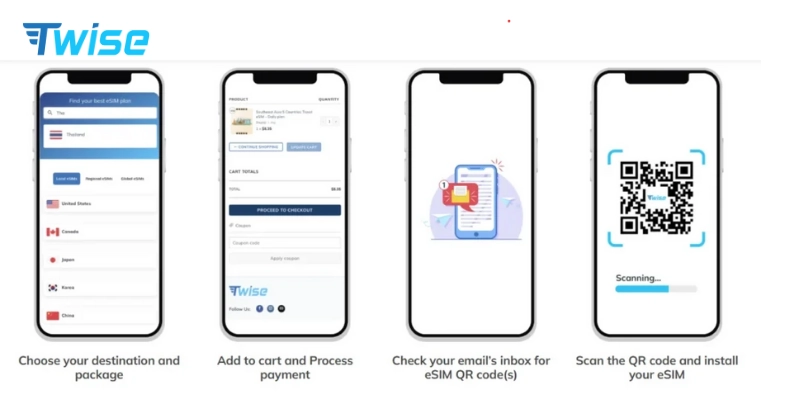
- Confirm your exact phone model and region support eSIM — check Twise’s device compatibility guide rather than assuming based on the model family alone.
- Confirm the phone is carrier-unlocked. An eSIM-capable phone can still reject a travel profile if it’s locked to another carrier.
- Buy the plan and save your order details — QR code, manual activation info, support contact, and order number, stored somewhere accessible offline.
- Install on stable Wi-Fi, following Twise’s setup guide for your device.
- Check when validity actually starts — at installation, when the line is enabled, at first network connection in Indonesia, or on a scheduled date. This varies by plan, so don’t assume.
- Configure dual-SIM settings: set the Twise eSIM as your cellular data line, enable data roaming on that line if required, keep your home SIM’s data roaming off, disable automatic cellular data switching unless you want it, and optionally leave your home SIM active for incoming OTPs (subject to your home carrier’s charges).
- Do a pre-departure check that the profile installed correctly, without connecting it prematurely if that would start your validity period early.
When a Local SIM or Another Connectivity Option Is Better?
- You need an Indonesian phone number — a local SIM is the more appropriate choice.
- You’re staying longer than 90 days — formal local registration and a renewable domestic plan fit better than a short-term travel eSIM.
- Your itinerary is heavily remote — pick the local carrier that actually reaches your specific route, ahead of pre-arrival convenience.
- Your phone is locked or non-eSIM — a physical tourist SIM, pocket Wi-Fi, or home roaming are your options.
- Several people need continuous data — compare the cost and battery impact of multiple eSIMs against hotspot sharing or pocket Wi-Fi.
- You need heavy hotspot use — confirm tethering and high-speed-data policies before buying, not after.
Indonesia eSIM Pre-Departure Checklist
- Confirm the exact phone model supports eSIM
- Confirm the phone is unlocked
- Match plan duration to your trip dates
- Check the partner network
- Check activation and validity rules
- Check high-speed data and fair-use terms
- Check hotspot availability
- Install on reliable Wi-Fi
- Save the QR code and support details
- Download offline maps
- Save accommodation and driver information
- Disable data roaming on your home SIM
- Confirm how you’ll receive OTP messages
- Download ferry, train, or flight tickets
- Test your key travel apps before departure

FAQs
One matched to your route: established South Bali areas are well-served by most plans, while trips to Nusa Penida, the Gilis, or inland Ubud benefit from checking the specific partner network’s local performance first.
Not typically for a short trip using a foreign roaming eSIM or your home SIM’s roaming. Local Indonesian SIM use is covered for up to 90 days through the operator; stays beyond that require formal customs registration.
Usually yes for the eSIM line specifically, while your home SIM’s data roaming should stay off to avoid its own charges.
Generally yes for most travelers, though the actual comparison depends on your home carrier’s specific roaming rate.
Speed typically drops to a reduced rate rather than cutting off entirely — check your specific plan’s terms.
Move to a formal local SIM with proper customs IMEI registration rather than relying on a short-term travel eSIM.
See more helpful tips for your Indonesia journey
Slow eSIM Internet Abroad? Here’s How to Fix It