Tiếng Việt
A Middle East eSIM can provide mobile data across several supported countries without changing physical SIM cards at each border. It’s most useful for maps, transport apps, hotel messages, translation, and booking access. However, country lists differ substantially between providers. Twise’s current Middle East–Africa plan covers 13 destinations but does not list the UAE, Saudi Arabia, Bahrain, or Turkey, so travelers must verify their full route before purchasing.
Which Countries Does the Middle East eSIM Actually Cover?
Twise’s Middle East–Africa plan currently supports 13 destinations:
- Middle East: Israel, Jordan, Kuwait, Oman, Qatar, Yemen
- Africa: Algeria, Egypt, Kenya, Sudan
- Other regions: Iran, Mongolia, Nepal
Not included: UAE, Saudi Arabia, Bahrain, and Turkey are all absent from this list — despite being some of the region’s most visited destinations. If your itinerary includes any of these, this specific plan won’t work there.
“Middle East” is a commercial bundle name, not a standardized telecom region — every provider draws the line differently, which is exactly why checking the actual country list matters more than the product name. If one of your stops is missing, your options are: a separate country-specific eSIM, a broader global plan, a local tourist eSIM, or home-carrier roaming for a short stop.
One Region, Many Telecom Markets
Spectrum, carrier partnerships, eSIM onboarding, and identity rules all operate on a national basis — there’s no single “Middle East network.” The eSIM seller’s brand name isn’t the local network either; it’s a reseller connecting through partner operators in each country, and automatic network selection only chooses among carriers authorized for your specific profile, not every carrier in the country.
| Country | Main operator groups to verify | Local tourist-plan consideration |
| UAE | e& (Etisalat) and du | Visitor plans often include a local number |
| Saudi Arabia | stc, Mobily, and Zain | Useful for Hajj, Umrah, or longer trips |
| Qatar | Ooredoo and Vodafone Qatar | Online visitor eSIM onboarding available |
| Kuwait | Zain, Ooredoo, and stc | Compare airport/local plans with regional roaming |
| Oman | Omantel, Ooredoo, and Vodafone Oman | Coverage outside Muscat varies by route |
| Bahrain | Batelco, stc, and Zain | Local options can suit longer stays |
| Jordan | Zain, Orange, and Umniah | A local number helps with domestic calls |
| Egypt | Vodafone, Orange, e&, and WE | Larger local packages suit long stays |
Verify current operator details directly before publishing anything that names specific carriers, since these partnerships shift.
Best Fit by Destination
Several supported countries in one trip: the regional eSIM is convenient when every stop is on the list above and data-only service is sufficient.
One Gulf country only: a local tourist SIM or local eSIM may offer more data, a local number, and direct carrier support than a regional data-only plan.
UAE or Saudi Arabia: don’t use the 13-country product — neither destination is listed. Twise’s UAE Etisalat eSIM is a direct alternative for the UAE; for Saudi Arabia, check Twise’s other regional and global eSIM plans for an eligible option.
Jordan and Egypt: both currently appear on the regional list, making this a practical single-profile combination — Egypt also has its own dedicated eSIM plans if you want more data for Egypt specifically.
Qatar, Oman, and Kuwait: compare the regional plan against local visitor options based on trip length and whether you need a local number.
Business travelers: prioritize hotspot access, data allowance, support responsiveness, and the exact country list over headline price.
Long stays: a renewable local plan is usually more practical than a fixed 30-day roaming profile.
| Traveler need | Usually the better option | Check first |
| Several included countries | Regional eSIM | Complete country list |
| One country for 2–4 weeks | Local eSIM or SIM | Passport onboarding |
| UAE or Saudi itinerary | A different eligible plan | Live coverage |
| Jordan and Egypt | Regional plan | Partner networks |
| Short airport stop | Airport Wi-Fi or small plan | Airside Wi-Fi availability |
| Remote work | Large-data or local plan | Hotspot and fair-use terms |
| Local calls required | Local tourist plan | Registration |
What You Actually Get: Twise Middle East–Africa eSIM
The plan offers 1GB, 5GB, or 10GB high-speed data packages, valid for 30 days from activation. It’s data-only — no Middle Eastern local number, standard cellular calls, standard SMS, or guaranteed support for number-dependent local services.
Once the high-speed allowance is used, speed drops to 128Kbps, which still handles WhatsApp messages, email, and basic travel information, but not video or heavy browsing.
Hotspot sharing is supported on the current page, though sharing across multiple devices will draw down a fixed allowance faster than solo use.
Before buying, confirm on the live plan card: which partner network serves each supported country, the QR installation deadline, what triggers activation, the validity timezone, whether the 24-hour high-speed reset is rolling, top-up and renewal availability, APN requirements, and whether the QR code can be reinstalled if something goes wrong.
Check whether every country on your itinerary is included before choosing a data allowance — the destination list matters more than the gigabyte number.
Regional eSIM vs. Local SIM, Country eSIM, and Home Roaming
| Option | Best for | Local number | Setup effort | Main trade-off |
| Twise regional eSIM | Several included countries | No | Low | Major countries currently missing |
| Country travel eSIM | One destination | Usually no | Low | Needs a new profile per country |
| Local tourist eSIM | Longer stay or local calls | Usually yes | Medium | Identity verification required |
| Home roaming | Short stopover | Keeps home number | Very low | Potentially expensive |
| Pocket Wi-Fi | Several devices | No | Medium | Battery and collection logistics |
A regional eSIM makes sense when several included countries are on your route within one validity period. A country-specific travel eSIM is better when the regional package excludes your destination, or a stronger country-level deal exists. A local tourist eSIM or SIM suits a local phone number, larger data needs, or a longer stay. Home-carrier roaming works for a very short stop when the cost is understood. Pocket Wi-Fi helps groups, provided everyone stays near the router.
What Happens When You Cross Into Another Country?
The same regional profile typically registers with a new approved operator automatically — no second QR code needed. Give it several minutes before assuming it’s failed.
If it stays on “No Service” after crossing a border:
- Confirm the new country is actually included in your plan
- Toggle Airplane Mode on and off
- Confirm data roaming is enabled for the travel line
- Restart the phone
- Try automatic network selection
- Select an approved partner manually only if the product documentation names one
Don’t delete the eSIM at the border — if the QR code is single-use, that can turn a temporary registration delay into a real problem. Keep your accommodation address, entry documents, next transport booking, and pickup information saved offline before you cross.
Calls, SMS, WhatsApp, and Local Numbers
The current regional plan doesn’t include a phone number — it’s data-only. WhatsApp, Telegram, Zoom, Messenger, FaceTime, and email all work over the data connection, though exact feature availability can vary slightly by country. Ordinary cellular calls remain useful for hotels, airlines, tour operators, government services, and any contact who doesn’t use the same messaging app you do.
For OTP codes, keep your home SIM on when needed, turn its data roaming off, disable automatic cellular-data switching, and select the Twise eSIM as your data line — with awareness that incoming calls or SMS on your home SIM may still incur roaming charges. Travelers using dual SIM should check their roaming data usage to confirm data is actually coming from the travel profile and not the home line. Buy a local number specifically when frequent local calling, SMS, or number-dependent services matter to your trip.
How Much Data for a Multi-Country Trip?
| Usage style | Planning range | Typical activities |
| Light | 1–3GB total | Maps, texts, and booking access |
| Moderate | 5GB total | Daily navigation, social media, occasional app calls |
| Heavy | 10GB+ | Video, remote work, and hotspot sharing |
| Hotel-Wi-Fi-supported trip | Smaller fixed package | Mobile data mainly during transport |
| Business trip | Larger package or local plan | Meetings, cloud files, and authentication |
| Several travelers sharing | Larger package | Multiple connected devices |
Multi-country travel tends to use more data than a single-destination trip, since you’re repeatedly loading new maps, transport apps, hotel information, and translation content for each stop. Reserve large downloads, photo backups, and app updates for trusted hotel Wi-Fi rather than your mobile allowance. And regardless of package size, more gigabytes can’t create service where the partner network has no usable signal — that’s a coverage question, not a data-volume one.
Installing and Activating a Middle East eSIM
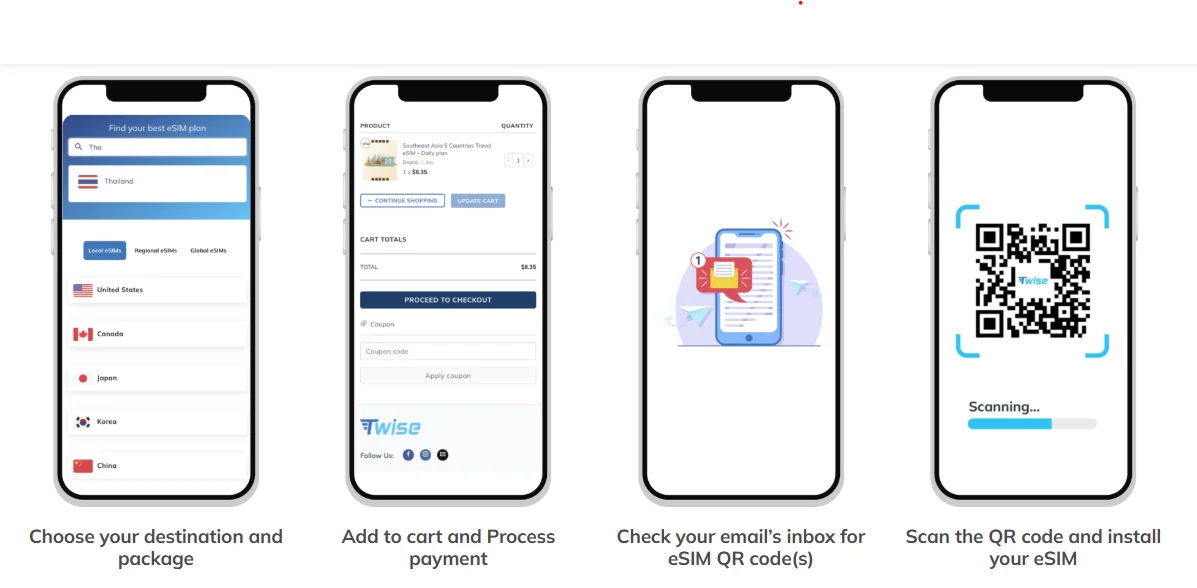
Confirm your exact phone model and regional version — check whether your phone supports eSIM and that it’s carrier-unlocked, since an eSIM-compatible device can still reject a travel profile when locked.
Before purchasing, verify every destination on your itinerary against the current coverage list rather than trusting the product name alone. Save the QR code, SM-DP+ details if provided, order number, support contact, and partner-network list somewhere accessible offline. Install on stable Wi-Fi, and treat installation and activation as separate events — check whether validity starts at installation, line activation, first supported-network connection, or a scheduled date. See how to order a Twise eSIM for the full purchase and setup walkthrough.
Configure dual-SIM settings: set the regional eSIM for cellular data, enable its roaming when required, and turn off data roaming on your home SIM.
After Landing in Your First Country
The five-minute sequence: disable Airplane Mode, turn on the regional eSIM line, select it for cellular data, enable data roaming for that line, keep home-SIM roaming off, wait a few minutes, test a lightweight page or map, and keep airport Wi-Fi available until the connection is confirmed.
Prioritize: your accommodation address, airport-transfer messages, ride-hailing app, maps, booking confirmation, translation, and payment or account verification. Don’t let cloud backups or app updates consume your fixed allowance immediately — download the next country’s map and accommodation details before you depart for the border.
When the Middle East eSIM Has No Signal
- Confirm the country is actually supported by your plan — check this first.
- Confirm the correct data line is selected; the phone may still be defaulting to the home SIM.
- Enable data roaming for the travel eSIM specifically.
- Toggle Airplane Mode, restart, and try automatic network selection.
- Check the APN matches exactly what was supplied for the product.
- If the eSIM worked in a city but stopped on a remote road, the profile is probably still valid — that’s route coverage, not a broken setup.
When troubleshooting, don’t delete the profile immediately; first review the Twise eSIM refund policy and complete the required support steps. If you contact support, have ready: order number, device model, current country and city, screenshots of your eSIM line settings, APN, available networks, and whether it worked in a previous country.
When a Local SIM or a Different eSIM Is Better
- Your country isn’t included — this applies especially to UAE or Saudi itineraries under the current 13-country list.
- You need a local telephone number — choose a local visitor SIM/eSIM with voice and SMS.
- You’re staying in one country for several weeks — a domestic plan usually offers better value, top-ups, and operator support.
- You need extensive high-speed data — a 10GB regional allowance may not stretch across daily video, laptop use, or several people.
- You’re traveling for Hajj or Umrah — use a Saudi-eligible product or local visitor plan; the current 13-country list doesn’t include Saudi Arabia.
- Your phone doesn’t support eSIM — use a physical tourist SIM, pocket Wi-Fi, or home roaming.

FAQs
Israel, Jordan, Kuwait, Oman, Qatar, Yemen, Algeria, Egypt, Kenya, Sudan, Iran, Mongolia, and Nepal — 13 destinations total.
No. The UAE isn’t on the current 13-country list — use Twise’s UAE Etisalat eSIM instead.
Yes, WhatsApp and similar apps work over the data connection.
The profile typically registers automatically with a new approved partner network — no new QR code needed, though it can take a few minutes.
No, not with the regional plan, as long as the new country is included.
Confirm the country is covered, check data roaming, toggle Airplane Mode, restart, and verify the APN before assuming a fault.
See more useful tips for your Middle East journey
Best eSIM Oman: Everything travelers need to know
Best Qatar eSIM: Plans, Coverage, Tips & Tricks
How Much Does a Travel Hotspot Cost? Pocket Wi-Fi vs Phone Hotspot vs eSIM