Tiếng Việt
A Nepal eSIM lets an unlocked, compatible phone connect to mobile data without changing its physical SIM. Twise covers Nepal through regional and global travel plans rather than a Nepal-only local eSIM. This can be convenient for airport messages, maps, and multi-country trips, but it may not include a Nepalese number. Coverage is generally more practical in populated areas and can disappear on remote trekking routes, so offline preparation remains essential.
Nepal’s Mobile Networks at a Glance
Nepal runs on two mobile network operators, not three. Nepal Telecommunications Authority data for early 2026 shows Nepal Telecom holding roughly 55.6% of mobile-broadband subscriptions and Ncell holding about 44.4%. Market share reflects subscriber numbers, not guaranteed signal strength at any specific location — a traveler in a valley where Nepal Telecom’s tower reaches but Ncell’s doesn’t will get the opposite experience from someone one village over.
| Operator | Market position | Traveler relevance | Notes |
| Nepal Telecom | Market leader, ~55.6% of mobile broadband | Broad domestic reach, including many rural areas | State-owned; largest 4G subscriber base in the country |
| Ncell | ~44.4% of mobile broadband | Dedicated tourist SIM and eSIM products | Strong in Kathmandu Valley and secondary cities |
Smart Cell doesn’t appear in the regulator’s current mobile-broadband subscriber tables and shouldn’t be treated as an equal third option — the market is a genuine two-operator structure.
Nepal is a 4G-first market. NTA figures put 4G subscriptions at roughly 26.7 million against about 765,000 on 3G, meaning 4G is now the default technology by a wide margin. Commercial 5G remains in trial and planning stages rather than something a traveler should expect to use.
Twise’s Current Nepal Coverage: Regional and Global Plans
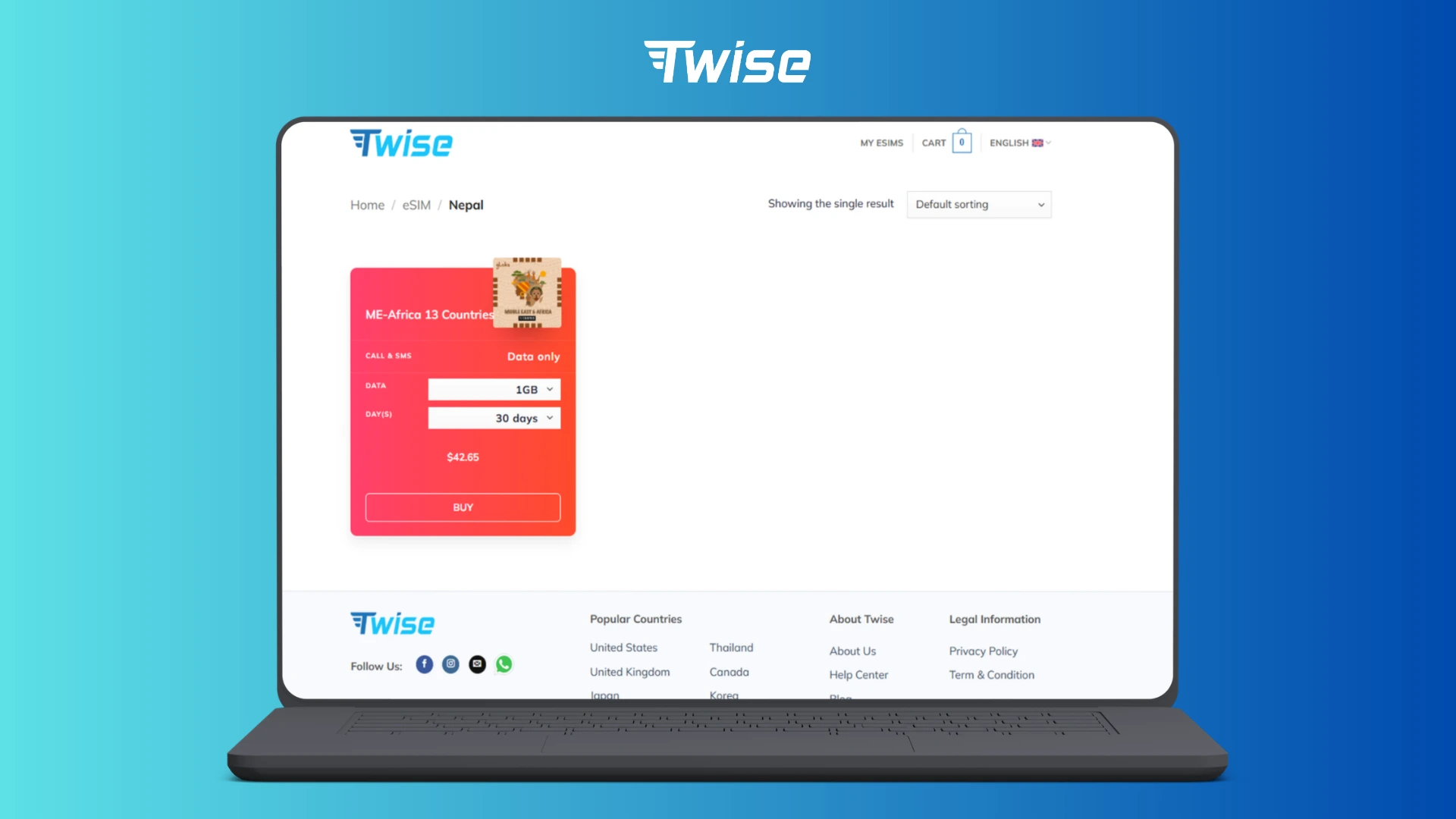
Twise does not currently offer a Nepal-only local eSIM. Nepal is instead reachable through eSIM plans that include Nepal as part of broader regional or global products.
- Asia–Australia 31 Countries Plan — a reasonable fit if your trip combines Nepal with India, Thailand, Singapore, Malaysia, Australia, or other included Asia-Pacific destinations.
- World 150 Countries Plan — better suited to longer, multi-continent journeys where broad convenience matters more than Nepal-specific pricing.
- World 33 Countries Plan — check the live product card before assuming Nepal is included; eligibility depends on the current country list and exact configuration.
Before buying, confirm the plan card discloses: whether Nepal is currently included, the Nepal partner network, whether it’s data-only or supports voice/SMS, data allowance, validity period, activation trigger, speed or fair-use terms, hotspot availability, top-up or renewal rules, and APN requirements.
| Itinerary | Likely Twise fit | Main consideration |
| Nepal plus India or Southeast Asia | Regional plan | Included countries |
| Nepal within a long global trip | World plan | Wide coverage convenience |
| Nepal-only city trip | Compare regional plan with local Ncell | Convenience vs. local value |
| Nepal trekking trip | Conditional fit | Partner network and offline backup |
| Need for local calls | Weak fit if data-only | Consider local service instead |
Compare eSIM plans that include Nepal by destination list, validity, and data allowance rather than assuming any single plan is the default choice.
Travel eSIM vs. Local Nepal SIM, Ncell Tourist eSIM, and Roaming
| Option | Best for | Local number | Setup effort | Main trade-off |
| Twise regional/global eSIM | Multi-country trips | Usually no | Low | Not a Nepal-only local plan |
| Ncell tourist eSIM/SIM | Local calls and tourist packages | Yes | Medium | Identity registration |
| Nepal Telecom eSIM/SIM | Domestic service and local support | Yes | Medium | Tourist onboarding may need a counter |
| Home roaming | Very short use | Keeps home number | Very low | Potentially high cost |
| Lodge Wi-Fi | Trekking stopovers | No | Low | Variable speed, power, and availability |
An international travel eSIM suits online purchase, keeping your home SIM installed, and connecting across several countries. Ncell currently sells tourist packages with data, calls, and SMS — physical tourist SIMs are available at Tribhuvan International Airport with original-passport registration, and tourist eSIMs are advertised through its online platform. Nepal Telecom also offers eSIM service, though much of its digital portal is built around converting an existing Nepal Telecom number rather than a simple anonymous tourist checkout. A physical local SIM suits non-eSIM phones or travelers who want in-store help. Lodge and tea-house Wi-Fi work as a supplementary layer on trekking routes, not a replacement for mobile service.
Coverage in Real Travel Situations
| Travel situation | Reasonable expectation | Preparation |
| Kathmandu or Pokhara centre | Usually the best chance of usable 4G | Keep hotel Wi-Fi available |
| Major highway and towns | Intermittently strong | Download the route in advance |
| Lower trekking village | Mobile data may be available | Save the next lodge’s details |
| Deep valley or forested section | Signal may weaken or disappear | Use offline maps |
| High pass or remote trail | No reliable mobile assumption | Follow the trek’s emergency plan |
| Tea house or lodge | Wi-Fi may be sold or shared | Expect variable speed |
| Cold high-altitude environment | Battery may drain faster | Carry a charged power bank |
Tribhuvan International Airport and the Kathmandu Valley generally offer the strongest chance of network access, though indoor airport conditions and initial phone registration can delay the first connection. Coverage between Kathmandu and Pokhara is a separate question from in-city coverage — road sections through valleys and hills away from settlements behave differently. Around Pokhara and the Annapurna foothills, service is more practical near the city and lower settlements, and less predictable as the route climbs or moves behind terrain.
Chitwan, Lumbini, and Terai towns may have useful 4G, but park interiors and rural roads shouldn’t be assumed to have continuous service. In the Everest region, Lukla and Namche Bazaar differ meaningfully from isolated valleys, passes, or high-altitude trail sections. On Annapurna, Langtang, and Manaslu routes, ask your guide or lodge which network currently performs better on your exact trail — coverage here changes often enough that a blanket claim isn’t reliable.
Mobile Data on Nepal’s Trekking Routes
Mobile coverage is not a safety system. Don’t plan around being able to call for help from every point on a trek — that’s what a dedicated emergency plan and your trekking agency are for.
Before leaving the last large town, save: offline maps, trekking permits and ID copies, guide and agency contacts, lodge names and locations, weather information, travel-insurance details, and flight or jeep booking references.
Tea-house Wi-Fi availability, speed, and cost vary between lodges and routes — treat it as a bonus, not a plan. Carry a power bank and use low-power mode or Airplane Mode during long no-signal stretches; a phone constantly searching for an unreachable tower drains battery fast. After a no-signal section, briefly toggle Airplane Mode at the next settlement to prompt fresh network registration.
Calls, SMS, WhatsApp, and Local Numbers
Whether a Twise plan includes a +977 number depends on the exact live plan — don’t assume a regional data eSIM includes local voice service, since most don’t. WhatsApp, Messenger, FaceTime, and similar apps work fine when the data connection is usable. For calling guides or lodges that don’t use internet calling, a local Ncell or Nepal Telecom number is often easier.
For OTP codes, keep your home SIM active if needed, but turn off its data roaming and automatic cellular-data switching. Travelers using dual SIM can check their roaming data usage to confirm that mobile data is coming from the travel profile rather than the home line. A local number is worth the registration effort for longer stays, frequent domestic calls, or arranging transport independently.
How Much Data Do You Need?
| Travel style | Planning range | Typical use |
| Light city use | 500MB–1GB per day | Maps, messages, and bookings |
| Standard tourist use | 1–2GB per day | Social media, music, and app calls |
| Heavy use | 3GB+ per day | Video uploads and hotspot use |
| Trekking with limited signal | Smaller total allowance may suffice | Data used mainly in settlements |
| Remote work in Kathmandu/Pokhara | Larger plan | Calls, cloud files, and tethering |
Trekking often uses less data overall but needs more validity — the phone may have no connection for long sections, while weather or transport delays extend the trip. A global plan with a large allowance still can’t create coverage in an unserved valley; that’s a signal question, not a volume one. Confirm hotspot and tethering support before relying on it for remote work, and avoid automatic laptop updates over mobile data.
Installing and Activating Your Nepal Travel eSIM
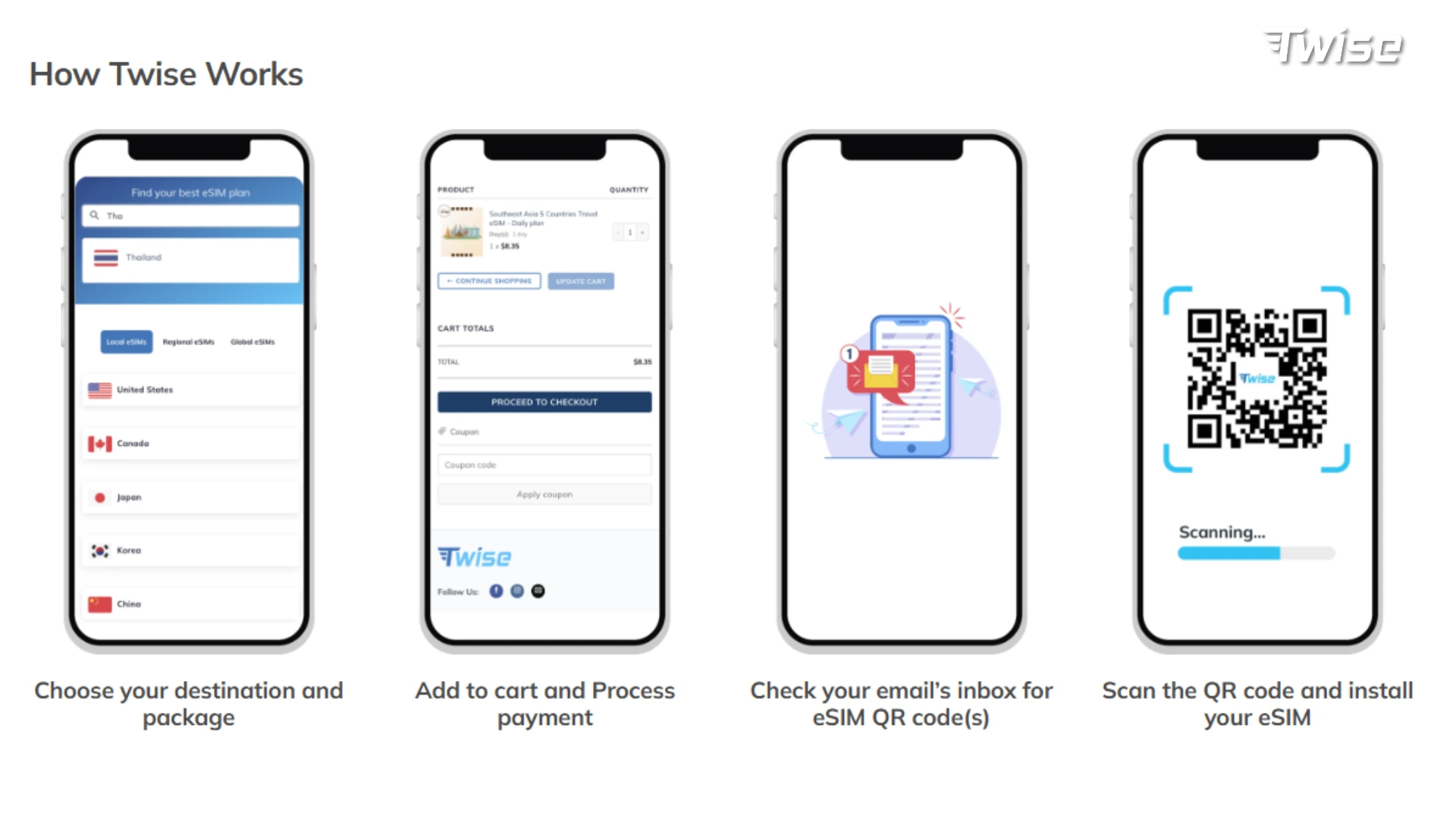
Before purchasing, check whether your phone supports eSIM and confirm that it is carrier-unlocked — an EID doesn’t override a carrier lock, and Ncell specifically states that locked imported phones can’t use its eSIM.
- Purchase the plan and save the QR code, manual installation details, order number, and support contact offline.
- Install using reliable Wi-Fi before departure, if the product rules allow it — installation and activation aren’t necessarily the same event.
- Configure dual-SIM settings: select the Twise profile for cellular data, enable data roaming for that profile if required, disable home-SIM data roaming, disable automatic data switching, and keep the home line active only when needed.
- Confirm the activation trigger — whether validity starts at installation, line activation, first supported-network connection, or a scheduled date.
After Landing at Kathmandu Airport
The five-minute sequence: turn off Airplane Mode, enable the Nepal-covered travel eSIM, select it for mobile data, turn on data roaming for that line if required, keep the home SIM’s roaming off, wait several minutes, test a lightweight map or webpage, and keep airport Wi-Fi available until the connection is confirmed.
Prioritize: your hotel or guesthouse address, the airport pickup message, maps, ride or taxi communication, domestic flight details, your trekking-agency contact, and payment or account verification. If you need a +977 number, the Ncell tourist counter or another mobile outlet can wait until these immediate tasks are done. Pause photo backups and app updates until stable accommodation Wi-Fi is available.
When the Nepal eSIM Has No Signal
- Confirm the correct data line is selected — the profile can be installed while the phone still tries the home SIM.
- Check data roaming, since international eSIMs often need it to connect through Ncell or Nepal Telecom.
- Toggle Airplane Mode and restart before touching advanced settings.
- Try automatic network selection first; use manual selection only if the plan identifies an approved network.
- Verify the APN matches what was supplied with the product.
- If the plan worked in Kathmandu but stopped in a mountain valley, the profile is probably still fine — that’s a coverage issue, not a setup failure.
- Don’t delete the eSIM immediately; some QR codes can’t be reinstalled without provider support. Review the Twise eSIM refund policy before deleting or replacing a profile that doesn’t connect.
If you contact support, have ready: order number, phone model, location, screenshots, APN, selected network, and whether the eSIM worked earlier.

FAQ
Ncell’s tourist SIM is available at Tribhuvan International Airport with passport registration; a Twise regional or global eSIM should be bought and installed before departure instead.
For a local Ncell or Nepal Telecom SIM, yes. For a Twise travel eSIM, check the specific product’s requirements.
Yes, WhatsApp and similar apps work over the eSIM’s data connection with your existing number.
Check the specific plan’s hotspot policy before relying on it.
It depends on the specific plans compared — a local SIM often wins on long-stay value, while a travel eSIM wins on setup convenience.
More useful tips for your Nepal journey
How Much Does a Travel Hotspot Cost? Pocket Wi-Fi vs Phone Hotspot vs eSIM