Tiếng Việt
An Oceania eSIM provides mobile data in selected countries without requiring a new physical SIM at each destination. It can be convenient for Australia–New Zealand trips, airport arrival, navigation, bookings, and hotel messages. However, “Oceania” does not represent one standardized coverage area. Some plans include only Australia and Guam, while others include Australia and New Zealand. Check every destination, activation rule, and partner network before purchasing.
Oceania’s Mobile Network Landscape
Australia runs on three major groups — Telstra, Optus, and Vodafone Australia — with meaningfully different footprints rather than interchangeable coverage. Telstra currently reports the largest predicted network footprint under Australia’s standardized 2026 coverage-map rules, though actual experience still varies with terrain, buildings, weather, and congestion.
New Zealand runs on Spark, One NZ, and 2degrees. Current independent results show a mixed picture: Spark led Coverage Experience, One NZ led Download Speed Experience, and 2degrees secured the greatest total number of outright and shared awards. Note that Vodafone New Zealand rebranded to One NZ — some product documentation may still reference the old Vodafone name.
Pacific islands are separate mobile markets entirely. Each island country or territory has its own operators and roaming agreements — a partner network available in Australia has no bearing on coverage in Fiji or Vanuatu.
| Market | Main operator groups | Main traveler issue |
| Australia | Telstra, Optus, Vodafone | Large differences in geographic footprint |
| New Zealand | Spark, One NZ, 2degrees | Terrain, rural coverage, and device bands |
| Guam | Local US-affiliated carrier market | Confirm the approved roaming partner |
| Pacific islands | Country-specific operators | Regional plans may exclude the island entirely |
The eSIM seller’s brand isn’t the local network — it’s a reseller connecting through an upstream profile provider to the actual local MNO in each country.
Which Countries Does Your Oceania eSIM Actually Cover?
“Oceania” is a geographical label, not a standardized mobile-roaming zone — every regional eSIM provider draws a different country line under that name, so checking the actual list matters more than the label.
The current TRUE Asia–Australia plan includes Australia and Guam, but not New Zealand or most independent Pacific island destinations. Note the naming inconsistency: the live product currently displays as “34 Countries” while its URL still reads “31-countries” — worth confirming the correct figure before you rely on either number.
Twise separately lists Australia–New Zealand daily and fixed-data plans that cover both countries directly — this is the product to use if New Zealand is part of your route, not the TRUE bundle. For Guam and Saipan specifically, use the dedicated Guam–Saipan option rather than assuming the broad Asia–Australia plan covers both islands identically.
| Destination | TRUE Asia–Australia plan | Dedicated Twise option | Verify before buying |
| Australia | Listed | Yes | Partner network and rural route |
| New Zealand | Not visible on current TRUE list | Yes | Partner network |
| Guam | Listed | Guam–Saipan option | Validity and data |
| Saipan | Not visible on TRUE list | Guam–Saipan option | Exact island inclusion |
| Fiji | Not visible | Check current catalog | Coverage and partner |
| Samoa | Not visible | Check current catalog | Coverage and partner |
| Tonga | Not visible | Check current catalog | Coverage and partner |
| Vanuatu | Not visible | Check current catalog | Coverage and partner |
If Fiji, Samoa, or another island is missing from your plan, your options are a country-specific plan, a different regional product, a local SIM, or home roaming for a short stop. Before selecting an allowance, compare the supported destinations in the current Oceania eSIM plans.
Best Fit by Destination
Australia only: a country-specific plan is usually easier to compare by local network, data allowance, and rural-route performance than a broader regional bundle.
New Zealand only: choose based on partner network, South Island itinerary, data use, and whether you need a local number.
Australia and New Zealand together: use a dedicated two-country plan rather than the Asia–Australia product, since it doesn’t currently list New Zealand. Compare the available New Zealand eSIM plans if that’s the more relevant fit for your route.
Australia plus Asian destinations: the TRUE Asia–Australia product can work well when Australia is combined with Japan, Singapore, Indonesia, or other countries on its live list.
Pacific island hopping: confirm every single island before buying — don’t infer coverage from the word “Oceania.” When a Pacific destination is missing, search other country and regional eSIM plans rather than assuming the regional label includes it.
A long one-country stay: a local prepaid eSIM usually offers a local number, more data, and easier renewal than a fixed-term travel eSIM.
What You Actually Get: Twise Oceania Plans
Australia–New Zealand daily plans offer a fresh high-speed allowance each day, dropping to reduced speed once that’s used. Fixed-data plans suit longer trips, remote work, or irregular daily usage better than a daily reset.
The TRUE Asia–Australia plan’s current live terms: 6GB total at 5G/4G speeds, reduced to 128Kbps after that’s used, hotspot supported, no renewal, data-only, smartphone use recommended, QR installation within 180 days. Confirm before publishing whether a 90-day validity or GMT+8 calendar-day rule you may have seen elsewhere applies to a different SKU or is simply outdated — this needs resolving against the current page, not assumed.
Every product card should clearly show: exact supported countries, the local partner network by country, data allowance, 4G/5G availability, throttled speed, hotspot policy, whether it’s local-number or data-only, QR installation deadline, activation trigger, expiry timezone, top-up and renewal rules, and reinstallation rules.
Regional eSIM vs. Local SIM and Home Roaming
| Option | Best for | Local number | Setup | Main trade-off |
| Regional Twise eSIM | Several supported destinations | Usually no | Low | Country exclusions |
| Australia–New Zealand eSIM | Two-country itinerary | Usually no | Low | Partner-network limitations |
| Country travel eSIM | One-country short stay | Usually no | Low | Separate profile for the next country |
| Local prepaid eSIM | Long stay and local calls | Yes | Medium | Identity setup |
| Physical tourist SIM | Non-eSIM devices | Usually yes | Medium | Store or delivery required |
| Home roaming | Short stopover | Keeps home number | Very low | Higher potential cost |
Telstra currently supports prepaid eSIM purchase and activation in Australia, including identity verification using an international passport. In New Zealand, 2degrees supports eSIM with prepaid plans and offers a visitor-oriented travel SIM with calls, texts, and local data. Either is worth comparing directly if a local number matters more than pre-arrival convenience.

Device Compatibility Beyond Basic eSIM Support
Confirm your exact phone model and regional variant, not just the phone-family name, and confirm the phone is carrier-unlocked — an EID doesn’t override a carrier lock. Check whether your phone supports eSIM before purchasing.
For New Zealand specifically, some imported devices may lack LTE Band 28, which One NZ identifies as relevant to rural and indoor reception — worth checking if your device was purchased outside New Zealand. The current TRUE product isn’t recommended for direct tablet installation; it’s built for smartphones. Hotspot sharing is supported, but connected laptops or tablets can consume a 6GB allowance quickly.
Crossing Into the Next Country or Island
The profile disconnects from the previous partner network and searches for an approved one at your new location — allow several minutes after landing before assuming the profile has failed. Confirm the next destination is actually included before changing any settings, and use automatic network selection first; manual selection should only use a partner explicitly listed in the product instructions.
Save your hotel address, transfer message, local map, ferry or flight details, and booking reference offline before departing for the next leg. Don’t delete the profile during a border transition — a single-use QR code may not reinstall without support.
How Much Data Do You Need?
| Travel style | Planning range | Typical use |
| Light | 500MB–1GB per day | Maps, messages, and bookings |
| Standard | 1–2GB per day | Social media, music, and internet calls |
| Heavy | 3GB+ per day | Video, remote work, and hotspot |
| Hotel-Wi-Fi-supported trip | Smaller fixed plan | Data mainly during transport |
| Road trip | Moderate plan with longer validity | Navigation, weather, and accommodation |
| Multi-country trip | 6–20GB depending on length | New maps and apps at each stop |
Is 6GB enough? It can suit light use across an 8- or 10-day trip, but disappears quickly with video uploads, cloud backups, or laptop tethering. Road trips tend to use more data than city stays, since you’re repeatedly loading maps, weather, fuel stops, and accommodation changes. And regardless of allowance size, more data can’t extend a network’s actual footprint — a larger plan won’t create service beyond where the local carrier already reaches.
Calls, SMS, WhatsApp, and Verification Codes
The TRUE plan doesn’t include a phone number — it’s data-only. Internet-based calls work fine through WhatsApp, FaceTime, and similar apps when the data connection is usable, and selecting a travel eSIM for data doesn’t normally require changing the number registered to WhatsApp.
For OTPs, leave your home line active only when needed, disable its data roaming, disable automatic cellular-data switching, select the Twise eSIM as your data line, and check your home carrier’s SMS and call charges before relying on it. A local prepaid eSIM is the better choice for frequent domestic calls, long stays, or number-dependent services.
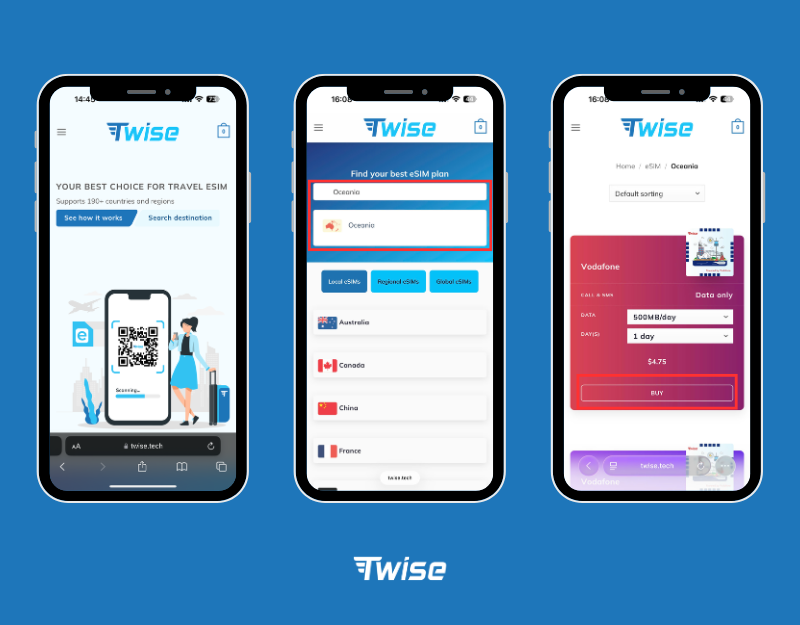
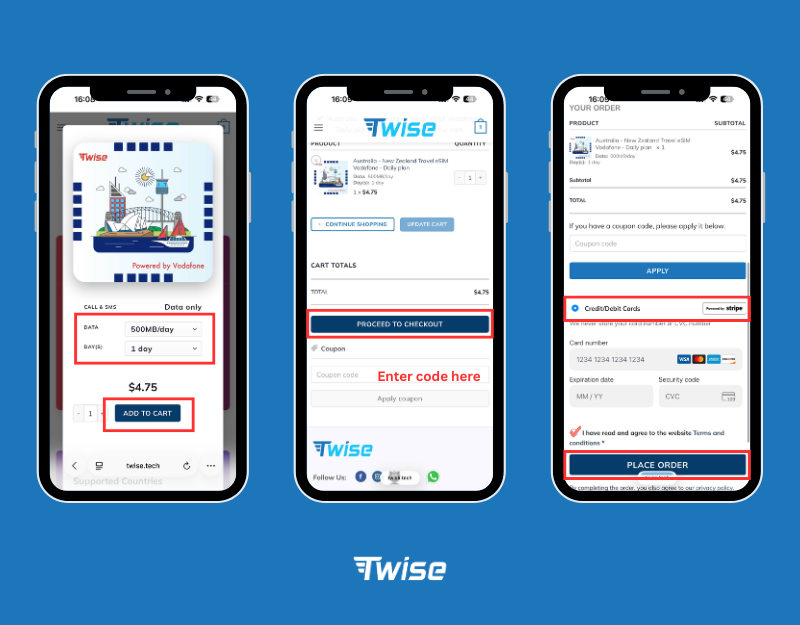
Installing and Activating Your Oceania eSIM
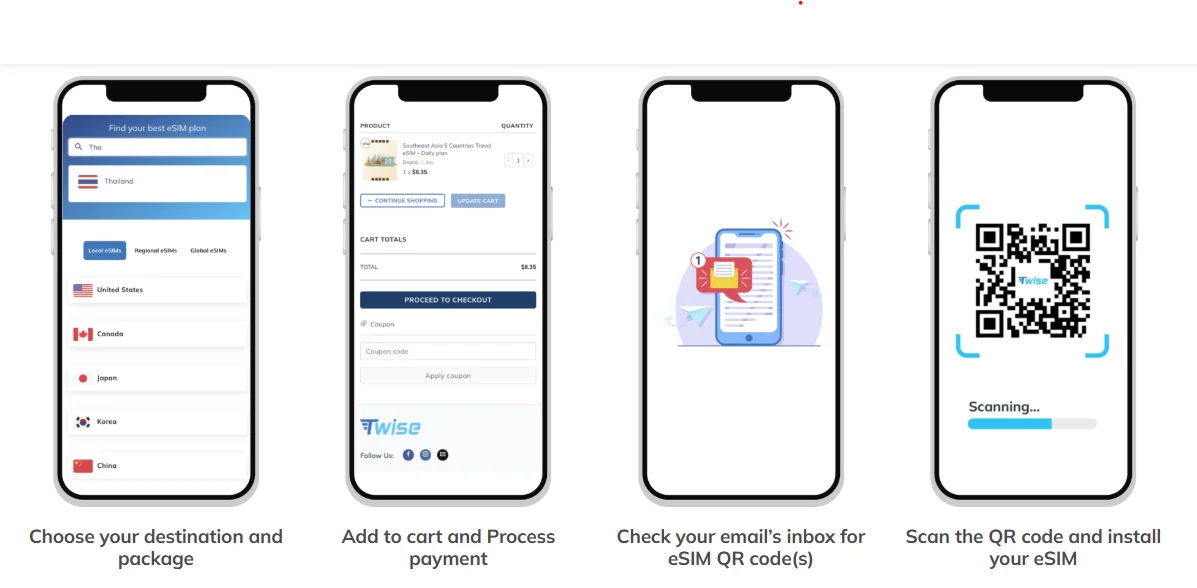
Verify the exact plan’s country list, validity, and activation trigger before scanning anything. Save the QR code and manual installation details somewhere accessible offline.
Important activation warning: the current TRUE product page states that scanning the QR code starts the usage period immediately in any country. Don’t scan it weeks before departure unless Twise confirms different instructions for your specific order — this is the single most common way travelers accidentally burn validity before their trip starts.
Configure dual-SIM settings: select the Twise profile for mobile data, enable data roaming for the travel profile when required, disable home-SIM data roaming, disable automatic data switching, and label the lines clearly so you don’t confuse them mid-trip. Confirm whether your specific plan counts validity in rolling 24-hour periods or calendar days, and which timezone controls that.
After Landing
The five-minute sequence: disable Airplane Mode, enable the travel eSIM, select it for cellular data, enable data roaming for that line, keep the home SIM’s roaming off, wait a few minutes, test a lightweight page or map, and keep airport Wi-Fi available until it’s confirmed working.
Prioritize your accommodation address, airport transfer, maps, local transport, flight or ferry booking, weather, and payment verification. Pause cloud photo backups, app updates, and large downloads until trusted Wi-Fi is available, and download the next destination’s map and accommodation details before boarding your next leg.
When a Local SIM or Different Option Is Better
- Your destination isn’t included — this applies to most Pacific islands under the current TRUE coverage list.
- You’re staying in one country for several weeks — a renewable domestic plan usually offers better value.
- You need a local number for cellular calls and SMS.
- You’re traveling deep into regional Australia — pick a direct network suited to your specific route and prepare a separate emergency communication plan.
- You need extensive hotspot data — a fixed 6GB plan may be too small.
- Your phone lacks the relevant regional bands — a different device or local solution may be necessary.
- Your phone doesn’t support eSIM at all — use a physical tourist SIM, pocket Wi-Fi, or home roaming.
FAQs
It depends entirely on your route: a two-country Australia–New Zealand plan suits that specific combination, while the TRUE Asia–Australia plan suits Australia paired with Asian destinations.
Not on the current live list — use the dedicated Australia–New Zealand plan instead if your trip needs both.
Which network does a Twise Oceania eSIM use? It depends on the plan and country; check the partner network listed for each destination before buying.
No, the current Twise regional and TRUE products are data-only.
Yes, WhatsApp works over the eSIM’s data connection using your existing account.
Yes, hotspot is currently supported, though shared devices consume the allowance faster.
See more useful tips for your journey to Oceania
Australia eSIM: High-speed connection and Cost effective
Prepaid eSIM Australia: Local Carrier vs Travel eSIM for Tourists