Tiếng Việt
An eSIM for South Africa is a digital SIM profile that gives you mobile data on arrival, without swapping a physical card or queuing at an airport kiosk. It connects to South Africa’s local mobile networks and works alongside your home SIM, so you keep your original number for calls and texts while using the eSIM purely for data.
For first-time visitors, that distinction matters: most travel eSIMs, including Twise’s South Africa plans, are data-only. Voice calls and SMS still run through apps like WhatsApp, or through your regular SIM if you leave it active for incoming calls.
Below, we break down how South Africa’s mobile networks actually compare, how eSIM fits into that picture, and what to check before you buy one.
South Africa Mobile Networks Compared: Which suits your trip the most?
South Africa’s mobile market is run by a handful of network operators (MNOs), plus a growing number of digital resellers (MVNOs) that ride on top of that infrastructure. Coverage quality and eSIM accessibility differ quite a bit between them, which is worth knowing before you assume “any local SIM will do.”
| Network | Coverage Strength | eSIM Access for Visitors | Best Suited For |
| Vodacom | Widest 4G/LTE footprint, expanding 5G, generally the fastest average speeds | Mostly in-store or physical SIM; limited direct online prepaid eSIM signup | Travelers prioritizing raw speed and coverage in cities and regional routes |
| MTN | Strong national infrastructure, competitive 4G/5G | Online self-service prepaid eSIM provisioning has been inconsistent | Travelers already routed through MTN via an international eSIM partner |
| Telkom / Cell C | Budget-tier coverage, more concentrated in urban areas | Limited eSIM support, mostly postpaid or retail-based | Local budget users rather than short-term visitors |
| Local MVNOs (Afrihost Air Mobile, Melon Mobile, FNB Connect) | Runs on MTN/Vodacom infrastructure | Fully digital, online-accessible prepaid eSIM | Longer-stay visitors comfortable with local sign-up |
| International travel eSIMs (Twise and similar) | Routed through Vodacom/MTN infrastructure, typically 4G LTE | Instant online purchase, QR code activation, no local registration | First-time visitors who want data working before or right after landing |
View all South Africa eSIM Plans
The practical takeaway: South Africa’s major carriers offer excellent coverage, but self-service prepaid eSIM signup directly with Vodacom or MTN is not always seamless for a short-term foreign visitor. This is the gap that international travel eSIMs are built to close — you get connectivity routed through the same underlying networks, without navigating local retail processes or paperwork.
One more thing worth knowing: South Africa requires local SIM registration under RICA (identity verification for local numbers). Travel eSIMs from providers like Twise operate outside that requirement, since they’re not issuing a local phone number — just a data connection.
What Is an eSIM, in Plain Terms
An eSIM (embedded SIM) is a digital profile installed via QR code instead of a physical chip. Once installed, it behaves like a regular SIM for data: it connects to a local or partner network, uses that network’s towers, and counts data against whatever plan you purchased.
You don’t remove your existing SIM. Most phones support dual SIM, so your original number stays active for calls while the eSIM handles data. This is the setup most travelers use in South Africa: home SIM for calls, eSIM for maps, messaging apps, and mobile data.
Why Travelers Use an eSIM in South Africa
The value of an eSIM shows up in specific, recurring travel moments — not as a blanket “better than everything” claim.
- Airport arrival in Cape Town or Johannesburg. Data is active as soon as you land, so you can pull up your accommodation address, order a ride, or message a driver without hunting for airport WiFi.
- Maps and offline routing between cities. Distances between Cape Town, the Garden Route, and Kruger are long. Reliable data means live navigation instead of guessing at turns.
- Translation and local context. Useful in markets, transport hubs, or when reading signage that assumes local language fluency.
- Hotel and tour operator messaging. Many safari lodges and tour operators coordinate pickup times over WhatsApp — this needs working data, not a working local phone number.
- Booking and payment verification. Two-factor codes for bank apps or booking platforms often arrive by SMS to your home number or by app-based push, both of which still work if you keep your original SIM active alongside the eSIM.
- Avoiding home-carrier roaming charges. This is usually the actual cost driver that pushes travelers to look at eSIM options in the first place, rather than paying per-MB roaming rates.
Where an eSIM is not a full solution: rural game reserves and long stretches between towns can have patchy or no signal on any network, local or international. If your itinerary includes multi-day safaris in remote reserves, treat connectivity as intermittent and keep offline maps and downloaded documents as backup, regardless of which SIM or eSIM you’re using.
Twise eSIM Options for South Africa
Twise offers two data-only eSIM structures suited to different trip shapes.
South Africa Travel eSIM (Daily Plan)
Built for travelers spending most or all of their trip inside South Africa.
- Choose 500MB or 1GB of high-speed data per day
- After the daily high-speed allowance is used, speed steps down to 128Kbps — enough for messaging apps, not for video streaming
- Data resets automatically every day at 00:00 (GMT+1), so unused data doesn’t carry over but you also never run out mid-trip from one bad usage day
- Validity from 1 to 30 days
- Hotspot/tethering supported, useful for sharing one connection across a phone and a laptop
World Travel eSIM (Multi-Country, Fixed Data)
Built for travelers combining South Africa with other legs of a longer trip.
- Fixed high-speed data pool (commonly 10GB) usable across roughly 70 countries
- Routed through international partner networks including TRUE and Orange, alongside regional infrastructure, so the same eSIM keeps working as you cross borders
- Validity options of 5, 7, 10, 15, or 30 days
- One profile instead of separate local SIMs per country — simpler if your trip includes South Africa plus stops elsewhere in Africa, Europe, or Asia
If your trip is South Africa-only, the daily plan is generally the more cost-predictable choice. If South Africa is one stop on a wider itinerary, the multi-country plan avoids re-purchasing a new eSIM at every border.
How to Activate a Twise eSIM
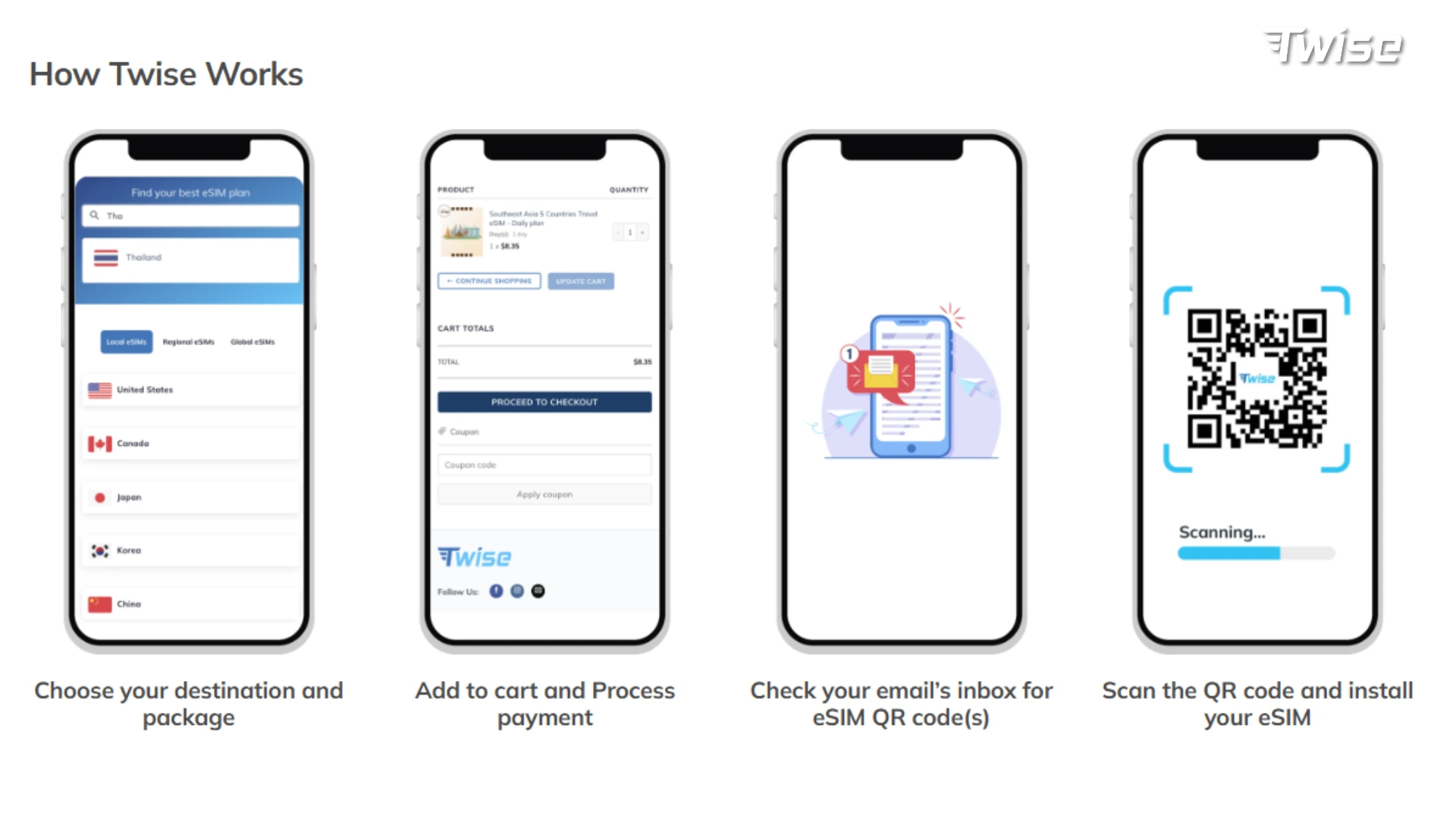
- Check device compatibility. Confirm your phone is carrier-unlocked and supports eSIM (most phones from the last 4–5 years do; check under Settings before buying).
- Choose a plan based on trip length and whether you’re staying in South Africa or traveling onward.
- Complete payment through Twise’s secure checkout (Stripe-processed).
- Receive your QR code by email, typically within one minute of payment.
- Install the profile:
- iPhone: Settings → Cellular → Add Cellular Plan → Scan QR Code
- Android: Settings → Connections → SIM Manager → Add eSIM → Scan QR Code
- Enable data roaming on the eSIM line once you land, or once you’re ready to start using it. Activation is typically instant.
Doing steps 1–5 before departure, while on home WiFi, means the eSIM is ready to switch on the moment you land — no setup needed at the airport itself.
Why Twise for South Africa Travel Data
- Fast delivery — QR code typically arrives within a minute of purchase, so there’s no waiting around before a trip
- No local registration — as a data-only profile, it sidesteps RICA identity paperwork required for local South African phone numbers
- Secure payment — checkout runs through Stripe
- 24/7 support — reachable by email, WhatsApp, or Facebook if a profile fails to activate
- Replacement/refund policy — covers technical activation issues rather than leaving you to troubleshoot alone
See current South Africa eSIM plans and pricing for exact package options, or browse all destinations at twise.tech.

FAQs
No — Twise and most travel eSIMs are data-only. Calls and SMS need an internet-based app (WhatsApp, iMessage, etc.) or your original SIM kept active for that purpose.
Coverage in remote game reserves is inconsistent across all networks, not just eSIMs. Plan for intermittent signal on multi-day safaris and download offline maps in advance.
Speed drops to 128Kbps until the next reset at 00:00 (GMT+1) — still workable for messaging, not for streaming.
If South Africa is your only destination, the daily plan is more cost-efficient. If you’re continuing to other countries, the multi-country plan (via TRUE and Orange partner networks) avoids buying a new eSIM at each border.
More useful tips for your journey in South Africa:
Seychelles eSIM: What is The ultimate choice for travel eSIM
Does FaceTime Use Data? How Much Data FaceTime Uses When Traveling