Tiếng Việt
An eSIM for Argentina is a digital SIM profile that activates mobile data on arrival, without a physical card, a SIM-shop visit, or local identity registration. It runs alongside your home SIM, so you keep your original number for calls while the eSIM handles data.
Most travel eSIMs for Argentina, including Twise’s plans, are data-only. That’s a deliberate tradeoff: it’s what lets activation stay instant and registration-free, but it also means calls and texts still route through apps like WhatsApp, or through your home SIM if you leave it active.
Below is how Argentina’s actual mobile networks compare, then how eSIM plans map onto that — including where coverage genuinely thins out.
Argentina Mobile Networks Landscape: Why Claro is the leader?
Argentina’s mobile market runs on three national operators: Claro, Movistar, and Personal. International travel eSIMs don’t build their own towers — they route through one or more of these networks, so which one your eSIM uses actually matters for where it works well.
| Network | Coverage Strength | Best Suited For | Notes for Travelers |
| Claro | Broadest national footprint, strongest rural and highway coverage | Patagonia, Mendoza, long-distance road routes | Generally the safer pick outside major cities |
| Movistar | Fast, reliable 4G/LTE in Buenos Aires, Córdoba, Rosario | Urban stays, city-focused itineraries | Coverage drops off in remote or mountainous terrain |
| Personal | Balanced performance across cities and semi-rural areas | Mixed urban/regional trips | Less commonly used as the sole backbone for travel eSIMs |
The pattern that matters for trip planning: city-only trips have flexibility, remote-region trips don’t. If your route includes Buenos Aires and Córdoba only, most networks perform well. If it includes El Calafate, El Chaltén, or Bariloche, network choice stops being a minor detail.
Local SIM registration in Argentina requires DNI or passport identity validation through the carrier — a process built for residents, not a two-week visitor. This is the specific friction that international travel eSIMs are designed to skip, since they issue a data profile rather than a registered local number.
What Is an eSIM, in Plain Terms
An eSIM (embedded SIM) is a digital profile installed by scanning a QR code, instead of inserting a physical chip. Once installed, it connects to a local or partner network and uses data against whatever plan you bought — functionally the same as a SIM card, without the plastic.
Your phone doesn’t lose its original SIM. On a dual-SIM-capable device (most phones from the last several years), your home number stays active for calls and any SMS-based verification, while the eSIM is dedicated to data.
Why Travelers Use an eSIM in Argentina
The case for an eSIM shows up in specific trip moments, not as a claim that it solves everything.
- Landing at Buenos Aires (Ezeiza or Aeroparque). Data is live the moment you land, so you can confirm a driver, check your accommodation address, or message ahead without searching for airport WiFi.
- Navigating between cities. Argentina is large — Buenos Aires to Mendoza or Bariloche involves serious distance. Working maps and live transit info matter more here than in a compact country.
- Translation in day-to-day situations. Markets, bus terminals, and smaller-town signage don’t always assume English.
- Coordinating with tour operators and guesthouses. Many Patagonia trekking operators and estancias confirm pickups over WhatsApp — that needs data, not a local phone number.
- Booking and payment verification. Two-factor codes for banking or booking apps typically still reach your home SIM or an authenticator app, so keeping that SIM active alongside the eSIM covers this.
- Avoiding home-carrier roaming rates. Usually the practical reason travelers start comparing eSIM options in the first place, rather than paying per-day or per-MB roaming charges.
Where an eSIM has real limits: extended dead zones are common on trekking routes around El Chaltén, on remote highway stretches, and near some Chile border crossings. This isn’t specific to any one provider — it’s the terrain. Download offline maps before leaving Buenos Aires or another major hub, regardless of which eSIM you’re using.
Twise eSIM Options for Argentina
Twise structures its Argentina coverage around three plan types, depending on trip shape.
South America Daily Plan
Covers Argentina plus nine other South American countries — built for multi-stop regional trips.
- Choose 500MB, 1GB, or 2GB of high-speed data per day
- Speed steps down to 128Kbps after the daily limit — workable for messaging, not for streaming
- Data resets automatically each day at 00:00 (GMT+1)
- Validity from 1 to 30 days, so it fits both short city breaks and longer regional itineraries
South America Fixed Data Plan
Better suited to travelers whose daily usage varies (heavy data on travel days, light on quiet days).
- Fixed total data pool: 3GB, 5GB, 8GB, or 10GB
- Validity from 5 to 30 days
- No daily cap — use the pool however it’s needed across the trip
- Hotspot/tethering included without daily-limit restrictions
World Travel eSIM (98 Countries)
For travelers combining Argentina with other continents, not just neighboring countries.
- Fixed high-speed data pool (commonly 10GB) valid across roughly 98 countries
- Routed through international partner networks including TRUE and Orange, alongside regional infrastructure, so connectivity continues as you cross into new countries
- Validity options of 15 or 30 days
Choosing between them: city-only Argentina trip → Daily Plan. Argentina plus Chile, Brazil, or Uruguay → South America Fixed Data Plan or Daily Plan depending on usage pattern. Argentina as one stop on a longer intercontinental trip → World Travel eSIM.
How to Activate a Twise eSIM
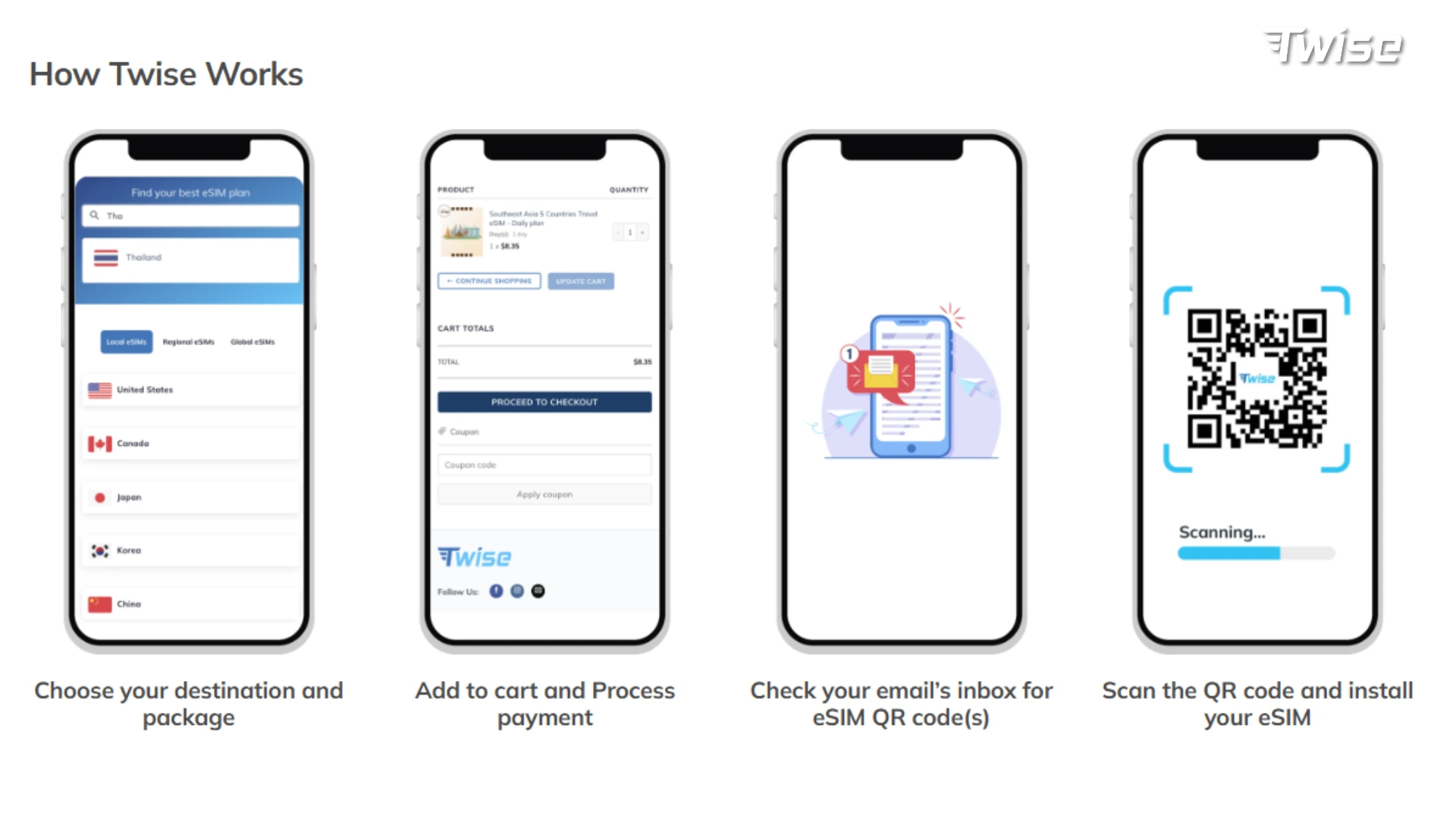
- Confirm device compatibility — carrier-unlocked and eSIM-capable (check under Settings before buying).
- Select a plan based on which countries and how many days you’re covering.
- Complete payment through Twise’s secure checkout (Stripe-processed) — no ID documentation required.
- Receive the QR code by email, usually within one minute.
- Install the profile:
- iPhone: Settings → Cellular → Add Cellular Plan → Scan QR Code
- Android: Settings → Connections → SIM Manager → Add eSIM → Scan QR Code
- Time your activation — validity starts once the plan is activated, so align it with your actual arrival rather than the purchase date if you’re buying in advance.
Installing before departure, on home WiFi, means the eSIM is ready to switch on the moment you land instead of fumbling with setup at the airport.

FAQs
Yes, on any dual-SIM-capable phone. Your home SIM stays your primary number; the eSIM is dedicated to data.
Depends on the plan and provider — travel eSIMs typically route through Claro, Movistar, or a mix, since those carry the country’s broadest coverage.
No. Because Twise plans are data-only profiles rather than local phone numbers, they don’t require Argentina’s local SIM registration process.
On the Daily Plan, speed drops to 128Kbps until the next reset at 00:00 (GMT+1). The Fixed Data Plan avoids this by using a total pool instead of a daily cap.
The South America Daily or Fixed Data Plan, both of which cover Argentina plus nine other South American countries under one profile.
More useful tips for your trip to Argentina
Argentina Money Apps for Travelers: Exchange Rates, Western Union, Payments & Mobile Data Tips