

Best Thailand eSIM for Tourists | Top Networks
May
Thailand moves fast — and so does the need for reliable data. Whether you’re calling a Grab driver in rush-hour Bangkok, locating a beach restaurant in Koh Samui, or posting Reels from the lantern festival in Chiang Mai, a high-speed data connection is no longer a convenience on a Thailand trip. It is the logistical backbone of the whole thing. The question is not whether you need an eSIM Thailand tourist— it’s which one gives you the coverage, speed, and value that matches where you’re actually going.
Comparing the Big Three Thai Networks: AIS, TrueMove H, and DTAC
Thailand’s mobile market is dominated by three carriers, each with a distinct coverage strategy and tourist-facing product lineup. Understanding the difference between them is the first step toward choosing the right eSIM Thailand tourist plan for your itinerary.
| AIS
Advanced Info Service — The Coverage Giant ✅Widest coverage in remote mountains and far-flung islands ✅Top-tier 5G speeds in urban areas ✅Most reliable for deep jungle and highland trekking routes ✅Strongest network in northern Thailand provinces ❌Usually the most expensive tourist plan option ❌Tourist packages can feel overpriced relative to what you actually use |
TrueMove H
The Urban Multimedia Carrier ✅Strong 5G presence in Bangkok, Pattaya, and major urban centres ✅Often includes social media data perks ✅Good value for city-focused trips ❌Coverage can thin out faster than AIS in deep rural areas ❌Less consistent on smaller or more remote islands |
DTAC (Recommended)
Now merged with TrueMove — best of both worlds ✅Famous “Happy Tourist” packages optimized for visitor use ✅Excellent urban speeds and tourist-app reliability ✅Best value-for-money of the three for typical tourist itineraries ✅Now shares tower infrastructure with TrueMove H ❌Historically less rural coverage than AIS — though the merger has significantly narrowed this gap |
For most tourists, the decision between these three carriers comes down to two variables: where you’re going and what you’re paying. AIS wins for travelers venturing into genuinely remote terrain — deep forest trekking routes in Chiang Rai, off-grid island hopping. For the 95% of tourists who are splitting their trip between cities and popular islands, the gap between AIS and DTAC has become far less meaningful — for reasons that require a closer look at what happened in 2022.
The DTAC Edge: Why the True-DTAC Merger Changes Everything
If you last researched Thai carrier options a few years ago, you may have the outdated impression that DTAC means weaker rural coverage. That impression is no longer accurate — and understanding why requires a quick look at Thailand’s biggest telecom development of the decade.

One merged entity. Two tower networks. Combined for the first time.
In late 2022 and through 2023, DTAC and TrueMove H completed a landmark merger, creating one of Southeast Asia’s largest combined telecom operators. The operational consequence that matters to travelers is this: DTAC eSIM users can now automatically switch between the base stations of both the DTAC and TrueMove H networks — whichever is strongest at any given location.
This means that a DTAC Travel eSIM purchased through Twise now effectively gives you access to the combined tower footprint of two major Thai carriers. Whether you’re in central Bangkok, on a ferry between Koh Samui and Koh Phangan, or somewhere on the Andaman coast near Krabi, the eSIM latches onto the best available signal from the merged network — without you doing anything.
What this means in practice for tourist destinations
The merged tower network now reaches islands and coastal areas that previously fell in DTAC’s weaker zones. Koh Phi Phi — historically a signal challenge for DTAC users — now benefits from TrueMove’s coastal infrastructure feeding into the combined network. The same applies to stretches of Pai highway in northern Thailand and highland communities in Mae Hong Son Province.
AIS still leads in the most remote, off-grid locations — the kind of places where you are hiking for three days without a road in sight. But for any destination that appears on a standard tourist itinerary — including all major islands, beach resorts, national parks with visitor facilities, and every city or town of consequence — DTAC’s post-merger coverage is more than sufficient.
The tourist sweet spot in 2025: AIS covers the 5% of Thailand that requires the absolute maximum signal reach. DTAC, powered by the merged TrueMove network, covers the 95% that tourists actually visit — at a significantly more attractive price point. For the vast majority of eSIM Thailand tourist itineraries, that is the relevant comparison.
Why Buy Your DTAC eSIM via Twise?
Knowing that DTAC is the right network for your Thailand trip is one thing. Knowing which eSIM provider in Thailand to use to access that network is another. Twise offers a DTAC-based plan built specifically for tourists — and the feature set goes considerably beyond a standard data card.
50GB of High-Speed Data — and a Safety Net When It Runs Out
50GB of 5G/4G data is the headline figure — and it is genuinely large enough to cover a typical tourist trip without anxiety. To put it in context: 50GB allows approximately 2,500 high-resolution Instagram photos uploaded, 40 hours of HD video streaming, and continuous Google Maps navigation for the entire trip combined. If you do exhaust the 50GB, the plan automatically switches to unlimited data at 384Kbps — adequate for maps, messaging, and basic browsing to keep you functional until you reach a Wi-Fi connection.
Unlimited Messaging on the Five Apps Tourists Actually Use
The Twise DTAC plan includes unlimited data for Facebook Messenger, LINE, WhatsApp, WeChat, and KakaoTalk — the five most-used messaging platforms among international tourists in Thailand. This is not a gimmick. It means that even if your main 50GB data pool is running low, you retain full-quality messaging on all of these platforms. Coordinating with your hotel, messaging your Grab driver, or staying in touch with family back home stays intact regardless of overall data balance.
30 Minutes of International Calls — Included in the Plan
This is the feature that most data-only eSIM plans do not offer. The Twise DTAC plan includes 30 minutes of international voice calls to seven countries: China, Hong Kong, Macau, Taiwan, India, Korea, and Vietnam. For tourists from these countries traveling in Thailand, this is a meaningful practical benefit — covering a call to your bank about a card issue, an airline about a flight change, or family who isn’t on WhatsApp. Full details on how to use these minutes are in Section 4.
5G/4G Priority — What This Means for Grab and Real-Time Navigation
The Twise DTAC plan prioritizes 5G and 4G LTE connections, which translates directly into low-latency performance for real-time apps. Grab (Thailand’s dominant ride-hailing platform) relies on rapid location updates between your phone and the driver — poor latency causes the app to stutter, pins to drop, and rides to fail. With 5G/4G priority, Grab bookings work at the speed the app was designed for. The same applies to live map updates in Koh Samui traffic, and video calls on KakaoTalk during boat transfers.
Zero Airport Queue — Scan and Go
Physical SIM cards at Thai airports involve a queue, a form, potentially a language barrier, and a counter that may or may not be open when you land at 2AM. The Twise eSIM is purchased online, delivered by QR code to your email, and installed before you board your flight. By the time you clear immigration at Suvarnabhumi, your eSIM is active and connected to the DTAC network. The airport SIM counter is a line you simply walk past.
The Rare Calling Feature: 30 Minutes International — and How to Use It
Most travel eSIMs are data-only products. The inclusion of international calling minutes in the Twise DTAC plan is genuinely uncommon in the tourist eSIM market — and the dialing format is specific enough that it is worth explaining clearly before you need it.
When do you actually need this? Common scenarios: your bank calls to verify an unusual transaction and needs a callback; an airline has changed your flight and the automated SMS link doesn’t load; a family member in Korea or Vietnam needs a direct voice call rather than a WhatsApp message. These are exactly the moments where having a calling option built into your eSIM plan — rather than needing to download an app and set up a VoIP account on the spot — saves real time and stress.
How to dial internationally with the Twise DTAC plan
00400 + Country Code + (Area Code) + Number
| Vietnam | 00400 + 84 + (area code) + number |
| Korea | 00400 + 82 + (area code) + number |
| China | 00400 + 86 + (area code) + number |
| India | 00400 + 91 + (area code) + number |
| Hong Kong | 00400 + 852 + number |
| Taiwan | 00400 + 886 + (area code) + number |
| Macau | 00400 + 853 + number |
Ex: To call a Vietnam mobile number like 0359xxx, dial: 0040084359xxx.
The 30 minutes are shared across all seven destinations — you are not limited to one country per allocation. Save the dialing format in your phone’s notes app before departure so you have it available without needing to search for it in Thailand. Minutes are included in the plan price; no separate top-up or credit purchase is required.
Coverage by Destination: Where DTAC Performs Across Thailand
Thailand’s tourism geography spans dense urban centres, beach resort islands, highland trekking areas, and everything in between. Here is how the DTAC merged network performs across the destinations on a typical tourist itinerary.
| Bangkok
DTAC / TrueMove (merged) ★★★★★ Excellent 5G coverage throughout the city, BTS Skytrain, MRT, and shopping malls. No meaningful difference between carriers in Bangkok. |
Chiang Mai
DTAC / TrueMove (merged) ★★★★★ Strong 4G/5G coverage in the city and Old Town. Mountain routes toward Doi Inthanon: expect variable signal on all carriers beyond 2,000m altitude. |
| Phuket
DTAC / TrueMove (merged) ★★★★★ Full 5G coverage across Patong, Kata, Karon, and the airport. Resort areas and beaches: consistent strong signal throughout. |
Koh Samui
DTAC / TrueMove (merged) ★★★★ Good coverage around the main ring road and resort areas. Interior highland roads: signal drops across all carriers. Ferry crossings: variable but generally functional. |
| Koh Phi Phi
DTAC / TrueMove (merged) ★★★★ Significantly improved post-merger. Tonsai Bay and tourist areas: reliable 4G. Remote viewpoint trails: signal thins on all carriers, bring offline maps. |
Krabi / Railay
DTAC / TrueMove (merged) ★★★★ Krabi town and Ao Nang: strong 4G. Railay Beach (accessible only by boat): good signal considering the geography. Limestone caves: no signal on any carrier. |
| Pai (Mae Hong Son)
Mixed — AIS leads in depth ★★★ Pai town: adequate 4G on DTAC post-merger. The curving mountain highway between Chiang Mai and Pai: AIS holds signal more consistently in the deepest valley sections. |
Ayutthaya / Sukhothai
DTAC / TrueMove (merged) ★★★★★ Historical park areas and town centres: reliable 4G on DTAC. Day trip destinations from Bangkok are well within the merged network’s coverage footprint. |
When to choose AIS instead: If your itinerary is specifically focused on remote highland trekking in Chiang Rai Province, multi-day loops through Mae Hong Son’s northern border areas, or stays on very small and undeveloped islands without established tourist infrastructure, AIS’s superior rural reach becomes meaningfully relevant. For any destination that has a resort, a hostel, or a dive shop, DTAC’s merged network covers it.
Comparison: Airport SIM vs. Twise DTAC eSIM
The airport SIM counter at Suvarnabhumi or Don Mueang is the default choice for travelers who haven’t researched ahead of time. Here is an honest comparison of what you get from each option.
| Feature | Airport SIM (Typical) | Twise DTAC eSIM |
| High-speed data | 15–30GB | 50GB |
| After data runs out | Speed throttled or cut | Unlimited at 384Kbps (messaging still works) |
| International calls | Local only (or no calls) | 30 mins to 7 countries included |
| Messaging apps | Standard data — no separate allocation | Unlimited for 5 major platforms |
| Network | AIS, TrueMove, or DTAC (varies by counter) | DTAC + TrueMove merged towers |
| Setup | Airport queue — 10–30+ min wait | QR scan at home — zero queue |
| Physical SIM required | Yes — SIM swap needed | No — eSIM, dual SIM compatible |
| Availability | Counter hours only; may be closed at odd arrival times | Purchase and install any time before departure |
| Keep home number active | Physical SIM swap — home SIM inactive | Dual SIM — home number stays active for OTPs |
The airport SIM is not a bad product — it is simply an optimized-for-convenience product that trades features for availability. For travelers who didn’t plan ahead, it is the right fallback. For travelers who did plan ahead — and reading this guide qualifies you — the Twise DTAC eSIM offers more data, international calling, unlimited messaging, and the convenience of not needing the airport counter at all.
Pro Tips for Thailand Travelers
- Keep your home SIM active alongside the eSIM
Most modern smartphones support dual SIM — a physical SIM and an eSIM running simultaneously. Keep your home SIM active in the physical tray and set the Twise eSIM as your data line. This means your home number remains available for banking OTPs, international SMS authentication, and calls from people who don’t have WhatsApp. You use DTAC data for everything Thailand-related without losing your home connectivity.
- Install the eSIM before you leave — not at the airport
eSIM profile installation requires an internet connection. Do it at home or at your departure airport over Wi-Fi. Installing in Thailand is possible over hotel Wi-Fi, but it’s an unnecessary complication after a long flight. Once installed, the eSIM activates automatically when your phone detects the DTAC tower at Suvarnabhumi — before you clear the arrivals hall.
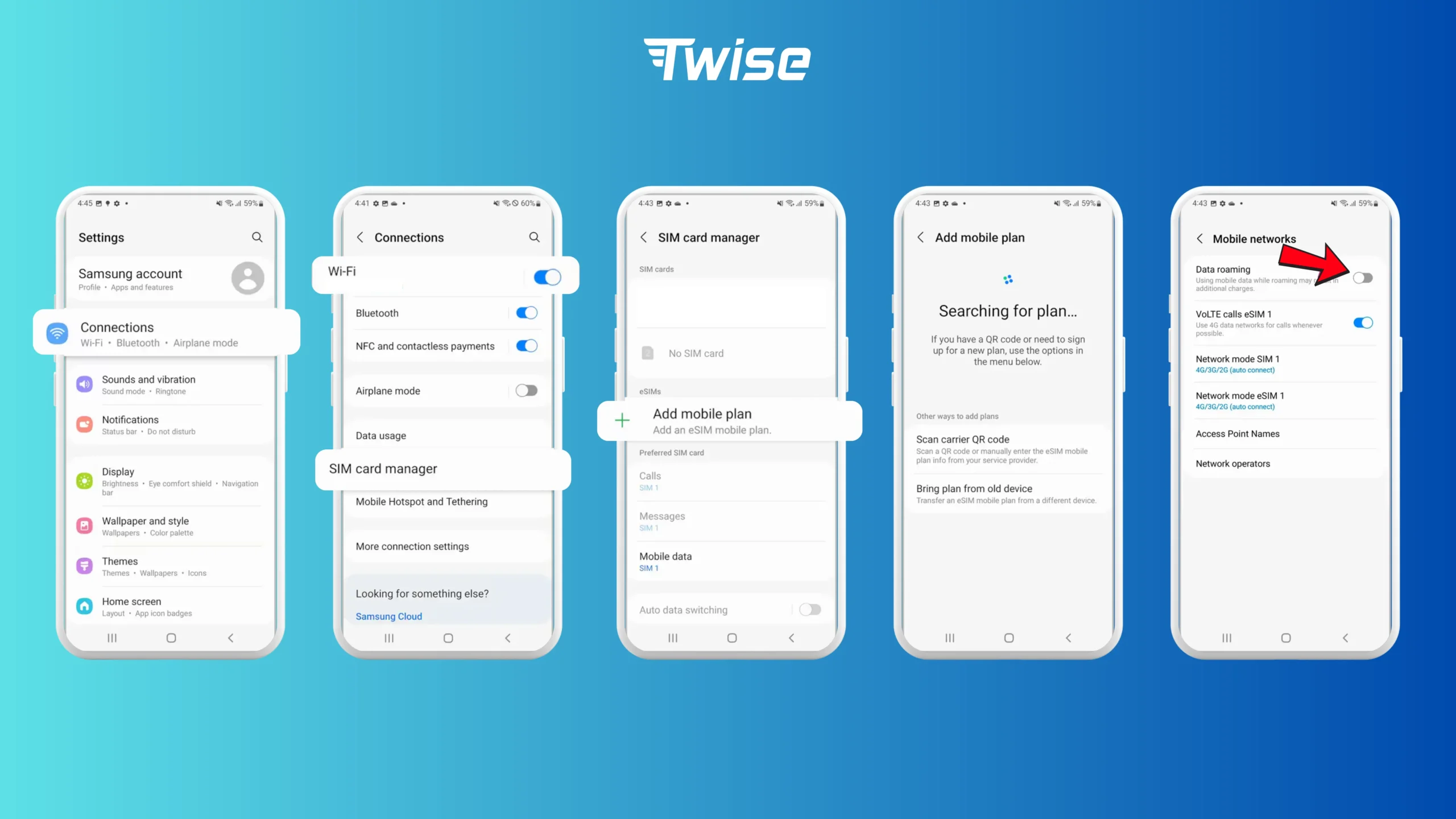
Read more: Installing eSIM on Android Phones: A Step-by-Step Guide
- Download Grab before you fly and link a card
Grab is Thailand’s dominant ride-hailing and food delivery app. Setting it up — account creation, card linking, address setup — is significantly easier over home Wi-Fi than in a Bangkok taxi queue. With 50GB of DTAC 5G data and Grab pre-configured, booking a car from Suvarnabhumi to your hotel takes under 90 seconds after clearing customs.
- Download offline maps for islands and remote areas
Even with DTAC’s strong coverage, ferry crossings, speedboat transfers between islands, and mountain roads can experience brief signal gaps. Download offline Google Maps or Maps.me regions for Phuket, Koh Samui, Koh Phi Phi, and Chiang Mai before departure. These take a few minutes to download on home Wi-Fi and provide navigation backup during any temporary dead zones.
- Use the unlimited messaging perk strategically
If you find yourself approaching the 50GB high-speed limit — possible on video-heavy trips — switch your communication entirely to the unlimited messaging platforms (WhatsApp, LINE, Messenger) for text and voice calls. This preserves your remaining high-speed data for navigation and photo uploads while keeping you fully connected for communication throughout the rest of your trip.
The Best eSIM in Thailand for Tourists
Thailand’s three carrier options — AIS, TrueMove H, and DTAC — each have a legitimate claim on a specific type of traveler. AIS is the uncontested choice for serious off-grid adventurers willing to pay a premium for the deepest possible rural signal. TrueMove performs well in urban centres. DTAC, transformed by its merger with TrueMove, now delivers a combined tower network that covers virtually every destination on a standard tourist itinerary — with a product range built specifically for the visitor experience.
For the tourist who is moving between Bangkok, islands, and at least one northern city — which describes the overwhelming majority of Thailand visitors — the Twise DTAC eSIM offers the most complete package available from any eSIM provider in Thailand in 2025. Fifty gigabytes of high-speed data, unlimited messaging on the five apps tourists depend on most, thirty minutes of international calling to seven countries, and activation that happens before you board the plane — all on a merged network that now reaches Koh Phi Phi and the Andaman coast with coverage that wasn’t available on DTAC alone two years ago.
The airport SIM counter will always be there as a fallback. You simply no longer need it.
Don’t settle for less data. Travel Thailand with total confidence. Get your 50GB DTAC Thailand eSIM from Twise — 5G priority, 30 mins international calls, unlimited messaging, zero queues. Get Twise DTAC Thailand eSIM.
