


Nomad eSIM USA Review: Plans, Coverage & Alternatives
Jun
Nomad is one of the few travel eSIM providers offering a 3-day free trial for the USA — test it before committing to a full plan. Beyond that, it runs on AT&T and Verizon networks, supports hotspot, and lets you add more data to the same eSIM without reinstalling. For data-first travelers, that combination is genuinely useful. For travelers who need a U.S. phone number, traditional calls, or SMS, it is the wrong product — and that distinction matters more in the U.S. than in most other destinations.
Nomad USA in 60 Seconds: Who Should Choose It?
| If your U.S. trip looks like this | Nomad fit | Better comparison if not |
| City trip using maps, rideshare, hotel apps | Strong | Nomad data plan |
| Road trip through rural areas or national parks | Strong | AT&T + Verizon coverage suits this well |
| Family sharing hotspot from one phone | Good | Choose larger plan; monitor data |
| Business trip needing client calls | Weak | Twise domestic U.S. eSIM |
| Long stay needing U.S. number | Weak | Twise T-Mobile or AT&T |
| App-only communication (WhatsApp, FaceTime) | Strong | Nomad works well |
| Unsure how much data you need | Good | Use Nomad’s Data Calculator or 3-day trial |
| SMS verification or local U.S. forms | Weak | U.S. number plan required |
Nomad is a strong USA eSIM if you mainly need mobile data and hotspot. It is weaker if you need a local U.S. number, traditional SMS, or regular phone calls.
What Nomad eSIM USA Actually Is
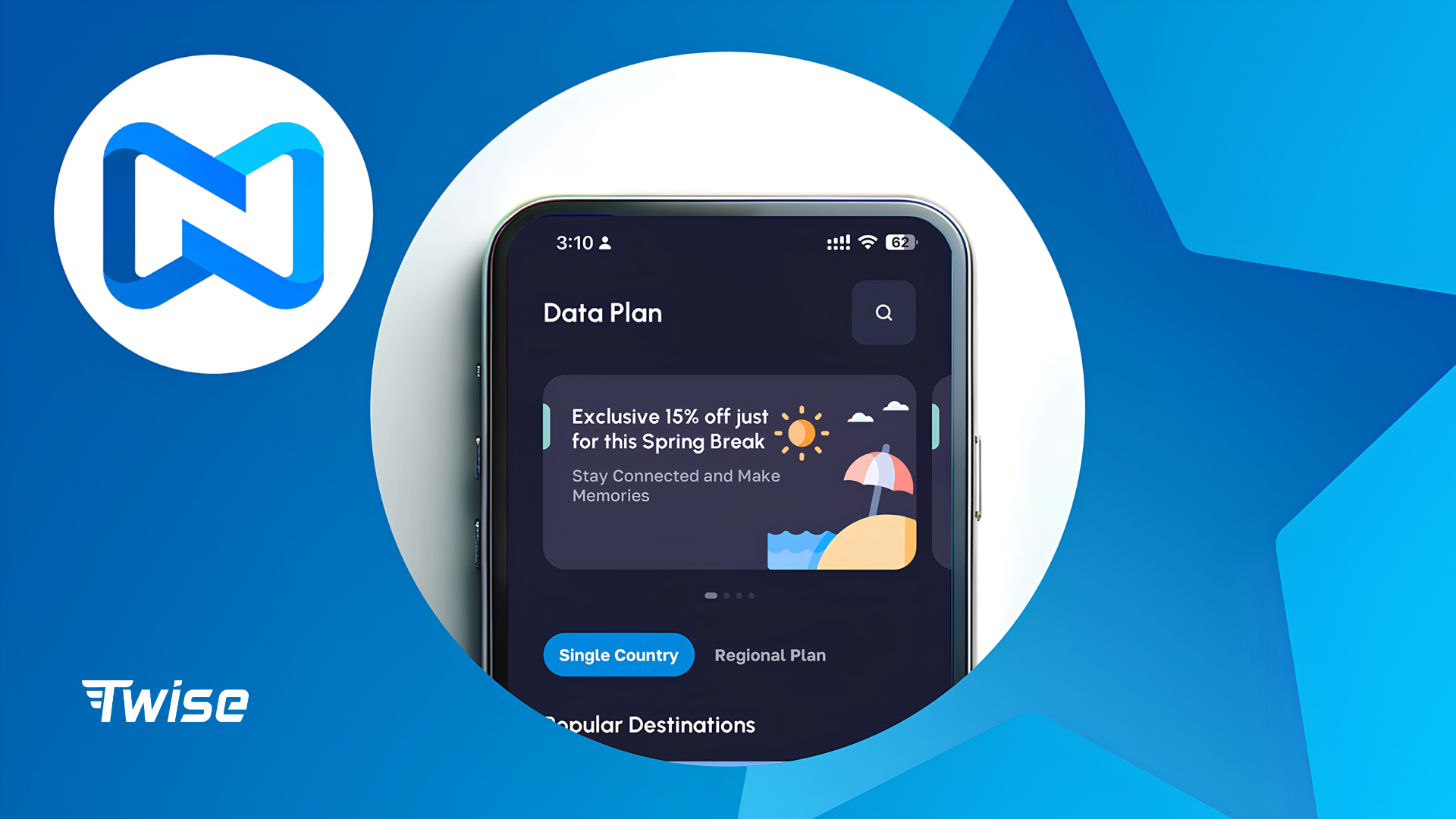
Nomad is a prepaid travel eSIM provider — not a domestic U.S. phone carrier. It sells data plans for destinations worldwide, including the United States, through its app and website. Plans are installed via QR code, no physical SIM required.
Nomad’s USA eSIM runs on AT&T and Verizon networks, and automatically switches between them for reliable 4G/5G connectivity. This is not the same as a T-Mobile, AT&T, or Verizon domestic prepaid SIM with a local number, calls, and SMS.
What Nomad gives travelers: mobile data, hotspot support, add-ons without reinstalling, and the ability to keep a home SIM active simultaneously on dual-SIM phones.
What travelers should verify before buying: data amount, validity period, whether the unlimited plan rules fit actual usage, activation timing, hotspot behavior, and whether the trip requires calls or SMS — because most Nomad eSIMs are data-only, though some plans include a local phone number. Check the specific plan details before purchase.
Nomad’s Real Network Advantage: AT&T + Verizon
This is the most meaningful technical differentiation between Nomad and most other travel eSIMs in the USA.
Nomad’s USA eSIM connects to AT&T and Verizon, automatically switching between them for the strongest available signal. Saily runs on T-Mobile and AT&T. Airalo’s standard USA plan runs on T-Mobile and Verizon. Nomad’s AT&T + Verizon combination is the only pairing in this group that excludes T-Mobile entirely.
Why this matters in practice:
| Network | Best for | Weakest in |
| AT&T | Rural Southeast, highways, suburban areas | Dense urban core vs T-Mobile |
| Verizon | Rural nationwide, national parks, mountain routes | Some international device band gaps |
| T-Mobile | Dense urban areas, indoor venues | Rural Midwest, Mountain West routes |
For travelers driving through Arizona, Utah, Wyoming, Montana, or the rural South, AT&T and Verizon dual-network access provides more reliable coverage than T-Mobile-only or T-Mobile-primary plans. National parks like Yosemite, Zion, Yellowstone, Grand Canyon, and Arches have long stretches with no service regardless of carrier — offline maps are essential regardless of which eSIM you use — but on the approach routes and in park towns, Verizon and AT&T typically outperform T-Mobile.
One caveat for international phones: Some devices purchased outside the U.S. lack certain Verizon or AT&T frequency bands. If your phone does not support those bands, it may connect only to one network rather than switching between both. Check your device’s supported bands before assuming full dual-network access.
Nomad USA Plans: Data, Unlimited Options, Add-Ons, and the Free Trial
3-day free trial
Nomad offers a 3-day free trial for the USA — test performance on AT&T and Verizon networks before buying a longer plan. This is a genuine differentiator. No other provider in this review series offers a trial period. For travelers who are unsure about network performance in their specific destination or who have an unlocked international phone and want to verify band compatibility, the trial removes financial risk from the decision.
Fixed data plans
Nomad offers prepaid data packages for U.S. travel at multiple sizes. Fixed plans work well when travelers can estimate usage in advance — a 3-day city trip is easier to budget than a 3-week road trip with unpredictable data demands.
Unlimited-style options
Nomad’s USA page shows unlimited options for 10, 15, and 20-day periods. After daily high-speed data is used, connection continues at a throttled speed of 512 kbps. For travelers doing light browsing after a full day of navigation and social media, 512 kbps handles text-based messaging. For video calls or continued map use, it will feel slow. Check the daily high-speed cap on the specific unlimited plan before relying on it for heavy use days.
Add-ons: the same eSIM, more data
Nomad allows users to buy add-ons to continue using the same USA eSIM, with the add-on activating automatically when the initial plan expires. This is more convenient than it sounds. Most travel eSIM providers require purchasing a new plan — and sometimes reinstalling an eSIM profile — when data runs out. Nomad’s add-on system means travelers who underestimate usage can extend mid-trip without device configuration changes. For road trips where data needs are hard to predict in advance, this is a practical safety net.
Data Calculator
Nomad offers a Data Calculator on its website to help travelers estimate how much data they need based on typical usage patterns. For travelers who have never bought a travel eSIM before or who are planning an unusually data-heavy trip (remote work, family hotspot, frequent video calls), this tool is worth checking before choosing a plan size.
The “No Number” Reality: Calls, SMS, and What Works
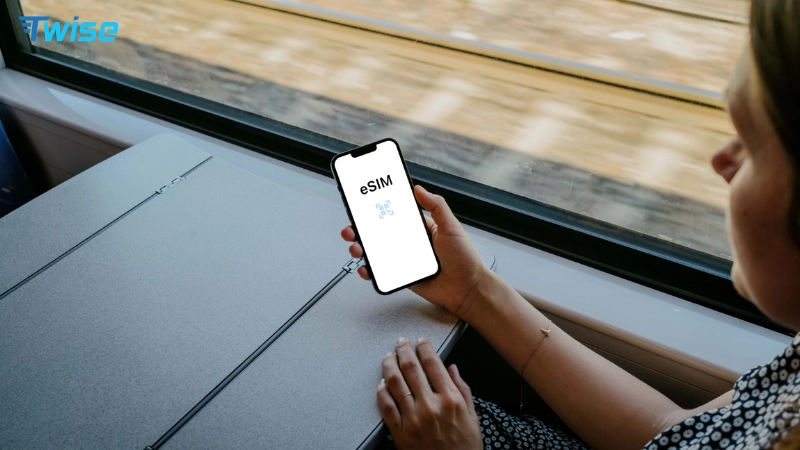
Most Nomad eSIMs are data-only. Calls and texting are not possible with Nomad’s data-only eSIMs. Your phone may display “No Number” or “Unknown Number” on the Nomad eSIM line — this is expected and does not affect data performance.
What works over Nomad data
WhatsApp, iMessage over data, FaceTime Audio and Video, Messenger, Telegram, Signal, Google Meet, LINE, WeChat, Google Maps, Apple Maps, Uber, Lyft, hotel apps, airline apps, email, and web browsing all work over mobile data without a phone number.
What does not work on data-only
Traditional cellular calls cannot be made or received. Local U.S. SMS cannot be received. Two-way texting with businesses, restaurants, and service providers does not work. Any form requiring a U.S. callback number cannot be completed through the Nomad eSIM line.
Where this creates friction in the U.S.
The U.S. relies on phone-number contact more than most destinations. Hotels text check-in codes and key access instructions. Rideshare drivers call when visual pickup is difficult at crowded airports and stadiums. Car rental desks ask for a callback number. Medical and urgent care services communicate by call or SMS by default. Delivery drivers contact recipients by phone when instructions are unclear.
Travelers who book through app interfaces with in-app chat can minimize these touchpoints. First-time U.S. visitors and travelers using non-app-native services will encounter them without warning.
When data-only is enough
For travelers who communicate through WhatsApp, use hotel apps with in-app messaging, coordinate rideshare through the app interface without driver calls, and avoid traditional service contact — data-only covers the full trip comfortably. Short city trips with app-native habits are the clearest fit.
Hotspot on Nomad USA: Genuine Strength With Practical Limits
Nomad confirms its eSIMs support hotspot and tethering. This is a consistent feature, not a plan-tier limitation — hotspot works across Nomad’s USA data plans. Freetring
When hotspot is most useful for U.S. travel
Families where one phone shares data with a child’s tablet or a travel partner’s phone. Remote workers who need laptop connectivity at a rental property, in a car, or at a location without reliable Wi-Fi. Travelers at airport layovers who want reliable data on a laptop without depending on airport Wi-Fi quality. Road trippers who use a phone as the navigation source and a passenger’s device for entertainment.
When hotspot burns data faster than expected
A laptop connected over hotspot behaves differently than a phone. Background cloud syncing, system updates, multiple browser tabs, video calls, and app updates can consume several GB in a single work session. A child’s tablet streaming YouTube over hotspot can drain a travel plan faster than a full day of phone-only navigation and social media. Travelers planning significant hotspot use should choose a plan size that accounts for connected-device consumption, not just phone usage.
Hotspot + unlimited plans: If using an unlimited plan, hotspot data counts toward the daily high-speed cap. A family sharing 2GB/day of hotspot across two devices reaches the throttle point faster than one person using a phone directly.
Setup: Buy, Install, Activate, Test
Buy before flying. Nomad recommends purchasing and installing before travel because eSIM installation requires a stable internet connection. Airport Wi-Fi at arrival is available but can be congested and slow.
Install before travel, activate when needed. Nomad says users can buy and install the eSIM in advance, but should activate within 60 days of purchase — after that, the plan automatically activates and starts the expiry clock. Install at home over Wi-Fi. Do not activate until you need the data connection.
After landing in the USA. Turn on the Nomad eSIM line in settings, select it as the cellular data source, enable data roaming on the Nomad line if the setup instructions specify it, and let it connect to AT&T or Verizon. Test before leaving airport Wi-Fi range.
Test before leaving the terminal. Turn off Wi-Fi, load Google Maps, open a webpage, and test hotspot if you plan to share data. Identifying a connection problem at the airport is significantly easier than troubleshooting in a taxi or at a hotel front desk.
If Nomad does not connect. Use airport Wi-Fi, confirm the eSIM line is enabled, check that the correct line is selected for mobile data, verify data roaming is on for the Nomad line specifically, restart the phone, try manual network selection if the device allows it, and contact Nomad support before deleting the eSIM profile — deletion is difficult to reverse.
Real U.S. Travel Situations: Where Nomad Fits and Where It Falls Short
Road trip across multiple states. This is Nomad’s strongest use case. AT&T and Verizon dual-network access provides more consistent rural coverage than T-Mobile-primary plans. Add-ons mean data can be extended mid-route without device reconfiguration. Download offline maps before departure for national park segments and remote highway stretches.
Family trip with hotspot sharing. Nomad’s hotspot support works, but a family of four sharing data from one phone needs a larger plan than single-device estimates suggest. Monitor usage actively on heavy hotspot days — the add-on system makes extending easy if the original plan runs short.
City trip — New York, LA, Chicago, Miami. AT&T and Verizon both perform well in major U.S. cities. For urban-only trips, Nomad’s network combination is not a disadvantage, but it is also not the specific advantage it is for rural routes. Urban travelers who mainly need maps and rideshare apps are served comparably by Saily or Airalo at potentially lower price points.
Business travel. Nomad works for data and app-based calls. Client callbacks, conference venue coordination, and professional contact often rely on a traditional U.S. number. For business travelers where those interactions are expected, a domestic eSIM with unlimited calls is the cleaner setup.
Remote work stay. Data + hotspot for laptop use is where Nomad’s add-on flexibility matters most. Remote workers whose data needs vary day-to-day — some days heavy with video calls, some days light — benefit from being able to extend the same eSIM rather than buying a new plan mid-stay.
Nomad Pros and Cons
Strengths: AT&T and Verizon dual-network access — strong for road trips and rural routes. 3-day free trial to test before committing. Add-ons on the same eSIM without reinstalling. Hotspot supported across plans. Data Calculator to estimate needs before purchase. Flexible plan sizes for different trip lengths and usage patterns.
Limitations: Most plans are data-only — no traditional calls or SMS. “No Number” display on device can confuse first-time eSIM users. Daily high-speed cap on unlimited plans throttles to 512 kbps after threshold. Family hotspot can drain data faster than expected. Not a domestic U.S. phone plan with unlimited calls and texts.
Nomad vs Twise U.S. Domestic eSIM
| Feature | Nomad USA eSIM | Twise U.S. domestic eSIM |
| Network | AT&T + Verizon | T-Mobile or AT&T (choose by itinerary) |
| Data | Yes | Yes |
| Unlimited data | Available — check daily cap | Available on T-Mobile / AT&T options |
| Hotspot | Supported | Supported |
| U.S. phone number | Most plans: no | Yes |
| Traditional calls | Most plans: no | Yes, unlimited |
| SMS | Most plans: no | Yes, unlimited |
| Add-ons | Yes — same eSIM, no reinstall | — |
| Free trial | 3-day trial available | — |
| Best for | Data + hotspot, road trips, flexible plans | Local U.S. SIM experience with calls and texts |
When Nomad is the better choice
Nomad suits travelers who want flexible data, hotspot, road trip coverage on AT&T and Verizon, add-on convenience, and primarily use app-based communication. The free trial makes it lower-risk than most alternatives for travelers who are uncertain about network performance.
When Twise is the better choice
Twise U.S. domestic eSIM is built for travelers who need unlimited calls, unlimited texts, and unlimited data as a domestic-style plan rather than a travel data bucket. The choice between T-Mobile and AT&T lets travelers match the plan to their specific itinerary — T-Mobile for urban-heavy trips, AT&T for routes through the rural South or Southeast.
Alternatives by Traveler Need
| Traveler need | Options to compare | Why |
| Local number + calls + texts | Twise T-Mobile / AT&T | Domestic U.S. SIM-style service |
| Data-only, urban focus | Nomad, Saily, Airalo | Compare network and price |
| Road trip, rural coverage | Nomad (AT&T + Verizon), Twise AT&T | Route coverage matters more than brand |
| Unlimited-style data | Nomad unlimited, Holafly, Twise | Check daily cap and hotspot rules |
| Family hotspot | Nomad larger plans, Twise unlimited | Data spikes when devices are shared |
| Multi-country North America | Nomad regional, Airalo regional | Check country list and network per country |
| Try before committing | Nomad 3-day trial | Only provider in this group with a trial |
Pre-Trip Checklist
- Decide whether you need a U.S. number before buying — if yes, Nomad is likely not the right product
- Consider the 3-day free trial if you are unsure about network performance for your route
- Use Nomad’s Data Calculator to estimate plan size if usage is hard to predict
- Verify your phone supports AT&T and Verizon bands if purchased outside the U.S.
- Download offline maps for all driving routes and national park segments before departure
- Install the eSIM over home Wi-Fi before flying — not at the airport
- Set Nomad as the cellular data line and turn off data roaming on the home SIM
- Buy an add-on before the original plan expires if usage has been heavier than expected
About Twise eSIM
Data gets you connected. A local U.S. number gets you reachable — and in the U.S., being reachable by hotels, rental desks, rideshare drivers, and local services makes the difference between a smooth trip and constant workarounds.
Twise U.S. domestic eSIM plans include unlimited calls, unlimited texts, and unlimited data on T-Mobile or AT&T networks — structured as domestic subscriber plans, not wholesale travel data arrangements. Choose T-Mobile for city-heavy itineraries, AT&T for routes through the rural South or Southeast.
FAQ
More helpful tips for your USA journey
Airalo eSIM USA Review: Data, Calls, Texts, Coverage & Better Alternatives
AT&T Prepaid eSIM plans for Travelers: What to Know before You purchase
Using the Same eSIM on Multiple Devices: Is It Possible?
