Tiếng Việt
Traveling to the United States requires a reliable and stable internet connection, a non-negotiable tool for navigation, communication, and sharing your experiences. While many travelers consider purchasing a SIM card upon arrival, the reality is often a complex, time-consuming, and frustrating process. The most efficient and modern solution is securing an eSIM USA before you even depart. Twise provides high-quality, authentic USA eSIM solutions, eliminating the difficulties of local procurement and ensuring you are connected the moment you land.
1. US Carrier Landscape: T-Mobile vs AT&T
T-Mobile has invested the most aggressively in mid-band 5G across dense urban areas, and it shows: in New York, Los Angeles, Chicago, and most convention and tourist districts, T-Mobile typically delivers the fastest real-world speeds, particularly for streaming, video calls, and rideshare apps that need consistent low latency.
AT&T’s strength is different. Its rural tower footprint is broader, which matters once you’re driving between cities, passing through small towns, or approaching a national park where cell infrastructure thins out fast. Travelers doing road trips through the Southwest, the Rockies, or the rural South consistently report fewer dead zones on AT&T than on T-Mobile.
Neither carrier is universally “better” — the right choice depends entirely on whether your trip is city-based or road-based.
Signal by destination
| Location | Best Network | Notes |
| New York, LA, Chicago | T-Mobile | Fastest 5G in dense urban cores |
| Rural South, Midwest highways | AT&T | Broader rural tower footprint |
| National Parks (Zion, Yellowstone, Grand Canyon) | AT&T (approach roads) | Both carriers lose signal deep inside most parks — download offline maps |
| Las Vegas, Miami | T-Mobile | Strong 5G in tourist corridors |
| Small towns / interstate driving | AT&T | More consistent coverage between metro areas |
If your entire trip stays within two or three major cities, T-Mobile is usually the safer default. If your itinerary includes long driving stretches, national parks, or secondary cities, AT&T is worth prioritizing even if it means slightly slower peak speeds downtown.
2. Local eSIM vs Travel eSIM for the USA: What’s the Difference?
This is the question most travelers get wrong before buying, and it’s the one that generic AI-written eSIM articles usually gloss over.
A local eSIM is provisioned directly on the AT&T or T-Mobile network and comes with a genuine US phone number, just like a resident’s SIM card. It supports calls, SMS, and — depending on the specific plan — mobile data. Because it’s a real carrier line, it requires your device’s EID and IMEI at checkout, and activation is processed within a business-hours window rather than instantly.
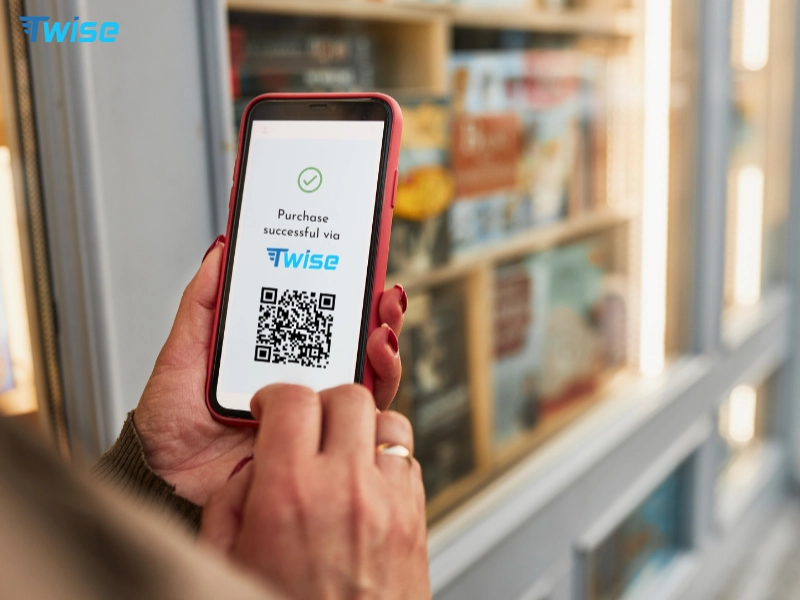
A travel/roaming eSIM, by contrast, is data-only in almost every case, has no local phone number attached, and activates the moment you scan the QR code and enable data roaming — no waiting, no business-hours window.
| Local eSIM (AT&T/T-Mobile) | Travel/Roaming eSIM | |
| Phone number | Real US number, calls & SMS | Usually data-only, no number |
| Activation | Requires EID/IMEI at checkout; provisioned within a business-hours window | Scan QR, works instantly on landing |
| Hotspot | Varies by plan — not guaranteed | Usually supported |
| Top-ups | Not supported on most local plans | Not supported — buy a new eSIM instead |
| Best for | Business travel, app sign-ups, long stays | Short trips, backup data, no local contact needed |
Twise‘s take: a local eSIM behaves exactly like a US resident’s line — but that authenticity is exactly why it can’t be activated in seconds the way a travel eSIM can. If your flight lands in a few hours and you only need data for maps and messaging apps, a travel eSIM is the lower-friction choice. If you need to receive one-time passcodes from a US bank, give a real callback number to a landlord or business partner, or sign up for apps that reject foreign numbers, book the local eSIM at least a day ahead of departure so activation has time to complete.
3. Twise Plans for the USA: Which Fits Your Trip?
Short city breaks (New York, Los Angeles, Las Vegas): A mid-size data plan in the 5–10GB range comfortably covers maps, hotel check-ins, and rideshare apps across a three- to five-day trip. Most city-break travelers don’t need a local number unless they’re also doing business meetings or long-term bookings.
Business travel & extended stays: Here the local number becomes the deciding factor, not the data amount. It lets you receive verification codes from US banking and delivery apps, and it gives local contacts a real domestic number instead of a foreign one that many US businesses hesitate to call back. Extended stays of two weeks or more also benefit from unlimited or large-cap plans, since daily data use adds up faster over a longer window.
Cross-country road trips & national park explorers: Prioritize a larger or unlimited data plan and lean toward AT&T for the rural stretches between parks. Regardless of carrier, download offline Google Maps for the parks themselves — Zion, Yellowstone, and the Grand Canyon all have long interior stretches with no signal on either network, so this isn’t a coverage complaint specific to one carrier, it’s simply how US national park infrastructure works.
| eSIM Type | Carrier | Data | Calls & SMS | Activation Time | Validity Period | Best For |
| US Domestic eSIM (T-Mobile) – Canada – Mexico | T-Mobile (Official) | Unlimited 5G | Unlimited | 6–8 hours | 5–60 days | Users who need stable coverage and calling |
| US Domestic eSIM (AT&T) – Canada – Mexico | AT&T (Official) | Unlimited 5G | Unlimited | 6–8 hours | 7–90 days | Users who need stable coverage and calling |
| US Travel eSIM (Data Only) | AT&T / T-Mobile | 500MB–2GB/day | Not supported | 1 minute | 1–30 days | Short-term travel or business trips |
| US – Canada – Mexico eSIM | AT&T / Rogers / Unefon | 500MB–2GB/day | Not supported | 1 minute | 1–30 days | Travelers moving between multiple countries |
4. Plan Comparison at a Glance
| Feature | Twise Local eSIM
(Voice + SMS + Data) |
Twise Data-Only eSIM |
| Real US number | Yes | No |
| Calls/SMS | Unlimited domestic | Not included |
| Activation | EID/IMEI required, business-hours provisioning | Instant QR scan |
| Hotspot | Plan-dependent — confirm before buying | Usually supported |
| Canada/Mexico roaming | Included on some plans, capped after a data threshold | Varies by plan |
| Best for | Long stays, business, app verification | Short trips, backup data |
5. Twise USA eSIM Available Data Plans & Durations Matrix
- Short-Term Travel Plans: We offer flexible options including an eSIM USA 1-day layout for quick airport transits, an eSIM USA 5 days configuration for holiday weekend getaways, and an eSIM USA 10 days package.
- Mid-Range Vacation Packages: If you are staying longer, choose our highly popular usa esim 14 days bundle or our usa esim 20 days plan.
- Long-Term & Business Layouts: Digital nomads can activate a fixed eSIM USA 30 days allocation or choose our comprehensive USA eSIM long-term continuous profiles.
- Data Volume Allocations: Fixed limits range from a light eSIM USA 1GB starter option, going up to eSIM USA 5GB, eSIM USA 10GB, and high-volume eSIM USA 20GB plans for streaming.
6. Why Twise Beats a Physical US SIM Card
Buying a physical SIM after landing sounds simple until you’re actually doing it: finding a carrier store or a Best Buy/Target counter, waiting in line after a long-haul flight, and then physically swapping a tray card into your phone. A Twise eSIM removes every one of those steps by moving the entire process online, before you ever board your flight.
Whether you are looking to buy an eSIM for the USA or looking for a flexible eSIM for the United States, our networks hook directly into carrier towers for nationwide eSIM US coverage without physical card swapping.
| Local US SIM (in-store) | Twise Local eSIM | |
| Where to get it | Airport kiosk, Best Buy, Target, carrier store | Online, before you fly |
| Wait time | Queue after a long flight | None — order ahead |
| Setup | Physical swap, tray tool | Digital or scan QR |
| Activation window | Immediate in-store | Requires EID/IMEI at checkout; processed within a business-hours window |
| Home number | Often disabled during use | Stays active via dual SIM |
The one honest tradeoff: a physical in-store SIM activates the moment you buy it, while a Twise local eSIM needs to be ordered in advance because provisioning happens within a business-hours window. For most travelers, ordering a day ahead is a small price for skipping the airport queue entirely.
7. Step-by-step guide to purchasing and installing your eSIM USA
Acquiring and activating your eSIM USA from Twise is designed to be a seamless, four-step process—starting with a clear guide on how to place an eSIM Twise order to get you connected instantly.
- Step 1: Visit the Twise website, select “USA” as your destination, and browse the available data plan to find the one that best fits your trip duration and data needs.
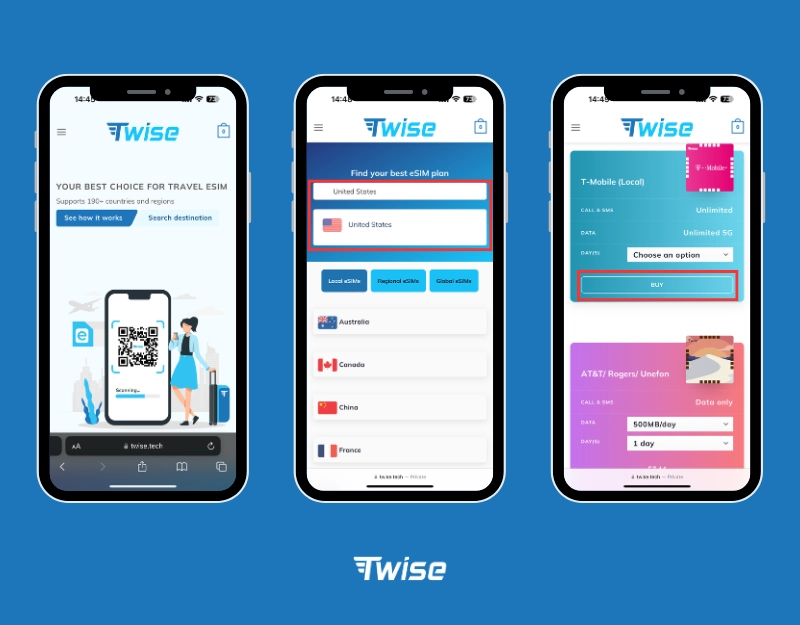
- Step 2: Complete the secure checkout process. Twise accepts all major global payment methods for your convenience.
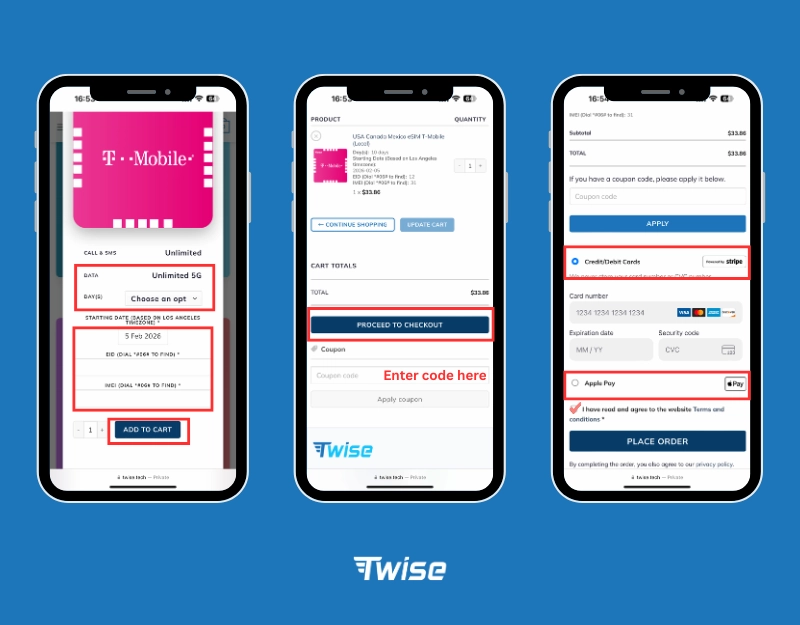
- Step 3: Check your email for the QR code and detailed activation instructions. For local plans, you will need to provide your device’s EID/IMEI during checkout for direct activation.
- Step 4: In your phone’s cellular settings, scan the QR code to add the plan. For roaming plans, ensure “Data Roaming” is turned on to begin using the internet.
Example: The process involves a clean checkout interface on the Twise website, followed by using the “Add Cellular Plan” or “Add eSIM” function in your phone’s settings to scan the provided QR code.
8. Practical Tips for Using Your eSIM in the USA
Use your US number for essential apps. Uber, DoorDash, and Venmo frequently require a US number for account verification — a local eSIM solves this in one step instead of relying on international SMS delivery, which is often delayed or blocked.
Save data in low-signal areas. Download Google Maps offline before heading into national parks or rural interstate stretches, where both AT&T and T-Mobile commonly drop to no signal regardless of plan.
Check hotspot support before you rely on it. Not every local plan includes tethering, and some do so only on higher-tier plans. Confirm this specifically at checkout if you plan to share data with a laptop or a second device.
Confirm your phone is unlocked and eSIM-capable. US-model iPhone 14 and 15 units are eSIM-only, with no physical SIM tray at all — check this before you travel, especially if your phone was purchased outside the US.
Keep your home SIM active for banking. Dual-SIM setups let your home number stay live for two-factor authentication texts from your bank while your US eSIM handles everyday data and calls.
Order local eSIMs ahead of departure. Because activation runs within a business-hours provisioning window rather than instantly, order at least a day before you fly if you need calls or a working number on arrival.
FAQs
Choose a local eSIM if you need a real US number for calls, SMS, or app verification. Choose a travel eSIM if you only need data and want instant activation on arrival.
Some local plans include limited data roaming in Canada and Mexico at reduced speed after a data threshold — check the specific plan’s terms before buying, since this isn’t universal across every SKU.
After activation, your number appears in your phone’s cellular or eSIM settings under the installed plan, usually within the carrier profile details.
Yes. Your device must be carrier-unlocked and eSIM-compatible. A phone still locked to a foreign carrier may fail to add the new eSIM profile entirely.