

 Tiếng Việt
An eSIM for Peru gives international travelers mobile data without replacing a physical SIM card or looking for a local phone shop after arrival. You purchase a plan online, install the digital profile and connect to a supported Peruvian network.
This is useful immediately after landing at Jorge Chávez International Airport. Mobile data lets you contact your hotel, arrange transport, open reservations, translate messages and navigate through Lima without depending entirely on airport Wi-Fi.
However, Peru’s geography creates real coverage limitations. A plan that performs well in Lima or Cusco may lose service on mountain roads, remote trekking routes or Amazon excursions. Choosing the right eSIM therefore requires more than comparing prices: you also need to understand the underlying Peruvian network.
Peru’s Mobile Network Landscape
Peru has four major infrastructure-owning mobile operators: Claro, Bitel, Entel and Movistar. Travel eSIM companies connect customers to one or more of these networks through roaming or wholesale agreements.
The market has changed significantly. At the end of the first quarter of 2026, Claro held 33.35% of Peru’s active mobile lines, followed by Bitel at 24.01%, Entel at 22.54% and Movistar at 19.81%. This means Bitel is no longer simply a small secondary operator by subscriber count.
| Peruvian MNO | Current market position | Network profile | Practical traveler fit |
| Claro | 33.35% | Large national network with expanding 4G and 5G | Lima, Cusco, Arequipa and mainstream tourism routes |
| Bitel | 24.01% | Budget-focused operator with broad regional infrastructure and expanding 5G | Regional travel when supported by the selected eSIM |
| Entel | 22.54% | Strong urban, coastal and selected highway coverage | Lima, southern coastal cities and established urban routes |
| Movistar | 19.81% | Long-established network with extensive 4G coverage | Urban trips, regional towns and selected rural routes |
Claro
Claro is Peru’s largest operator by active mobile lines. Its 5G rollout now covers almost 100 districts across areas including Lima, Callao, Arequipa, Cusco, Chiclayo, Piura, Ica and Chimbote. Its official coverage tool allows users to check 5G, 4G, 3G and 2G availability by location.
Claro is commonly used by international travel eSIM providers. It can be a practical option for trips centred on Lima, Arequipa, Cusco and other major destinations, but this does not guarantee continuous coverage between cities or on remote mountain routes.
Bitel
Bitel has grown to become Peru’s second-largest operator by active mobile lines. It provides 4G infrastructure across Peru and is expanding its 5G network in Lima, Callao and regional provinces. Bitel’s official maps distinguish between guaranteed coverage and additional network-capacity areas.
Despite its growing local presence, Bitel is less frequently listed as the primary network partner on mainstream international travel eSIM product pages. Check the product specification rather than assuming your eSIM can access it.
Entel
Entel is a major alternative to Claro and Movistar, particularly in urban and coastal areas. Its current 5G deployment includes locations in Lima, Arequipa, Ica, La Libertad, Lambayeque, Piura, Moquegua, Tacna and Áncash, subject to local availability.
Entel can perform well along populated corridors, but reception may become less predictable after leaving major roads or entering isolated Andean terrain.
Movistar
Movistar operates 5G, 4G and older network technologies across Peru. Its official coverage map lets travelers check the expected technology at a particular city or address rather than relying on a general nationwide claim.
Movistar remains a common partner for travel eSIM providers, including plans intended for urban centres and established tourism regions.
What the MNO Landscape Means for Travelers
There is no single Peruvian network that should be described as the best for every itinerary.
For Lima, Arequipa or central Cusco, the major operators can provide practical 4G access, with 5G available in supported areas. Differences become more noticeable during long-distance bus journeys, mountain excursions and trips into sparsely populated regions.
Before buying, check:
- Which Peruvian network the plan uses
- Whether it supports 4G only or includes 5G
- Whether more than one local network is available
- Whether manual network selection is permitted
- Whether hotspot sharing is supported
Use 4G as the planning baseline. Treat 5G as an additional benefit in supported urban locations rather than a connection you will maintain throughout the country.
What Is an eSIM for Peru?
A Peru eSIM is a digital mobile profile that provides cellular service through an eSIM-compatible device. Instead of inserting a physical SIM card, you normally install the profile using a QR code or provider app.
Most travel eSIMs for Peru are data-only. They support:
- Google Maps and other navigation apps
- WhatsApp, FaceTime and Telegram
- Hotel and tour messages
- Translation tools
- Airline and rail bookings
- Ride and taxi applications
- Email and online payment access
A data-only plan does not normally include a Peruvian +51 number, traditional mobile calls or standard SMS. Keep this distinction in mind when comparing a travel eSIM with a local prepaid plan.
Is It Difficult for Tourists to Buy a Local SIM in Peru?
A travel eSIM is usually easier, but local service is not completely unavailable to foreign visitors.
Peruvian operators use identity and biometric validation when registering mobile lines. This can make purchasing a local prepaid SIM less predictable than buying a travel eSIM online, particularly when the visitor does not have a Peruvian identity document.
However, the claim that foreigners can no longer buy any Peruvian mobile line is outdated. Claro resumed mobile-line sales to foreign customers in January 2026 through a new biometric validation system. Availability and accepted documents can still depend on the operator and sales location.
A local SIM or eSIM may still be worthwhile when you need:
- A Peruvian +51 phone number
- Domestic cellular calls
- Local SMS
- A renewable plan for a long stay
- Access to local prepaid promotions
A travel eSIM is simpler when you mainly need data for a short visit and want to install the plan before departure.
Which Type of eSIM Peru Plan Should You Choose?
Peru-only eSIM
A country-specific plan is suitable when Peru is your only destination. It usually offers a clearer data allowance and may provide better value per gigabyte than a global package.
This option works for an itinerary such as Lima, Paracas, Arequipa, Cusco and Machu Picchu without crossing into another country.
South America regional eSIM
A regional plan is more convenient when Peru is combined with Chile, Bolivia, Argentina, Ecuador, Colombia or Brazil.
Do not assume every South America plan includes the same countries. Check your entire itinerary, including short airport connections where mobile data may be useful.
World eSIM
A world plan can suit travelers visiting Peru as part of a multi-continent journey. It avoids purchasing another profile when continuing to North America, Europe or Asia.
The main trade-off is that global plans may cost more per gigabyte than a Peru-only or South America package.
Local Peruvian mobile plan
A local plan is better suited to someone staying for several weeks or months who needs a +51 number and traditional voice service. The purchase and identity-verification process may be less convenient for a first-time visitor.
Twise eSIM Options for Peru
Twise does not currently offer a Peru-local eSIM with a Peruvian phone number, cellular calls and SMS.
Instead, its Peru category focuses on South America data-only plans and broader international options. The live category currently lists regional products covering six, eight or eleven South American countries, along with several world plans.
| Twise option | Best for | Important limitation |
| South America 6 Countries | A focused regional itinerary | Confirm that every destination is included |
| South America 8 Countries | Wider regional travel | Data-only; no local Peruvian number |
| South America 11 Countries | Travelers crossing several borders | May cost more than a Peru-only plan |
| World eSIM | Multi-continent trips | Check the data allowance and network used in Peru |
| World 195+ Countries Orange option | Travelers prioritising broad international coverage | Product inclusions can differ from South America plans |
The South America products are designed primarily for mobile data. The World 195+ Countries option has different features, so check its live product card for current call, SMS, activation and data conditions rather than assuming every plan works in the same way.
Twise is most relevant when you want a practical data layer for maps, transport, bookings, translation and internet-based communication. It is not a direct replacement for a local Peru plan when a +51 number is essential.
Peru eSIM Providers Compared
Current pricing changes with promotions, exchange rates and package updates. The comparison below focuses on plan structure rather than declaring one provider universally better.
| Provider | Current plan approach | Network information | Best for |
| Twise | South America and world plans | Depends on the selected regional or global product | Multi-country itineraries |
| Airalo | Fixed-data, unlimited and selected voice/SMS options | Current Peru page lists Claro | Travelers wanting several package types |
| Saily | Fixed-data plans starting from $4.99 | Partner network shown after plan selection | App-based setup and security tools |
| Nomad | Fixed data with selected 4G/5G packages | Depends on the current Peru offer | Travelers wanting flexible data sizes |
| Holafly | Duration-based unlimited-style data | Movistar and Claro | Heavy phone-data users |
Airalo currently lists Peru packages from $4.50, with fixed data, unlimited options and selected plans that include calls and texts. Its current Peru page identifies Claro as a primary local network for some packages. Certain offers may require identity verification, so check the checkout conditions before purchasing.
Saily advertises Peru data plans from $4.99. Holafly uses Movistar and Claro and offers 4G/LTE and 5G where available, while also warning that connections can be weaker in mountains, jungles and other remote areas.
When comparing providers, consider the total high-speed allowance, validity, hotspot rules and local network—not only the headline price.
How Much Data Do You Need in Peru?
Choose your allowance according to your normal phone behavior.
| Traveler type | Suggested allowance |
| Maps, WhatsApp and digital tickets | 1–3GB per week |
| Navigation, browsing and social media | 5–10GB per week |
| Frequent photo and video uploads | 10–20GB per week |
| Remote work and occasional hotspot use | 20GB+ |
| Daily streaming or video meetings | Large fixed plan or unlimited-style option |
A traveler using maps, WhatsApp and hotel apps does not usually need unlimited data. Video streaming, automatic cloud backups and laptop tethering can consume a package quickly.
Download entertainment and phone updates before departure. Use trusted hotel Wi-Fi for large uploads so your mobile allowance remains available during day trips.
eSIM Coverage Across Peru’s Main Destinations
Lima and Callao
Travelers can generally expect 4G across populated areas, with 5G available in supported districts. Reception may weaken inside underground parking areas, older buildings and crowded venues.
Cusco and the Sacred Valley
Central Cusco has established mobile coverage. Service can become more variable when traveling through the Sacred Valley, mountain roads or smaller communities.
Save the hotel address, train details and tour contact information before leaving the city.
Machu Picchu and the Inca Trail
Aguas Calientes and populated visitor areas may have mobile service, but you should not expect continuous connectivity on mountain routes or the Inca Trail.
Download maps and essential documents before the trek. Mobile data should not be treated as the only safety or navigation tool.
Arequipa and Colca Canyon
Arequipa has urban 4G and expanding 5G availability. Coverage becomes less predictable on roads toward Colca Canyon and at remote viewpoints surrounded by mountainous terrain.
Lake Titicaca and Puno
Puno has useful urban connectivity, but reception can vary during island visits and boat trips. Keep tickets, accommodation information and meeting points available offline.
Amazon Regions
Cities such as Iquitos and Puerto Maldonado have mobile networks, but jungle lodges and river excursions may have weak or no cellular service.
Ask your accommodation whether it provides Wi-Fi or another communication system. Save essential information before leaving the city.
How to Install and Activate an eSIM for Peru
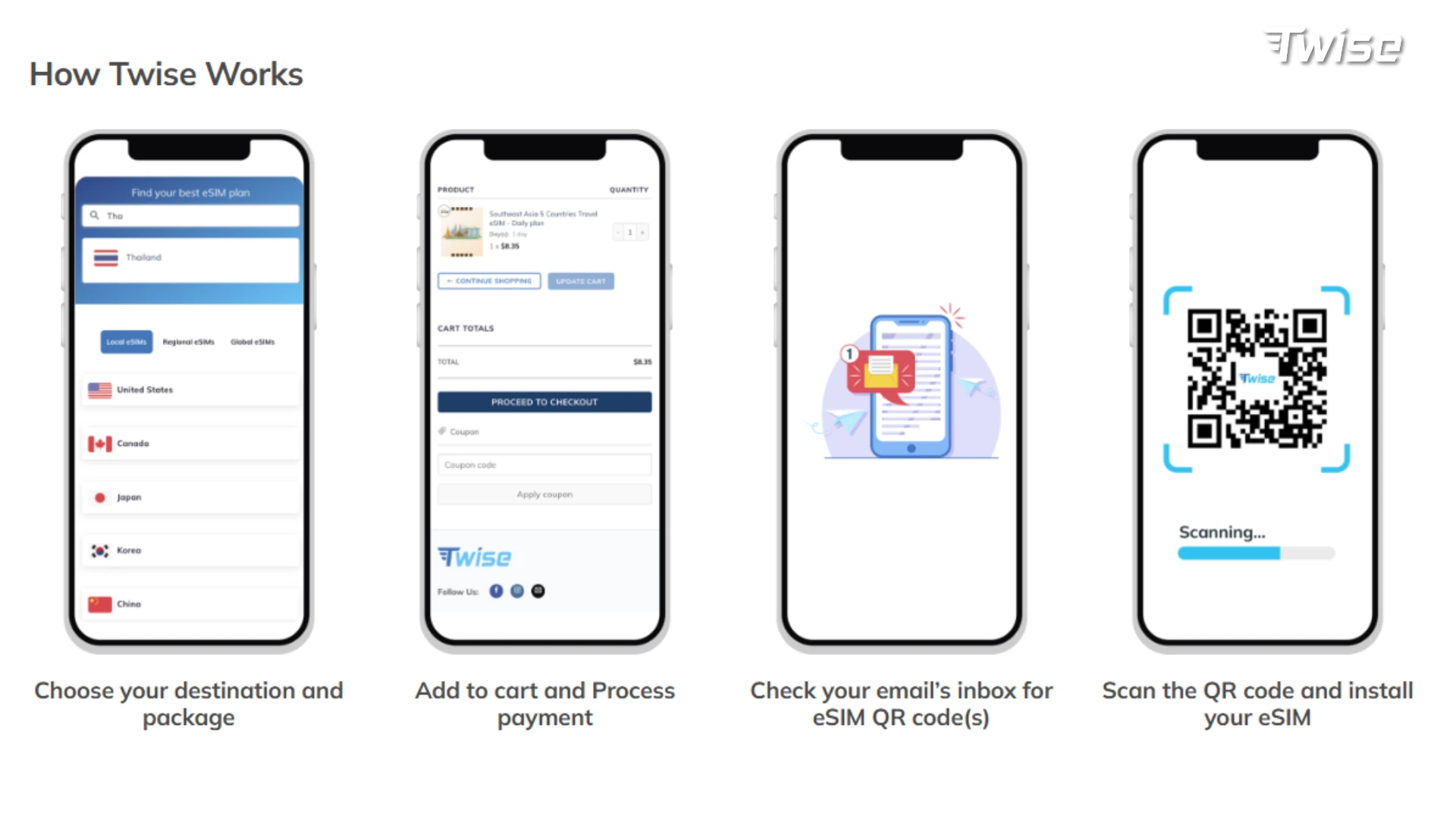
1. Check your device
Confirm that your exact phone model supports eSIM and is unlocked from its original carrier.
2. Select the right coverage
Choose Peru-only coverage for a single-country trip. Select South America or world coverage when crossing borders.
3. Install over stable Wi-Fi
Install the profile before departure when the product instructions allow it. Many travel eSIMs can be added in advance, but the activation rules vary.
Do not scan a QR code early when the provider specifically requires installation inside the supported region.
4. Keep the line off until arrival
Label the profile “Peru Travel” and keep it disabled until the appropriate activation time.
5. Configure mobile data
After landing:
- Turn on the travel eSIM.
- Select it as the cellular-data line.
- Enable data roaming for the travel eSIM when required.
- Disable data roaming on your home SIM.
- Turn off automatic cellular-data switching.
This configuration helps prevent the phone from quietly using expensive home-carrier roaming.
What to Do When Your Peru eSIM Does Not Work
First, confirm that the travel eSIM is enabled and selected for mobile data. Check that data roaming is turned on for that line.
Toggle Airplane Mode for approximately 30 seconds, then wait for the phone to register on the local network. Restart the device when necessary.
When automatic network selection fails, manually select only a network supported by the plan. Choosing an unrelated operator may prevent registration.
Check the provider’s APN instructions before changing other settings. Do not delete the profile while troubleshooting because many eSIM QR codes cannot be installed a second time.

FAQs
Most travel eSIMs are data-only. Selected providers may offer voice and SMS packages, but Twise’s South America plans do not provide a local Peruvian number or traditional cellular calling.
Yes, when all three countries are explicitly included in a South America plan. Always inspect the country list because regional packages differ between providers.
Install it before departure when advance installation is permitted, using a reliable Wi-Fi connection. Keep the line off until arrival or the activation time specified in the instructions.
Possibly. Access depends on the eSIM package, local partner network, device and location. Treat 4G as the reliable planning baseline and 5G as an additional benefit where supported.
More useful tips for your Peru journey:
South America eSIM: Best options with low price
Does FaceTime Use Data? How Much Data FaceTime Uses When Traveling