

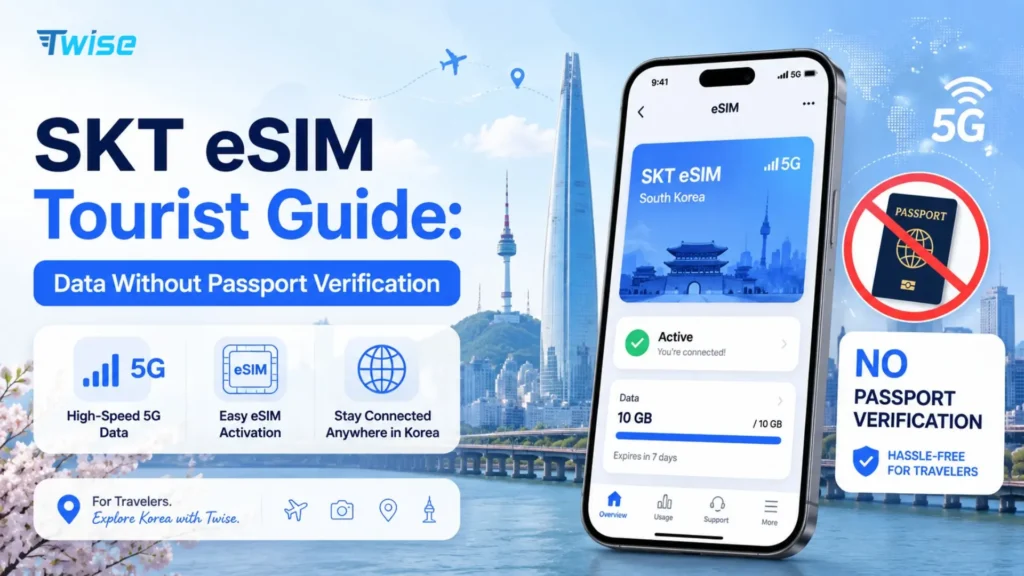
SKT eSIM Tourist Guide: Data Without Passport Verification
Aug
South Korea runs on three mobile networks — SK Telecom (SKT), KT, and LG U+ — and “SKT eSIM tourist” can mean several different products depending on who’s selling it. Some come with a Korean phone number and verification steps. Others are data-only and skip that entirely. The label “SKT” tells you the network; it doesn’t tell you what’s actually inside the product.
| Network | Tourist product shape | Typical use case |
| SK Telecom (SKT) | Data-only reseller eSIMs, or branded plans with a 010 number | Broadest reseller availability for data-only travel eSIMs |
| KT | Mostly data-only or bundled tourist products | Urban-focused travel plans |
| LG U+ | Data-only and Data+Voice options | Tourists who want a Korean number option built in |
This guide focuses on the question that actually determines your setup: do you need passport verification for the connectivity your trip requires, or is data-only enough?
Does an SKT eSIM Tourist Plan Require Passport Verification?
Not always — it depends on what the product includes. Data-only SKT-powered eSIMs are generally sold and used without positioning themselves around identity verification. Phone-number, calling, and SMS functionality follow a different, product-specific process.
Data-only SKT eSIM
A data-only eSIM connects your phone to SKT’s data network for internet access — no Korean number, no calls, no SMS. Products in this category are typically built around straightforward activation rather than identity-verification workflows.
SKT eSIM with a Korean 010 number
Once a product provisions an actual Korean phone number, it’s issuing something that can place calls and receive SMS — capabilities carriers generally tie to a verification step. Requirements vary by exact product, so check the current terms before assuming either way.
Why calls and SMS change the verification requirement
A number that can send and receive SMS or place calls functions differently from a data connection. Regulatory and anti-fraud expectations around active phone numbers are the practical reason voice/SMS products tend to carry more verification steps than plain data eSIMs.
What Does “SKT eSIM Tourist” Actually Mean?
The phrase gets used loosely across the market. It’s worth separating the three things it commonly refers to:
Official SK Telecom tourist eSIM
Sold directly by SK Telecom, sometimes including a 010 number and voice/SMS options, with SKT’s own verification process attached where applicable.
Reseller SKT tourist eSIM
Sold by third parties who provision SKT network access — usually structured as data-only, since resellers typically aren’t in the business of issuing verified local phone numbers.
SKT-powered data-only travel eSIM
The category Twise’s Korea product sits in: mobile data running on the SKT network, without a phone number, calls, or SMS attached.
The carrier name alone doesn’t tell you whether you’re getting data, a 010 number, calling, or SMS — you have to check the specific product.
What Can You Do in Korea Without Passport Verification?
For a data-first traveler, the honest answer is: almost everything you’ll actually use day to day.
Maps and public transport
Naver Map and KakaoMap for walking and transit routes, plus KTX and subway schedule lookups — all run on data alone.
Translation
Papago and Google Translate, including camera-based translation for menus and signs, need only an internet connection.
Hotel, tour, and booking messages
Email, WhatsApp, KakaoTalk, and browser-based booking portals all work over data, without a Korean number.
Tickets, social media, and browsing
QR ticket retrieval, Instagram, TikTok, and general browsing are all data-dependent, not number-dependent.
What data-only cannot provide
- Traditional Korean cellular calls
- Korean SMS
- Guaranteed local-account or identity verification tied to a Korean number
If none of those three apply to your trip, a data-only eSIM covers the rest.
Why Do Some SKT Tourist eSIMs Still Ask for a Passport?
Passport verification for voice and SMS
Products that issue a working Korean number tend to ask for passport information as part of activating that number — the verification is tied to the number, not to data access itself.
Data and voice/SMS are separate capabilities
It’s worth repeating because it’s the most commonly conflated point in this space: a plan can offer unlimited data with zero phone-number functionality, or a phone number with limited data. They aren’t bundled by default.
Why a 010 number does not equal real-name authentication
SK Telecom’s tourist information separates mobile-data access from the verification required to enable calling and messaging functions. Even where a 010 number is issued, that doesn’t automatically mean it satisfies Korean services that require deeper resident-style identity checks — those usually need a resident registration number, which a tourist eSIM doesn’t provide on any network.
Twise SKT eSIM vs SKT eSIM With a 010 Number
| Feature | Twise SKT data eSIM | SKT phone-number tourist eSIM |
| SKT-powered mobile data | Yes | Yes |
| Passport step for data-only use | Not positioned around identity verification | Product-dependent |
| Korean 010 number | No | Usually, plan-dependent |
| Standard calls | No | May be available after verification |
| SMS | No | May be available after verification |
| Maps / translation | Yes | Yes |
| App-based messaging | Yes | Yes |
| Korean identity verification | No | Not guaranteed |
| Best for | Data-first tourists | Travelers needing local telecom functions |
If your trip runs on maps, translation, and messaging apps, the data-only column covers it. If you specifically need a working Korean number for calls or SMS, you’re looking at a different product category — browse Korea eSIM plans to compare what each option actually includes before deciding, and check the specific SKT-powered Korea eSIM listing for the current data-only terms.
How to Set Up Twise SKT Data After Arriving in Korea
Before departure
- Confirm your device supports eSIM
- Confirm your phone is carrier-unlocked
- Save your QR code or activation instructions offline
- Download Naver Map, Papago, and any transport or booking apps you’ll need
After landing
Follow the specific Twise installation steps for the SKT product: install the eSIM profile, select the Korea eSIM as your Cellular Data line, and configure Data Roaming as instructed. Twise’s current pre-arrival guide specifically tells travelers to follow destination-specific installation timing for its SKT Korea product, rather than assuming every QR code should be scanned before departure — some Twise products are built to be scanned only after you land.
Keep your home SIM for important OTP messages
Leave your home SIM active for SMS, and turn off its data roaming so it doesn’t rack up charges while your Korea eSIM handles data. This is the simplest way to stay reachable for banking codes without paying for full roaming.
First 30 Minutes in Korea: Where SKT Data Actually Helps
- Incheon Airport → AREX or airport bus — check schedules and platforms as soon as you land
- Find the hotel with Naver Map — set your route before you’re standing at the taxi stand
- Translate an address with Papago — hand your phone to a driver or show it at an information desk
- Message the accommodation or tour operator — confirm your arrival time over WhatsApp or email
- Retrieve QR tickets and reservations — pull up transport passes or tour confirmations from your inbox
Every one of these runs on data. None require a Korean number.
Do You Need a Korean 010 Phone Number as a Tourist?
When data-only is enough
Maps, translation, messaging, search, bookings, and social media — the bulk of a typical first-time visit.
When a 010 number can be useful
Local calls, SMS, and certain reservation or queue systems — some restaurants and clinics still text a queue number to a Korean line.
When even a 010 number may not solve the problem
Services that require stronger Korean identity or payment verification, such as some banking or government platforms, generally need more than a tourist-issued number, regardless of which carrier issued it.
SKT eSIM Tourist Data: What Does “Unlimited” Really Mean?
High-speed data versus continued data
“Unlimited” typically means continued access rather than a guarantee of full network speed at every moment — the distinction matters more during heavy-usage periods than on an average day.
Fair-use and speed-management policies
Most tourist data plans, across carriers, reserve the right to manage speeds under unusually heavy network load. That’s a congestion clause, not a hidden daily cap.
5G availability depends on plan, device and location
Even with 5G-capable coverage, your actual speed depends on your device’s radio support and where you are in the country.
Hotspot users should check tethering rules
If you’re planning to tether a laptop, verify tethering is supported on the specific product — don’t assume “unlimited” data automatically includes unrestricted hotspot use.
We’re not attaching a specific speed figure to Twise’s current product here, since Twise’s own live terms describe the plan structure in ways that can be updated — check the current plan details before purchase rather than relying on a fixed number.
SKT Coverage for Seoul, Busan, Jeju and Intercity Travel
Seoul and major urban travel
Dense coverage across the city center and major transit lines is standard across all three carriers.
Busan and major tourist areas
Coastal and downtown areas are generally well covered, with normal variation near the edges of the city.
Jeju driving and navigation
Coverage supports typical driving routes, though signal can dip in more remote parts of the island.
KTX and intercity routes
Connectivity along major rail corridors is generally reliable, with occasional short gaps through tunnels or rural stretches.
Why offline maps still matter
No carrier can promise uninterrupted signal across every rural or mountain route. Downloading offline map areas before a remote-route day is a simple hedge, regardless of which eSIM you’re using.
Data-Only SKT vs Local SIM vs Pocket Wi-Fi vs Home Roaming
| Option | Best for | Main limitation |
| SKT-powered data eSIM | Fast data-first travel setup | No local calls/SMS |
| SKT/KT/LG U+ phone-number plan | Travelers needing a local number | Verification/setup may be required |
| Physical tourist SIM | Travelers preferring counter support | SIM swap and pickup logistics |
| Pocket Wi-Fi | Groups sharing one data connection | Extra device, needs charging |
| Home roaming | Maximum convenience, no new SIM | Price and data policies vary by carrier |
What to Do When Your SKT eSIM Does Not Work
QR code cannot be added
Check that your device is eSIM-compatible, confirm it’s carrier-unlocked, and make sure the profile hasn’t already been installed once (most eSIM QR codes are single-use).
SKT signal appears but there is no data
Check that the eSIM is selected as your active data line and that Data Roaming is switched on for that line, per the product’s setup instructions.
Data works but calls and texts do not
First confirm whether your product is data-only by design — if so, this isn’t a malfunction, it’s the product working as intended.
You suddenly need a Korean phone number
Don’t try to “upgrade” a data-only eSIM into voice/SMS functionality after the fact — it’s not designed for that. Instead, look at a phone-number-capable product for the remainder of the trip.
Coverage disappears temporarily
Keep offline maps and key booking confirmations saved locally so a brief signal gap in a subway tunnel or rural stretch doesn’t strand you.
Who Should Choose a Twise SKT eSIM?
Good fit: tourists whose trip depends primarily on maps, translation, hotel messages, transport information, bookings, social media, and app-based communication — the majority of first-time visitors to Korea.
Choose another option if: you specifically require a Korean 010 number, traditional calls, Korean SMS, resident-style authentication, or renewable long-term local service.
That’s the real decision this guide is built around — not “avoid verification at all costs,” but choosing data-only when data is genuinely all your trip requires. For travelers weighing options beyond Korea too, Twise’s broader international travel eSIM options follow the same data-first logic in other destinations.
The right SKT eSIM isn’t the one with the most features — it’s the one that matches what your trip actually needs. Most first-time visitors to Korea can run their entire itinerary on data alone. If a specific plan, reservation, or service turns out to need a Korean number, that’s a narrow, identifiable gap you can fill separately, rather than a reason to over-buy from the start.
FAQs
For data-only tourist eSIMs, yes — verification requirements are mainly associated with products that provision a working Korean phone number.
No. Data-only eSIMs don’t support conventional SMS. Apps like KakaoTalk or WhatsApp can handle messaging over data instead.
Follow the specific product’s instructions. Some eSIMs, including Twise’s current SKT product, are designed to be scanned and activated after landing rather than before departure.
Yes, and it’s recommended — keep your home SIM active for SMS/OTP while turning off its data roaming, so your Korea eSIM handles data separately.
No single network is universally better. Coverage and product fit depend on your route and whether you need data-only access or local phone-number functionality.
More useful tips for your journey to South Korea
Best Korea eSIM Providers: SKT, LG U+, Travel eSIMs & Unlimited Data Compared
Cheapest eSIM South Korea: Price vs Data vs Network Tradeoffs
Korea 4G vs 5G eSIM: What Travelers Actually Need
