

Vodafone Network Bands in Europe Explained: What Travelers Should Check Before Buying a Europe eSIM
Oct
If you are buying a Europe eSIM that connects through Vodafone, your phone needs more than eSIM support. It must also be carrier-unlocked and compatible with the network technologies used by Vodafone or its roaming partners.
Most recent iPhones, Samsung Galaxy flagships and Google Pixel phones support the main European LTE and 5G frequencies. Older phones, imported devices and carrier-specific regional models require closer checking.
Vodafone operates separate national networks and uses roaming partners in other destinations. Therefore, there is no single Vodafone frequency list that applies everywhere in Europe.
This guide explains the most useful European bands Vodafone network bands, how to check your phone and what else to verify before purchasing.
Already checked your phone? Compare Europe eSIM plans.
What Are Network Bands and Why Do They Matter?
Mobile networks transmit signals through radio-frequency ranges called bands. Your phone must support relevant bands to communicate with the local network.
eSIM support means your phone can store and use a digital SIM profile. Network-band support means your phone’s hardware can connect to the mobile frequencies used by the carrier.
They are related, but they are not the same.
A phone can successfully install a Vodafone-connected eSIM while lacking a useful frequency deployed in the destination. It might connect in a major city but have fewer network layers available indoors or outside urban areas.
Modern international flagships generally support many European bands. Older and region-specific models may support fewer.
Twise note: When an eSIM does not connect, missing network bands are only one possible cause. Twise support also checks carrier lock, profile installation, the selected data line, Data Roaming, APN configuration, network selection and activation status.
Vodafone Network Bands: What Travelers Should Know
 There is no single Europe-wide Vodafone network-band table.
Vodafone operates national networks with spectrum assigned by each country’s regulator. A Vodafone plan may also use partner networks when roaming outside its home market.
The bands available in Germany, the UK, Portugal, Romania or another Vodafone market may therefore differ. Travelers should look for broad European compatibility instead of searching for one “Vodafone band.”
| Network layer | What travelers should understand |
| LTE/4G capacity | B1, B3 and B7—approximately 2100, 1800 and 2600 MHz—are commonly useful European capacity bands. Exact Vodafone deployment varies by country. |
| LTE low-frequency coverage | B8, B20 and B28—approximately 900, 800 and 700 MHz—can provide wider reach and better indoor penetration. Not every band is used in every market. |
| 5G high-capacity layer | n78, around 3.5 GHz, is an important European 5G capacity band in supported Vodafone markets. |
| 5G coverage layers | Bands such as n1, n3 and n28 may be used for 5G or through Dynamic Spectrum Sharing, depending on the national network. |
| Carrier aggregation | Compatible phones may combine several frequency layers. Supported combinations depend on the phone model, firmware and local network. |
| Roaming partners | A Vodafone-branded travel plan may connect to a non-Vodafone partner in destinations where it does not use its own radio network. |
Lower-frequency layers such as B20 and B28 generally travel farther and perform better inside buildings than higher-frequency capacity layers. B3 and B7 are especially useful in cities and other higher-traffic locations.
For 5G, n78 can provide additional capacity and faster potential speeds, while n28 prioritizes broader reach. Neither band guarantees a specific speed or continuous 5G coverage.
Supporting one listed band does not guarantee perfect service. Performance also depends on the exact phone model, plan, location, congestion, provisioning and roaming agreement.
Date checked: September 19, 2026 | Sources checked: Vodafone market information and Apple, Samsung and Google device specifications. Network deployments change, so verify the current product and device details before purchasing.
Which bands are most useful for a Europe travel phone?
For broad European LTE compatibility, look for:
- B1 – 2100 MHz
- B3 – 1800 MHz
- B7 – 2600 MHz
- B8 – 900 MHz
- B20 – 800 MHz
- B28 – 700 MHz
For broad European Sub-6 5G compatibility, useful bands include:
- n1 – 2100 MHz
- n3 – 1800 MHz
- n28 – 700 MHz
- n78 – 3.5 GHz
Your phone does not necessarily need every band to connect. Supporting more relevant bands gives it access to more possible network layers across different destinations.
eSIM Compatibility and Vodafone Network Compatibility Are Not the Same
There are several separate questions:
- Can your phone install an eSIM?
- Is the device carrier-unlocked?
- Does the exact model support useful European frequencies?
- Does the selected plan permit access to the required network?
- Does the plan need Data Roaming or a specific APN?
You need all these elements to work together.
Apple’s troubleshooting guidance states that an iPhone must be unlocked—or both plans must come from the same carrier—to use Dual SIM with different carriers. It also notes that the carrier must support eSIM and that both plans must be correctly configured. Apple’s Dual SIM guidance reinforces why seeing “Add eSIM” is not enough by itself.
Think of eSIM compatibility as the digital-SIM part. Network compatibility is the can-this-phone-connect-effectively-to-the-local-radio-network part.
Both are necessary.
Check whether your phone supports eSIM.
How to Check If Your Phone Can Work With a Vodafone-Based Europe eSIM
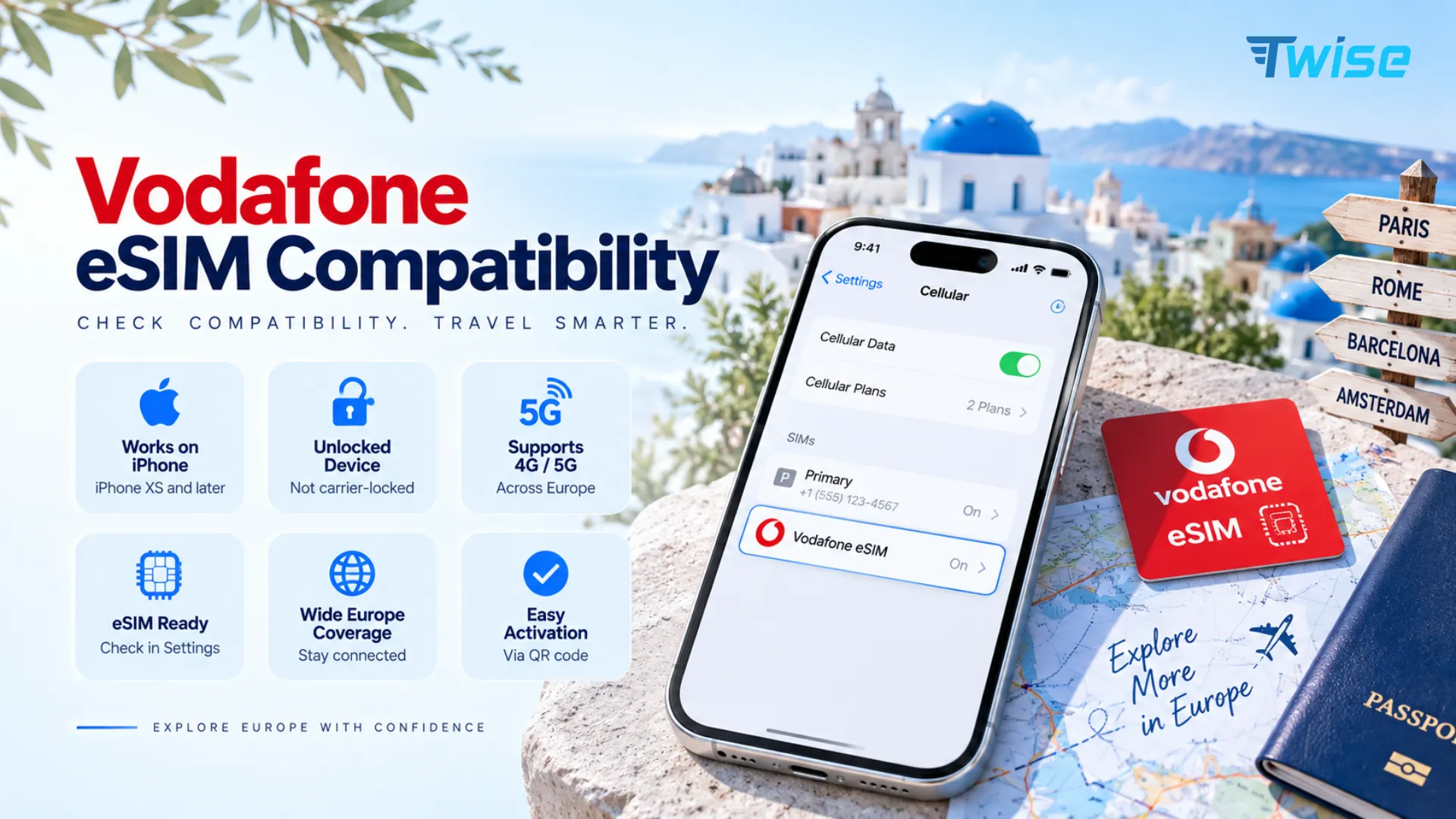
1. Check your exact phone model
Do not stop at “iPhone 15,” “Galaxy S24” or “Pixel 9.”
Find the complete model number and regional version. US, European, mainland Chinese and other variants may have different eSIM configurations, modems or supported frequencies.
You can usually find it under:
- iPhone: Settings → General → About
- Samsung: Settings → About Phone
- Google Pixel: Settings → About Phone → Regulatory Labels
2. Confirm that the phone supports eSIM
Look for:
- Add eSIM
- Add Cellular Plan
- Download a SIM instead?
- SIM Manager → Add eSIM
Then verify the exact model through the manufacturer’s specification page or Twise’s compatibility guide.
Seeing an EID or an “Add eSIM” menu is useful, but it does not confirm carrier-unlocked status.
3. Make sure the phone is carrier-unlocked
A locked phone may reject a Vodafone or travel eSIM even when its modem supports every required band.
On an iPhone, check:
Settings → General → About → Carrier Lock
The preferred result is No SIM restrictions.
Android wording varies. If the phone was purchased through a carrier, confirm the unlock status directly with that carrier before departure.
4. Check your LTE and 5G expectations
For a Europe trip, broad LTE compatibility is normally more important than matching one isolated 5G band.
LTE is sufficient for:
- Google Maps and navigation
- WhatsApp and other messaging apps
- Translation
- Ride-hailing
- Train and public-transport apps
- Hotel and tour communication
- Bookings and regular browsing
If you specifically want 5G, check for relevant Sub-6 bands such as n28 and n78. The phone, local network and selected plan must all support 5G.
5. Check the exact eSIM plan
Not every Europe eSIM uses Vodafone, and not every Vodafone-connected plan provides the same services.
Confirm:
- home network and roaming partners,
- included countries,
- 4G or 5G access,
- data allowance,
- fair-use or speed policy,
- hotspot rules,
- data-only or voice/SMS service,
- phone-number availability,
- APN requirements,
- activation timing and location.
Product-page details override general network-band guidance.
Do Travelers Really Need 5G for a Europe eSIM?
Not always.
LTE can comfortably support maps, messaging, translation, transport apps, email, browsing and ordinary social-media use.
| Traveler type | Is 5G essential? | What matters more |
| Maps and messaging | No | Stable LTE and roaming coverage |
| Social media | Usually no | Data allowance |
| Remote work | Helpful | Hotspot, stability and data volume |
| Video streaming | Helpful | High-speed allowance and fair-use policy |
| Short city trip | Usually no | Easy activation and validity |
| Rural travel | Usually no | Low-frequency LTE support |
| Older-phone user | No | LTE bands and unlock status |
5G is more useful for large uploads, cloud work, high-quality streaming or intensive hotspot use.
From a support perspective, the better first question is:
“Will this plan work with my phone, cover my itinerary and provide enough data?”
That is more useful than choosing solely because a product displays a 5G label.
Common Compatibility Mistakes Travelers Make
1. Checking eSIM support but not carrier lock
Seeing Add eSIM does not prove that the phone can accept another carrier’s profile.
Carrier lock is one of the first items travelers should check before purchasing.
2. Assuming every Europe eSIM uses Vodafone
Europe eSIMs use different home networks and roaming partners.
Even two Vodafone-connected plans may have different country coverage, roaming agreements or network access. Check the network shown on the exact product page.
3. Assuming 5G is required
LTE is sufficient for most tourist activities. Compatibility, coverage, data allowance and validity may matter more than maximum speed.
4. Confusing data-only service with local phone service
A data-only eSIM does not automatically include:
- A European phone number
- Cellular calls
- Incoming cellular SMS
- Outgoing cellular SMS
WhatsApp, FaceTime, Telegram and similar apps can still work over mobile data.
Some carrier-style Vodafone products may include voice or SMS, but this depends on the exact plan.
5. Forgetting post-installation settings
If the eSIM installs but has no internet, check:
- whether the eSIM line is enabled,
- whether it is selected for mobile data,
- Data Roaming,
- the supplied APN,
- automatic network selection,
- activation status,
- whether the phone needs restarting.
Twise Support Insight: “No Service” or “No Internet” does not automatically indicate missing Vodafone bands. Twise support normally checks carrier lock, profile installation, line selection, roaming, APN, network selection and activation before identifying a hardware compatibility problem.
What to Check Before Buying a Vodafone-Connected Europe eSIM
- Exact phone model and regional version.
- eSIM support.
- Carrier-unlocked status.
- Whether LTE is enough or you specifically need 5G.
- Hotspot requirements.
- Whether you need a European phone number.
- Which network or roaming partners the plan uses.
- Installation and activation instructions.
- Validity period and included countries.
- Data allowance and fair-use terms.
When a Vodafone-Based Europe eSIM Is a Good Fit
A Vodafone-connected eSIM can suit travelers with an unlocked, compatible phone who want data prepared for maps, translation, messaging, transport apps, hotel communication, bookings and everyday browsing.
A regional plan may also reduce the need to install another eSIM at each European border.
However, the Vodafone name alone should not determine the purchase. Also compare:
- Countries covered
- Local and roaming networks
- Data allowance
- Validity
- Hotspot policy
- Phone-number features
- Activation requirements
A Vodafone-based plan may be data-only or may include additional mobile services. Check the selected product rather than assuming every Vodafone option works the same way.
Twise Europe eSIM Options for Travelers
Twise offers different Europe eSIM formats, including regional data plans and carrier-style options where available.
For light users, focus on enough data for maps, messages and bookings.
For heavy users, compare larger allowances, hotspot support and fair-use limits.
For travelers needing a phone number, calls or SMS, check the service specifications rather than assuming these features are included.
For short trips, prioritize activation timing and validity.
For longer or multi-country trips, compare the complete country list and how much data remains available across the itinerary.
Twise can deliver compatible eSIM profiles by QR code, but the traveler must still use an unlocked, supported device. Always check the current product page because networks and plan specifications can change.
Check Your Phone Before Choosing a Europe eSIM
Vodafone compatibility in Europe is not about finding one universal band.
Check your exact phone model, eSIM support and carrier-unlocked status, then review the network and roaming details of the selected plan.
Broad LTE support—including B1, B3, B7, B8, B20 and B28—is useful across Europe. Bands such as n1, n3, n28 and n78 provide broader 5G flexibility, but 5G is not essential for most travelers.
FAQs About Vodafone Network Bands and Europe eSIM Compatibility
It needs to support the relevant frequencies used by Vodafone or the plan’s roaming partner in your destination. There is no single Vodafone band set that applies across all European countries.
No. Also check carrier lock, the exact regional model, relevant network bands and the plan’s activation requirements.
Usually not. LTE is sufficient for most maps, messaging, translation, bookings and transport apps. Choose 5G when extra speed matters and your phone, plan and local network support it.
Check the selected data line, Data Roaming, APN, automatic network selection and activation status. Carrier lock, local coverage or device-band compatibility may also require investigation.
Yes. These services work over mobile data. However, a data-only eSIM does not automatically provide a local phone number or conventional SMS.
Buying before departure gives you time to confirm compatibility, save the installation instructions and prepare offline backups. Check whether the plan should be installed before travel or only activated after reaching a supported destination.
More Helpful Tips For Your Europe Journey
Best Apps for Travel in Europe: Maps, Trains, Translation, Payments & eSIM Setup
How to Make Calls in Europe with a Local Europe eSIM
Locking Into the Fastest eSIM Europe 5G Networks on iPhone 16 and Android Ultra Devices
Orange Network Bands Explained: What Travelers Should Check Before Buying a Europe/France eSIM
