


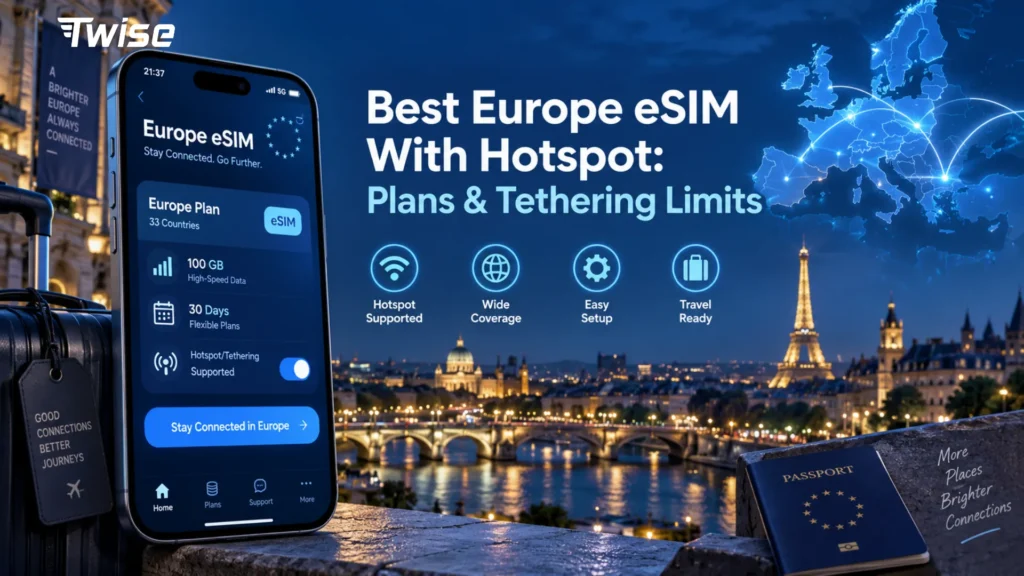
Best Europe eSIM With Hotspot: Plans & Tethering Limits
Sep
Most Europe travel eSIMs support hotspot, but hotspot support does not mean unlimited tethering. Before buying, compare the hotspot allowance, total high-speed data, fair-use policy (FUP), post-cap speed, and how many European countries the plan actually covers. For hotspot use in Europe, the best Europe eSIM with hotspot is the one whose tethering rules match how you’ll actually use it: Twise offers Europe plans with hotspot support on eligible plans and multi-country data continuity, while providers like Airalo, Holafly, and Saily each handle tethering differently — some cap it, some don’t.
If you’re working from a laptop at a café in Lisbon, sharing a connection with a travel partner on a train through Switzerland, or backing up hotel Wi-Fi with a second device, the right answer depends less on brand and more on how the plan treats tethered data.
Best Europe eSIM With Hotspot: Quick Comparison
Search intent here is strongly commercial, so here’s the comparison up front.
| Provider | Hotspot | Hotspot Limit | Europe Coverage | Data Type | Good Fit For |
| Twise Europe | Yes | Plan-dependent | Multi-country Europe | Daily / fixed data / Local with phone number | Travelers wanting predictable hotspot data |
| Airalo Europe | Yes | Uses plan/FUP allowance | Regional Europe | Fixed / unlimited | Flexible app-based plans |
| Holafly Europe | Yes | 1GB/day shareable | 30+ countries | Unlimited phone data | Heavy phone users, lighter tethering |
| Saily Europe | Yes | Unlimited sharing | 35 countries | Fixed / unlimited | Travelers frequently tethering |
| Local SIM / roaming | Varies | Carrier-dependent | Carrier-dependent | Varies | Travelers staying mostly in one country |
Saily’s own Europe page states hotspot sharing is unlimited. Airalo’s tethering uses the same data allowance and FUP as the main eSIM connection — some devices also need the eSIM’s APN entered manually in the Personal Hotspot field. Holafly’s Europe plan allows unlimited phone data but caps hotspot sharing at 1GB per day. Editorial note: recheck these limits before publishing, since hotspot policies change without notice.
What Does “Hotspot Support” Actually Mean?
Hotspot, or tethering, lets your phone share its eSIM’s mobile data connection with another device over Wi-Fi, USB, or Bluetooth. A provider listing “hotspot: yes” only confirms the feature technically works — it says nothing about how much you can share.
There are three common models. Some plans let hotspot draw from the same data allowance as the phone, with no separate limit. Others cap hotspot specifically — a daily allowance like Holafly’s 1GB/day, regardless of how much total data the plan includes. And some apply the plan’s fair-use or speed policy to tethered data the same way it applies to phone use.
This distinction matters because “unlimited data” and “unlimited hotspot” are different claims. Holafly’s Europe plan is a clear example: unlimited on the phone, capped at 1GB/day the moment you tether. Tethering itself doesn’t multiply your data use — but laptops tend to consume more than phones through video calls, cloud sync, background updates, and higher-resolution streaming, so the same hotspot allowance empties faster on a laptop than on a second phone.
How Much Hotspot Data Do You Actually Need?
Actual usage varies by resolution, apps, and background syncing, but these ranges are a reasonable starting point:
| Hotspot activity | Approximate data demand | Suggested plan approach |
| Email + browsing | Low | 5–10GB may be sufficient |
| Maps + tablet sharing | Low–medium | 10GB+ |
| Social media | Medium | 10–20GB+ |
| Video meetings | High | 20GB+ |
| HD streaming | Very high | Large or unlimited plan |
| Remote work + cloud sync | High | Large fixed or unlimited plan |
Laptop users should budget more than they expect. Windows and macOS updates, Google Drive or Dropbox syncing, and Zoom or Teams calls are common sources of usage travelers don’t account for until the data runs low.
This is also where the unlimited-vs-fixed decision matters. Unlimited data makes sense for heavy phone use or travelers who don’t want to track usage — but only if the hotspot terms match your needs; an unlimited phone plan with a 1GB/day hotspot cap won’t help a remote worker much. Fixed plans (10GB, 20GB, 30GB) are often easier to evaluate precisely because you know exactly how much high-speed, shareable data you’re getting. Either way, check the fair usage policy: the daily high-speed threshold, what happens after it (throttling vs. stopping), and whether the reset is daily or plan-wide. “Unlimited” and “unlimited hotspot” remain separate claims regardless of which model a provider uses.
Which Europe eSIM Hotspot Plan Fits Your Trip?
There’s no single “best” provider here — the right plan depends on the trip.
Phone + laptop travel: prioritize a fixed high-speed allowance or a clearly stated tethering rule that covers email, browsing, and occasional video calls without surprises.
Remote work in Europe: look past the “unlimited data” label and check the high-speed allowance, hotspot cap, throttled speed after the cap, and network coverage in the specific countries on your itinerary.
Couples or families sharing one connection: one eSIM plus hotspot works well when everyone stays together — a phone and a nearby laptop or tablet, for instance. Separate eSIMs become more practical once the group splits up during the day, since each person then needs independent maps and connectivity rather than relying on whoever is holding the hotspot phone.
Multi-country Europe trips: the priority shifts to continuity. Moving from France to Switzerland to Italy to Germany without swapping eSIMs at every border is where Twise’s multi-country data continuity is most useful — one profile, multiple networks, no re-registration at each stop.
Europe eSIM vs. Physical SIM vs. Home Roaming for Hotspot
| Option | Hotspot | Multi-Country Convenience | Setup | Main Limitation |
| Travel eSIM (Twise, etc.) | Usually plan-dependent | High | Digital, QR-based | Data/FUP terms vary by plan |
| European physical SIM | Usually carrier-dependent | Medium–high | Buy/swap SIM in person | May require a store visit or ID |
| Home carrier roaming | Usually carrier-dependent | High | Very easy | Can be expensive |
| Public Wi-Fi | No mobile allowance needed | Variable | Easy | Availability and security vary |
A travel eSIM suits travelers who want to set up before departure and keep one connection across several countries. A physical SIM can work well for a long stay in a single country but involves handling a card and possibly a store visit or registration. Home carrier roaming is the most convenient option on paper, but it’s worth checking your carrier’s actual roaming and tethering terms before relying on it for laptop work — some home plans throttle or block tethering abroad entirely.
Twise Europe eSIM for Hotspot and Multi-Country Travel
Eligible Twise Europe plans support hotspot sharing, which makes them a practical option for travelers connecting a laptop, tablet, or a second phone while moving between countries. Not every Twise Europe product carries identical tethering terms, so it’s worth checking the specific plan’s data structure — daily high-speed allowances, fixed total-data options, and multiple trip-duration tiers are all part of the current Europe lineup, with hotspot support where the plan lists it.
The bigger advantage for multi-country trips is what sits around the hotspot feature itself: multi-country data continuity so the same eSIM keeps working as you cross borders, QR-code delivery before departure, Dual-SIM compatibility so your home number stays active for calls and OTPs while data runs through the Twise eSIM, and no-KYC activation on eligible plans — no passport upload required to get connected.
Need hotspot data across several European countries? Compare Twise Europe eSIM plans by data allowance, trip length, and supported destinations, then confirm tethering support for the plan before you buy.
6 Things to Check Before Buying a Europe eSIM With Hotspot
Use this as a buying checklist rather than trusting the headline “hotspot: yes.”
- Is hotspot explicitly allowed? eSIM support alone doesn’t guarantee unrestricted tethering — check the plan’s own listing, not just the general provider page.
- Is there a separate hotspot allowance? Some plans cap tethering per day or for the entire validity period, independent of the total data.
- Does the fair usage policy apply to tethering? Hotspot use may count toward the same high-speed threshold as phone use.
- What happens after the high-speed data runs out? Data may stop entirely, throttle to a slower speed, or require a top-up — this varies by provider.
- Does hotspot work across every covered country? Regional plans rely on partner networks that can behave differently country to country.
- Does your phone support hotspot with that eSIM? Check device compatibility and carrier lock; some setups (Airalo included) require the eSIM’s APN entered manually in the Personal Hotspot field, not just the main data settings.
If you already have your eSIM installed and the hotspot option isn’t appearing, Twise’s existing guide on turning on hotspot with travel eSIM data walks through the iPhone, Samsung, and Pixel/Android steps in detail — worth checking before assuming the plan itself blocks tethering.
A Twise Europe eSIM with hotspot fits tourists crossing several countries, travelers pairing a phone with a tablet or laptop, couples occasionally sharing data, and anyone who wants a known high-speed allowance installed before departure. The one group that should look closer at the fine print: travelers with very heavy daily laptop usage, who should compare the exact high-speed allowance and hotspot terms rather than choosing on price alone. Beyond the hotspot itself, instant QR delivery, no-KYC activation on eligible plans, Dual-SIM support, and multi-country continuity make it easier to land, get online, and handle maps, ride-hailing, and hotel communication from the first hour of the trip.

FAQs About the Best Europe eSIM With Hotspot
There isn’t one universal answer — it depends on your tethering allowance needs, high-speed data, fair usage policy, countries covered, and trip length. A traveler tethering a laptop daily needs different terms than someone occasionally sharing maps with a travel partner.
Not necessarily. Providers can impose a separate tethering cap even when phone data is marketed as unlimited. Holafly is a clear example: its Europe plan advertises unlimited phone data but only 1GB per day of shareable hotspot data. Yes, as long as both the plan and your phone support tethering. Laptop use draws from the eSIM’s mobile data allowance just like any other connected device. Usually yes on supported regional plans, provided both countries are covered by the plan and tethering remains permitted under that plan’s network conditions.
Light browsing and email may need relatively little data, but video meetings, cloud backups, and streaming can consume tens of gigabytes quickly — budget on the higher end if you’re working remotely.
More Helpful Tips For Your Europe Journey
eSIM Europe Unlimited Data: Compare Plans & Limits
Vodafone eSIM Europe: Coverage, Roaming & Alternatives
Lebara eSIM Europe: Coverage, Roaming & Alternatives
