


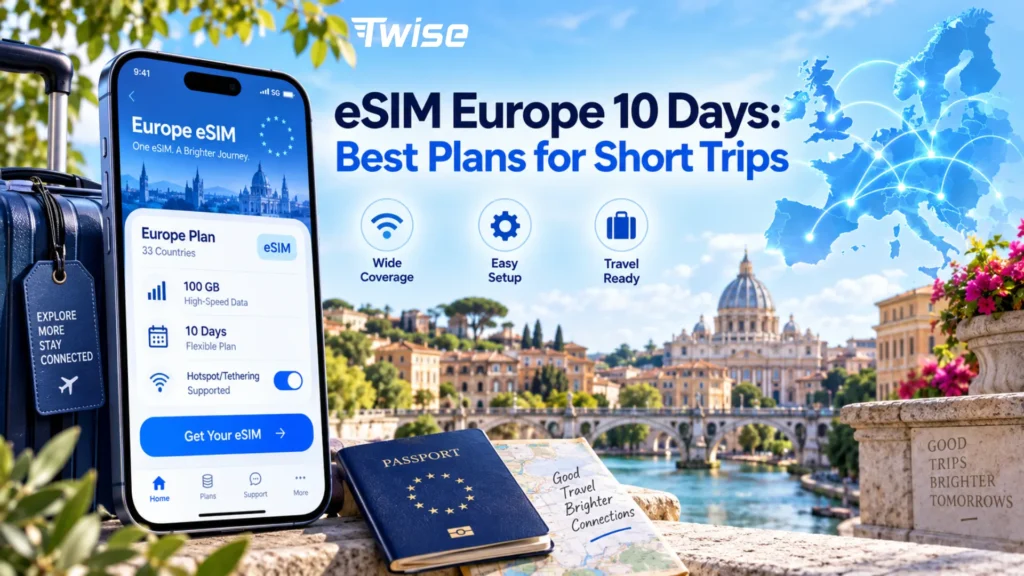
eSIM Europe 10 Days: Best Plans for Short Trips
Sep
A 10-day Europe trip usually doesn’t need a long-validity plan — it needs a plan matched to your actual daily data use, the number of countries on your itinerary, whether you need hotspot, and whether you need calls or SMS. For most travelers that means choosing between a small fixed-data plan for light use, 10–20GB for typical sightseeing, a daily-data plan for predictable usage, or a higher-data/unlimited option for heavy streaming and hotspot use. Twise is a practical option here for travelers who want to install their eSIM before departure and keep one connection active while moving between supported European destinations, rather than buying a new SIM at every border.
eSIM Europe 10 Days: Quick Plan Comparison
Here’s how the main plan types stack up for a 10-day trip specifically — not a generic provider ranking.
| Plan Type | Typical Data | Best For | Multi-Country | Hotspot | Main Consideration |
| Small fixed plan | 3–5GB | Maps, messaging, light browsing | Usually | Plan-dependent | Easy to run out |
| Medium fixed plan | 10–20GB | Typical sightseeing trip | Usually | Often | Good balance |
| Daily data plan | 1–3GB/day | Predictable daily use | Usually | Plan-dependent | Daily reset rules |
| High-data plan | 20–50GB | Social media + hotspot | Usually | Often | Higher cost |
| Unlimited plan | Unlimited/FUP | Heavy phone use | Provider-dependent | Often limited | Check fair-use policy |
How Much Data Do You Actually Need for 10 Days in Europe?

Trip length alone doesn’t determine the right plan — actual usage does, and it varies a lot between travelers.
3–5GB covers light use: Google Maps, WhatsApp, transport apps, booking confirmations, and occasional browsing. This is enough for someone who mostly relies on hotel Wi-Fi and only needs data for navigation between stops.
10GB is a practical reference point for typical tourist use — regular navigation, messaging, social media, and moderate browsing across the full ten days without heavy rationing.
20GB or more makes sense once video, frequent social uploads, hotspot sharing, or all-day navigation enter the picture. Two people sharing one hotspot connection, or someone posting video content daily, will burn through 10GB faster than expected.
Unlimited plans suit heavy phone users, but “unlimited” doesn’t mean unrestricted. Check the fair-use policy, what speed you’re throttled to after the high-speed threshold, and whether hotspot is capped separately — some unlimited plans still limit tethering even though phone data itself has no hard cap.
Which eSIM Europe 10 Days Plan Fits Your Trip?
One-country trips — staying only in France, Italy, Spain, or another single destination — give you the option to compare a local-country plan against a regional Europe plan on price and included features, rather than assuming regional is always better.
2–4 countries on one itinerary is where a regional eSIM earns its value: one profile that works across borders means you’re not installing or buying a new plan in every country you visit.
City-hopping by train puts the priority on continuous data for navigation, train apps, and hotel communication while moving — this is where daily data plans or medium fixed plans tend to work better than very small plans that run out mid-trip.
Heavy social media and video use points toward larger fixed-data or unlimited/FUP plans, since streaming and uploads consume data much faster than browsing.
Laptop or hotspot use needs its own check: confirm tethering is actually supported by the plan, and budget noticeably more data than you would for phone-only use, since laptops, cloud syncing, and video calls consume data far faster.
This is also where Twise’s plan structure comes in directly. Daily data plans work well for travelers who want a predictable, capped amount of high-speed data each day rather than watching a shared total shrink unpredictably. Fixed data plans suit travelers whose usage varies day to day — a quiet museum day followed by a heavy-navigation travel day. Regional Europe plans are the right fit for anyone crossing 2 or more countries in the 10-day window, since the same eSIM stays active across supported destinations without swapping SIMs at each border.
Traveling Europe for around 10 days? Compare Twise Europe eSIM plans by data allowance, supported countries, and trip duration, then choose the option that fits your itinerary.
Is a “10-Day” Plan the Only Option?
Not necessarily. A 7-day plan is usually too short for a full 10-day itinerary unless you have another connectivity option lined up for the remaining days, while an exact or flexible-duration plan minimizes unused validity when one is available. A 15- or 30-day plan can still be the better commercial choice even for a 10-day trip if its pricing or data allowance fits better than a product literally labeled “10 days” — you don’t need the label to match your trip length exactly, just the data and validity window. If you’re weighing this trade-off in detail, Twise’s dedicated Europe eSIM duration comparisons cover the 7-day and 30-day options side by side.
Twise vs. Other Europe Connectivity Options for 10 Days
| Option | Setup | Multi-Country Use | Keep Home SIM | Main Advantage | Main Limitation |
| Twise travel eSIM | Digital | Yes, on regional plans | Yes | Convenient for border-crossing trips | Requires a compatible, unlocked phone |
| Local physical SIM | Store/physical | Varies | Requires SIM management | Useful for local services | Less convenient across countries |
| Home carrier roaming | None | Often | Yes | Simplest setup | May be expensive |
| Public Wi-Fi | None | Wherever available | Yes | No mobile-data plan required | Unreliable when moving |
A Twise Europe eSIM adds instant QR delivery, no-KYC activation on eligible products, Dual-SIM compatibility, and regional continuity — practical features for a short trip covering several countries. A local physical SIM is reasonable if you’re staying in one country the whole time, but becomes a hassle the moment you cross a border. Home carrier roaming is the easiest to set up but worth comparing against your carrier’s roaming-pass cost and data allowance before you leave. Public Wi-Fi should be treated as a backup, not your primary connection for navigation, transport bookings, or arrival logistics.
What to Check Before Buying a 10-Day Europe eSIM
Work through this list before purchasing, not after landing:
- Countries included — verify every destination on your route, including transit countries like Switzerland, Türkiye, or the UK, which aren’t always covered identically across regional plans.
- When validity starts — some plans begin counting at first network connection, others at installation or another provider-defined trigger. Confirm this before installing early.
- Total data vs. daily data — 10GB total is a very different allowance from 1GB/day × 10 days; know which one you’re buying.
- What happens after the high-speed allowance — connectivity may stop, slow down, or require a top-up depending on the provider.
- Hotspot/tethering — important if you’re sharing a connection with a laptop, tablet, or travel companion.
- Calls and SMS — most travel eSIMs are data-only; if you need a local number, look specifically for a voice-enabled plan rather than assuming a data plan covers it.
- Device compatibility and carrier lock — your phone needs to support eSIM and should be carrier-unlocked.
Two related situations worth planning for: if your trip runs longer than 10 days, choose a longer-validity plan upfront rather than relying on an expired one mid-trip; and if you need a local phone number, go directly to a local Europe eSIM category with calls/SMS included rather than expecting a data-only plan to provide it.
Choose based on your actual itinerary and data use rather than trip duration alone. For a 10-day Europe trip, compare the countries included, data allowance, and activation rules before purchase.

FAQs About eSIM Europe 10 Days
It depends on use: light use (maps, messaging) often fits in 3–5GB, typical tourist use is comfortable around 10GB, and heavy use with video or hotspot needs 20GB or more. 10GB is a useful reference point, not a universal requirement.
Some providers offer flexible or exact-duration validity. If an exact 10-day product isn’t the best fit, a 15- or 30-day plan can still work well if the pricing and data allowance suit your trip better. Usually yes for maps, messaging, browsing, and moderate social media use — but not necessarily enough for extensive video streaming or regular hotspot sharing. Yes, as long as the regional plan explicitly includes every country on your itinerary — check the coverage list rather than assuming “Europe” means every country.
Installing before departure is generally convenient, but check when that specific plan’s validity actually starts so you don’t activate it too early and lose days before your trip begins.
More Helpful Tips For Your Europe Journey
Best Apps for Travel in Europe: Maps, Trains, Translation, Payments & eSIM Setup
How to Make Calls in Europe with a Local Europe eSIM
Best eSIM for data and calls in Europe | Best choice for travelers
Top 10 Best eSIM Providers for Europe: Data Plans for traveling
