

Beyond Japan Visa Requirements: The Ultimate 2026 Pre-Departure Tech & Connectivity Checklist
Sep
Understand Japan visa requirements for tourists in 2026, including visa-free entry, JAPAN eVISA eligibility, tourist visa documents, processing times, updated fees and Visit Japan Web. This guide explains how passport nationality and country of residence affect your application, how long visa-exempt travelers can stay, what documents may be required and how eVISA differs from Japan’s digital arrival service. It also covers airport immigration preparation, the live internet requirement for displaying an electronic Visa Issuance Notice and practical connectivity after landing, helping international travelers prepare for Japan without relying on outdated visa rules or generic application checklists.
Do You Need a Visa to Visit Japan?
You may or may not need a visa for Japan depending primarily on your passport, purpose of travel and applicable exemption rules.
Visa-free travelers
Passport holders covered by Japan’s short-stay exemption arrangements generally do not need to obtain a tourist visa in advance when meeting the relevant conditions.
The exemption applies to qualifying short stays, not work or long-term residence.
Travelers who need a tourist visa
If your passport is not covered by an exemption, check whether you qualify for JAPAN eVISA or must submit an application through the appropriate Japanese mission or accredited agency.
Do not use another traveler’s checklist automatically; Japan visa requirements can differ by nationality and residence.
Why passport nationality isn’t always the only factor
Your country of legal residence can determine where and how you apply.
For example, eVISA eligibility and the responsible embassy or consulate may depend on both nationality and residence.
How to check your exact requirement
Use two sources:
- Japan’s Ministry of Foreign Affairs;
- the Japanese embassy or consulate responsible for your legal residence.
Japan currently lists 74 countries and regions under its official short-term visa exemption arrangements. Check Japan’s official visa-exemption list
Japan Visa-Free Entry: Who Qualifies?
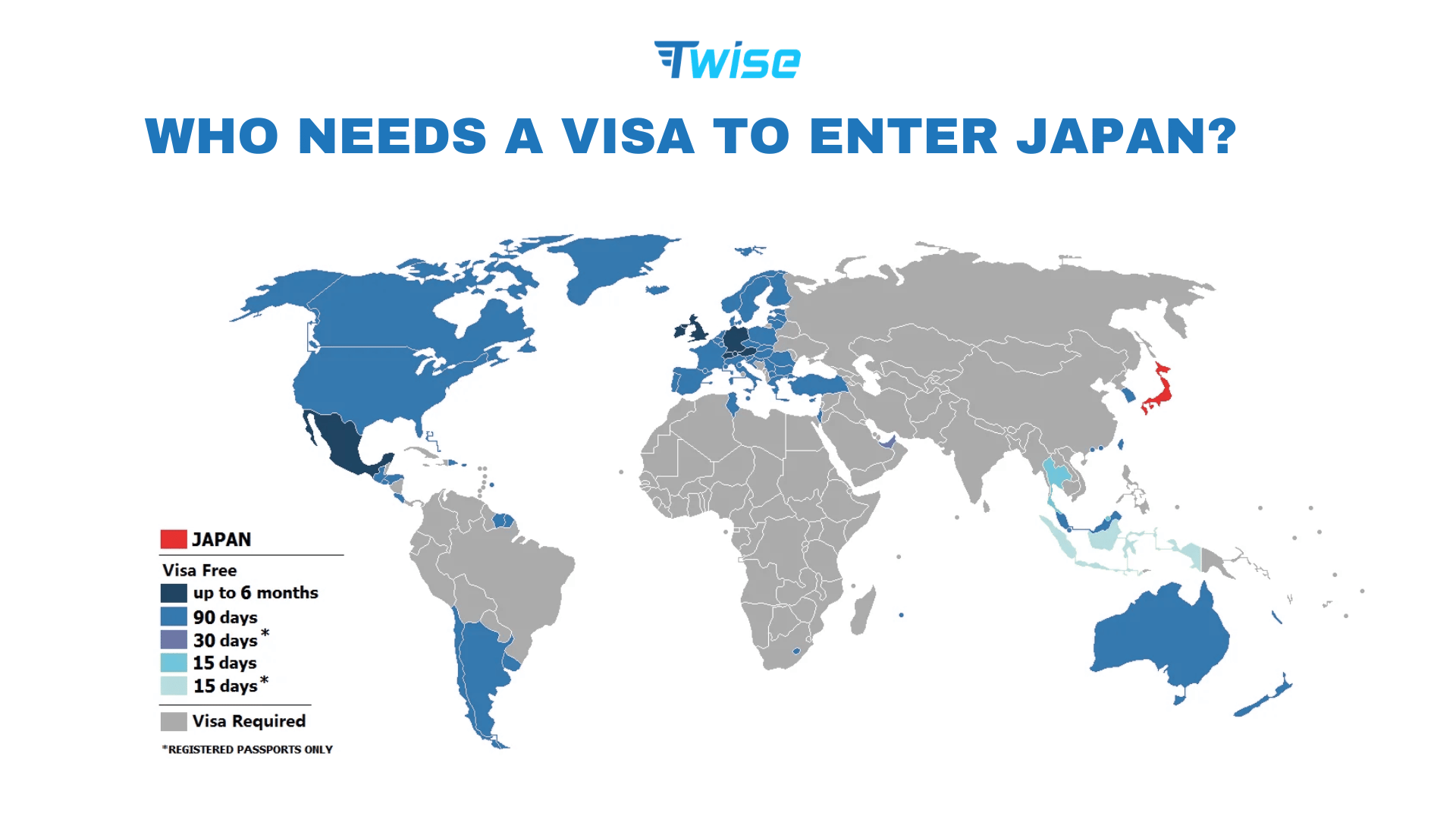
Japan’s visa-free arrangements cover 74 countries and regions, but conditions are not identical for every passport.
North America
Examples include:
- United States;
- Canada.
Europe
Examples include:
- United Kingdom;
- France;
- Germany;
- Italy;
- Spain;
- many other listed European passports.
Oceania
Australia and New Zealand are included.
Asia
Visa-free arrangements include examples such as:
- South Korea;
- Singapore;
- Thailand;
- Malaysia;
- Indonesia.
However, Asian passport conditions vary considerably.
Important special passport conditions
Some exemptions require specific passport types or additional conditions.
For example, certain nationalities need an ICAO-compliant ePassport, while Indonesia’s exemption includes a prior ePassport registration condition. Taiwan’s exemption is limited to qualifying passports with a personal ID number.
How Long Can You Stay in Japan Without a Visa?
| Exemption category | Typical permitted stay |
| Indonesia / Thailand under applicable exemption | 15 days |
| Brunei / Qatar | 30 days |
| Most other exempt countries/regions | 90 days |
| Certain bilateral arrangements | Possible extension beyond 90 days after immigration procedures |
Visa-free does not mean unlimited stay
Your permitted period is determined when you enter Japan.
Some bilateral arrangements can allow stays beyond 90 days only after completing the required immigration extension procedure.
Tourism vs work
A short-stay tourism exemption does not authorize paid work.
If your purpose is employment, study or another long-term activity, different Japan visa requirements apply.
Japan Tourist Visa Requirements If You Are Not Visa-Exempt
There is no single tourist visa document checklist that applies identically to every nationality and country of residence.
Common requirements can include the following.
Valid passport
Your passport must meet the requirements applicable to your visa route.
Avoid assuming a universal six-month validity rule unless the relevant Japanese mission specifically requires it.
Visa application form
Use the current form and instructions applicable to your location.
Recent photograph
Photo specifications may be defined by the relevant mission or application route.
Travel itinerary
You may need to explain where you plan to stay and what you intend to do in Japan.
Accommodation information
Hotel reservations or other accommodation details may be requested.
Evidence of ability to pay for the trip
Applicants may need financial evidence showing they can support their stay.
Flight/reservation information where required
Follow the checklist for your specific visa application rather than purchasing expensive non-refundable travel simply because another applicant did so.
Additional documents requested by the local Japanese mission
Embassies and consulates can request further evidence depending on individual circumstances.
JNTO’s current guidance lists common items including a valid passport, application form, recent photo, itinerary or accommodation information and proof of sufficient funds. See JNTO’s Japan visa guidance
What Is JAPAN eVISA and Who Can Use It?
What JAPAN eVISA is
JAPAN eVISA is an electronic single-entry short-term tourism visa for eligible applicants.
MOFA currently describes the standard eligible stay as up to 90 days, with specific exceptions.
Eligibility depends on residence as well as nationality
This is one of the most important parts of Japan visa requirements to understand.
Being a citizen of a particular country does not by itself guarantee access to the same online application route everywhere.
Examples of eVISA-supported residence locations
MOFA currently lists direct online routes involving residents of locations including:
- Australia;
- Brazil;
- Cambodia;
- Canada;
- Saudi Arabia;
- South Africa;
- Taiwan;
- United Kingdom;
- United States.
Other locations use accredited-agency arrangements. Check official JAPAN eVISA eligibility
Special duration examples
MOFA currently states that:
- Vietnamese nationals residing in Vietnam using the applicable eVISA route receive a 15-day period of stay;
- Filipino nationals residing in the Philippines under the applicable route receive 15 days.
When you cannot use JAPAN eVISA
You may need another visa route when:
- your purpose is not tourism;
- you plan a long-term stay;
- your residence is not eligible;
- your travel falls under another visa category.
JAPAN eVISA vs Visit Japan Web: What’s the Difference?
| Service | Purpose |
| JAPAN eVISA | Issues an electronic visa to eligible travelers |
| Visit Japan Web | Supports arrival procedures such as immigration and customs |
JAPAN eVISA gives eligible travelers a visa
If you require a visa and qualify for the system, JAPAN eVISA is part of your authorization process.
Visit Japan Web helps with arrival procedures
Visit Japan Web is an arrival-processing service, not a replacement for a visa.
Do visa-free travelers still use Visit Japan Web?
Yes.
Visa-free travelers can use Visit Japan Web even though they do not require JAPAN eVISA.
Is Visit Japan Web mandatory?
No.
JNTO currently states that advance Visit Japan Web registration is not required, although it can make some arrival procedures more convenient.
How to Apply for a Japan Tourist Visa
Step 1 — Check whether you are visa-exempt
Start with the official exemption list.
Step 2 — Check JAPAN eVISA eligibility
If you need a visa, determine whether your nationality and residence qualify for an eVISA route.
Step 3 — Identify the Japanese mission responsible for your residence
Applications generally need to go through the mission with jurisdiction over where you live.
Step 4 — Use the correct document checklist
Download the checklist for your nationality, purpose and application location.
Step 5 — Submit via eVISA, embassy/consulate or accredited agency as instructed
The correct submission method varies.
Step 6 — Respond to requests for additional documents
Additional evidence or an interview can sometimes be requested.
Step 7 — Confirm issuance before traveling
Submitting an application does not mean a visa has been approved.
How Long Does a Japan Tourist Visa Take?
MOFA states that the standard examination period is five working days beginning the day after an application is accepted, provided there are no particular issues.
Why applications can take longer
Processing may take longer because of:
- incomplete information;
- additional document requests;
- interviews;
- further examination;
- periods of high application volume.
Some cases can take weeks or longer.
Don’t book around the minimum processing time
Five working days is not a guaranteed turnaround.
Apply with sufficient time before departure.
How Much Does a Japan Tourist Visa Cost in 2026?
For applications accepted at Japanese overseas missions from July 1, 2026, MOFA lists approximately:
| Visa | Approximate fee |
| Single-entry | ¥15,000 |
| Multiple-entry | ¥30,000 |
Actual local-currency fees may vary, and nationality or purpose can affect the amount. Accredited agencies may also charge separate handling fees.
eVISA payment
Online credit-card payment is available through some eligible overseas missions and eVISA arrangements.
Agency fees are separate
A visa fee and an accredited agency’s service charge are not necessarily the same thing.
Do You Need Visit Japan Web Before Flying?
No. Visit Japan Web is not currently mandatory for all tourists.
Pre-registration can nevertheless simplify some arrival procedures.
What you can register
Visit Japan Web supports procedures including:
- immigration;
- customs declaration;
- eligible tax-free shopping functions.
When to complete it
Complete the information before your flight once your required travel and accommodation details are available.
Keep your login accessible
Make sure you can retrieve your account information and relevant QR code after landing.
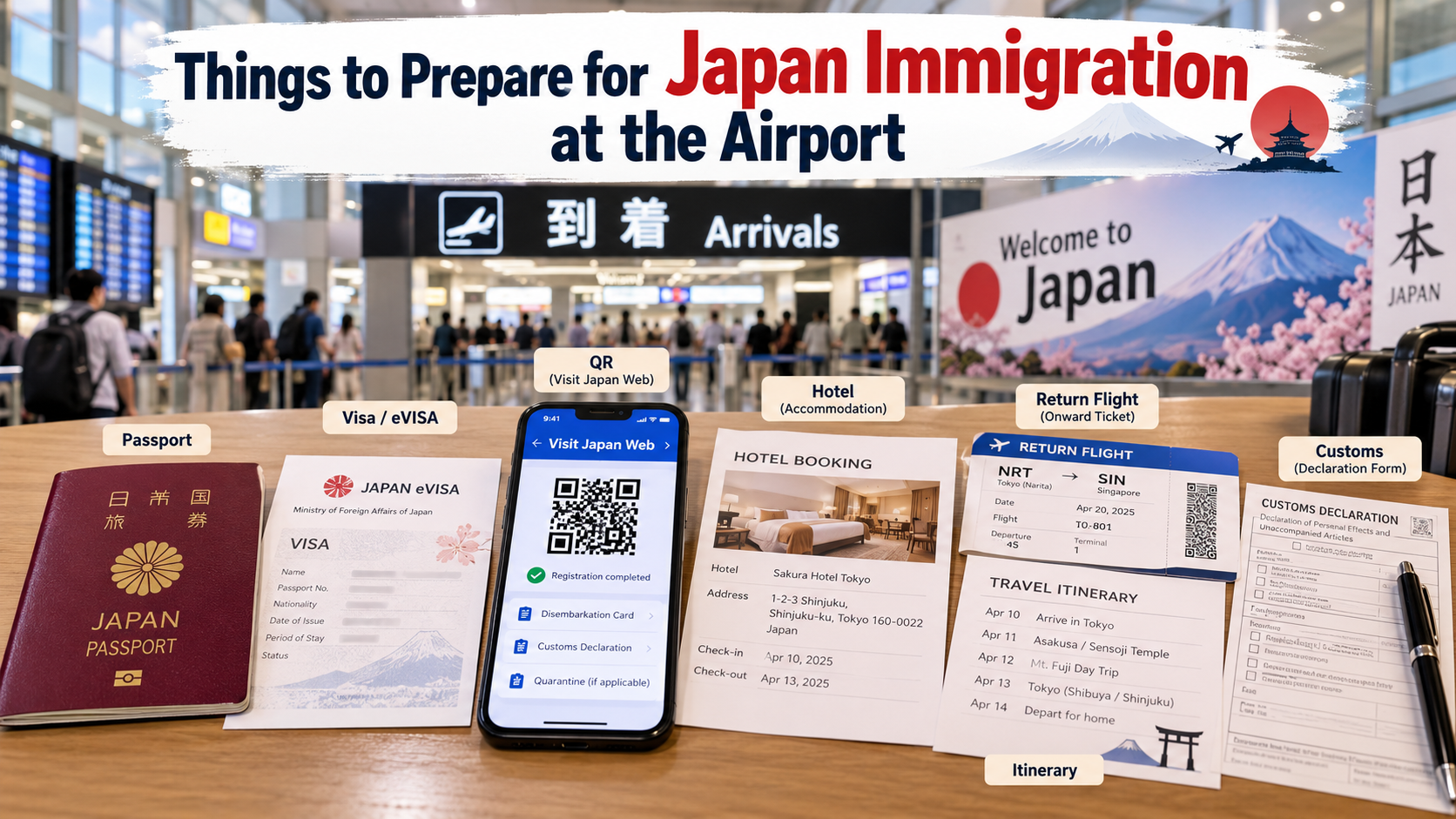
What to Prepare for Japan Immigration at the Airport
Keep relevant travel information easy to access rather than buried inside dozens of emails.
Passport
Carry the passport used for your travel authorization.
Visa or eVISA where applicable
Have the correct visa evidence available if your nationality requires it.
Arrival information / Visit Japan Web QR where used
Keep the relevant QR accessible if you registered.
Accommodation address
Save your first hotel’s address.
Return or onward travel details
Have them accessible if applicable or requested.
Basic itinerary if requested
You may be asked to explain the purpose and general plan of your stay.
Customs declaration
Complete the required customs procedure, digitally or through the available arrival process.
If You Have a JAPAN eVISA, Make Sure You Have Internet Access
This is an unusual but important operational detail.
MOFA states that eVISA holders must display their Visa Issuance Notice in an internet environment at the airport. A PDF, screenshot or printed copy is not accepted as a substitute.
Before leaving for the airport
Make sure you can:
- log into the required service;
- access your account information;
- connect to mobile data or reliable Wi-Fi.
Airport Wi-Fi can be a backup, not your only plan
Airport Wi-Fi is useful, but having an additional connectivity option reduces dependence on one network.
Where a Japan travel eSIM can help
Travelers who want mobile data available around arrival can compare a Twise Japan travel eSIM with roaming, airport Wi-Fi and physical SIM options.
A travel eSIM does not change Japan visa requirements or guarantee entry.
Keep other critical information offline
Save:
- hotel address;
- flight details;
- emergency contacts;
- transport plan.
But remember: an offline screenshot does not replace the live eVISA Visa Issuance Notice requirement.
After Immigration: Where Mobile Data Helps on Your First Day in Japan
Once immigration is complete, connectivity becomes a practical travel tool rather than a visa issue.
You can explore broader Twise travel eSIM options before departure if Japan is part of a larger trip.
Leaving Narita, Haneda or Kansai Airport
Use mobile data for rail routes, airport buses, route changes and hotel navigation.
Hotel check-in
Keep your reservation email, booking app and hotel messages accessible.
Maps and station navigation
Large stations can involve multiple exits and rail operators, making live navigation useful.
Translation
Translation apps help with menus, signs and unexpected conversations.
Train and attraction tickets
Many reservations and digital tickets live on your phone.
Banking or payment verification
A data-only Japan eSIM does not replace your home SIM if your bank requires conventional SMS OTP.
When to rely on offline backups instead
Keep offline information for:
- temporary signal loss;
- rural routes;
- underground areas;
- phone battery failure.
Common Japan Visa Mistakes to Avoid
Assuming every tourist gets 90 days
Some exempt travelers receive 15 or 30 days instead.
Using an unofficial eVISA website
Use official government channels or approved agencies.
Confusing Visit Japan Web with the visa application
They serve different purposes.
Following a generic six-month passport rule without checking official guidance
Use the actual requirement for your passport and application route.
Assuming five working days is guaranteed
It is a standard processing period, not a promise.
Using an outdated visa-fee article
Japan’s visa fees changed for applications accepted from July 1, 2026.
Screenshotting the eVISA notice and assuming that is sufficient
MOFA requires the live Visa Issuance Notice to be displayed in an internet environment.
Applying through the wrong jurisdiction
Where you legally reside can affect where you must apply.
Booking non-refundable travel before understanding your visa pathway
Confirm whether you are visa-exempt, eVISA-eligible or need a conventional application first.
FAQs About Japan Visa Requirements
US passport holders are currently covered by Japan’s short-stay visa exemption for qualifying visits, generally with up to 90 days granted upon landing.
UK passport holders are currently visa-exempt for qualifying short stays. Special bilateral provisions exist for longer stays, but additional immigration procedures are required beyond the normal landing period.
Trip length alone does not determine Japan visa requirements. Your passport nationality, travel purpose and relevant exemption or visa pathway determine whether advance authorization is required.
No. JNTO currently says advance registration is not required, although it can streamline arrival procedures.
Some travelers can use JAPAN eVISA. Eligibility depends on nationality, residence and the application arrangements of the Japanese mission responsible for your location.
MOFA’s standard processing period is five working days from the day after acceptance for straightforward applications. Additional checks can make processing considerably longer.
For applications accepted from July 1, 2026, MOFA lists approximate fees of ¥15,000 for single-entry and ¥30,000 for multiple-entry visas. Different fees or exemptions can apply.
Understanding Japan visa requirements before booking reduces the risk of building a trip around the wrong entry assumption. First determine whether your passport is visa-exempt, then check eVISA eligibility or the responsible Japanese mission if an application is required. After that, prepare arrival information, reliable access to any digital visa evidence and offline copies of essential travel details. Visa rules and connectivity serve different purposes, but both are easiest to manage before you reach the airport.
