


Lebara Network Bands in Europe Explained: What Travelers Should Check Before Buying a Europe eSIM
Oct
If you are buying a Europe eSIM connected through Lebara, your phone needs more than eSIM support. It should also be carrier-unlocked and compatible with the network technologies used by the specific Lebara plan and its local host network.
Most recent mainstream iPhones, Samsung Galaxy flagships and Google Pixel phones support the main European LTE and 5G frequencies. Older phones, imported models and regional variants deserve a closer check.
There is one important difference from carriers such as Vodafone or Orange: Lebara does not operate one mobile radio network across Europe. It is an MVNO, and the underlying network varies by country. Lebara says it directly operates in the UK, Netherlands, Germany, France and Denmark, with licensed Lebara brands in additional markets including Spain and Switzerland.
This guide explains what that means for Lebara network bands, eSIM compatibility and your phone.
Already checked your phone? Compare Europe eSIM plans.
What Are Network Bands and Why Do They Matter?
Mobile networks use different radio-frequency ranges called bands. Your phone must support relevant bands to communicate properly with the local network.
eSIM support means your phone can store and use a digital SIM profile. Network-band support means your phone’s hardware can connect to the mobile frequencies used by the carrier.
They are related, but they are not the same.
For example, your phone may successfully download a Lebara eSIM while lacking a useful low-frequency LTE band used by the host network in your destination. Modern international flagships generally support many European bands, while some older or region-specific phones support fewer.
Twise note: When an eSIM does not work after arrival, missing bands are only one possible cause. Twise support also checks carrier lock, which SIM is selected for mobile data, Data Roaming, APN configuration, network selection and activation status.
Lebara Network Bands: What Travelers Should Know
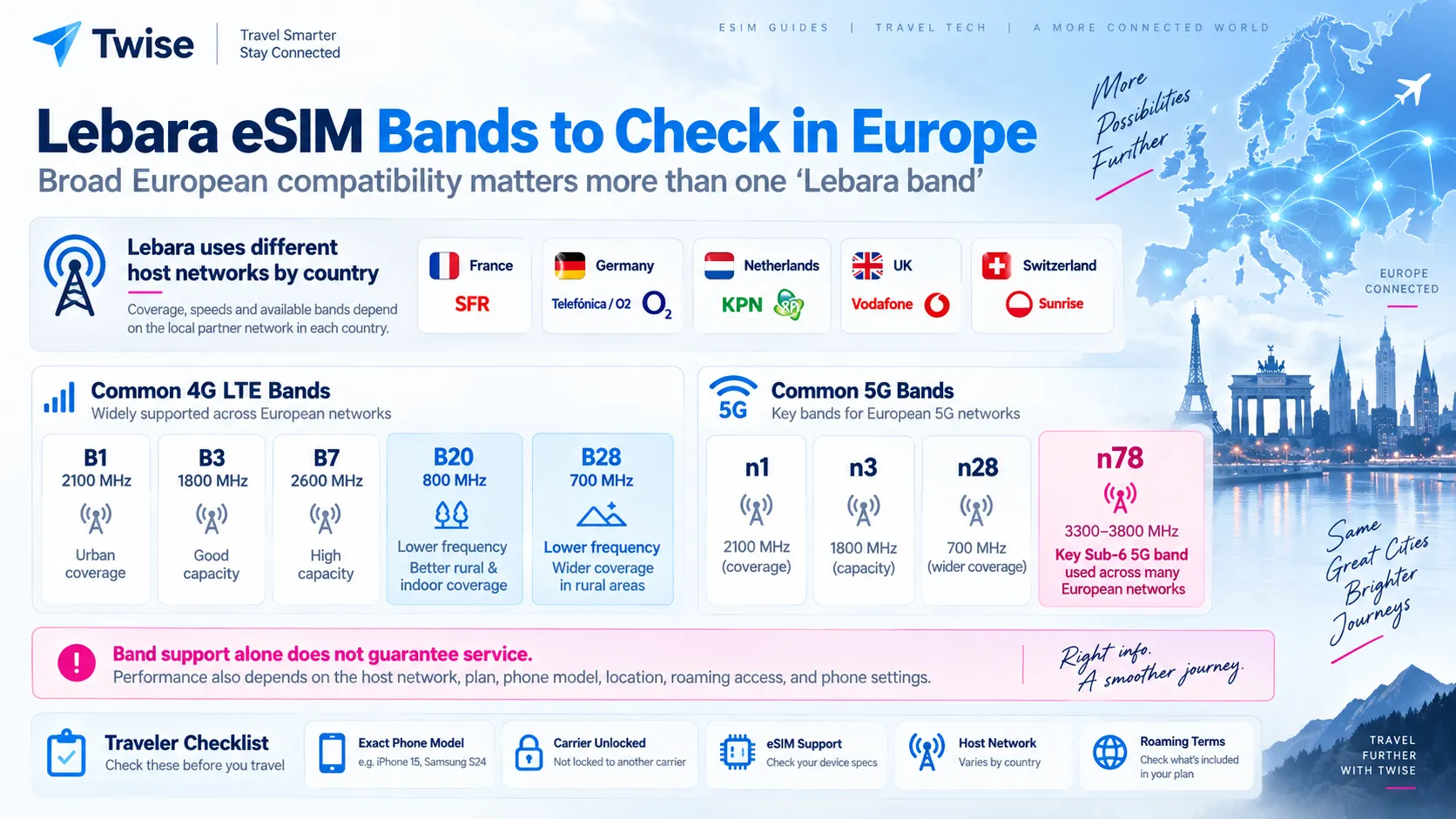
There is no single Europe-wide Lebara frequency table.
Lebara uses another operator’s radio network in each market. Current official Lebara pages identify SFR in France, Telefónica/O2 in Germany, KPN in the Netherlands and Vodafone in the UK. The Swiss Lebara brand uses Sunrise.
That makes the destination—and sometimes whether you are using a domestic plan or roaming—more important than a generic “Lebara band” specification.
| Market / layer | What travelers should understand |
| France – LTE/4G | Lebara uses SFR. SFR identifies 800, 1800, 2100 and 2600 MHz among its 4G+ layers—commonly corresponding to LTE B20, B3, B1 and B7. |
| France – 5G | SFR currently identifies 2100 MHz and 3.5 GHz 5G layers, corresponding to n1 and n78. |
| Germany – LTE/5G | Lebara currently uses Telefónica/O2. Telefónica operates LTE across several frequency layers and uses a mix of spectrum for 5G. |
| Germany – 5G | Telefónica identifies 700 MHz, 1800 MHz DSS and 3.6 GHz among its 5G resources—commonly n28, n3 and n78. |
| UK | Lebara operates on Vodafone. Vodafone has historically combined LTE resources including 800, 2100 and 2600 MHz; current band availability depends on location and network deployment. |
| Netherlands | Lebara currently uses KPN’s 5G network; check the current KPN network and exact phone specifications rather than assuming another Lebara country’s bands apply. |
| Switzerland | Lebara operates over Sunrise’s 4G/5G network; this is another example of why “Lebara bands” differ by country. |
SFR officially lists 800, 1800, 2100 and 2600 MHz for its 4G+ network and 2100 MHz plus 3.5 GHz for 5G. Telefónica Germany, meanwhile, documents 700 MHz, 1800 MHz and 3.6 GHz in its current 5G mix.
Date checked: September 18, 2026 | Sources checked: Lebara official / SFR / Telefónica-O2 / Vodafone / KPN-Lebara / Sunrise-Lebara / Apple / Google manufacturer specifications.
What bands are most useful on a Europe travel phone?
Instead of looking for one special “Lebara band,” travelers should look for broad European compatibility.
Commonly useful LTE bands include B1 (2100 MHz), B3 (1800 MHz), B7 (2600 MHz), B20 (800 MHz) and B28 (700 MHz). For 5G, bands such as n1, n3, n28 and n78 are relevant across various European network deployments.
Current international iPhones support a broad range that includes these LTE and 5G bands. Recent global Pixel models similarly support B1/B3/B7/B20/B28 and Sub-6 5G bands including n1/n3/n28/n78.
Supporting these frequencies improves flexibility, but one matching band does not guarantee a connection. The plan, host network, provisioning, location, congestion and phone configuration also matter.
eSIM Compatibility and Lebara Network Compatibility Are Not the Same
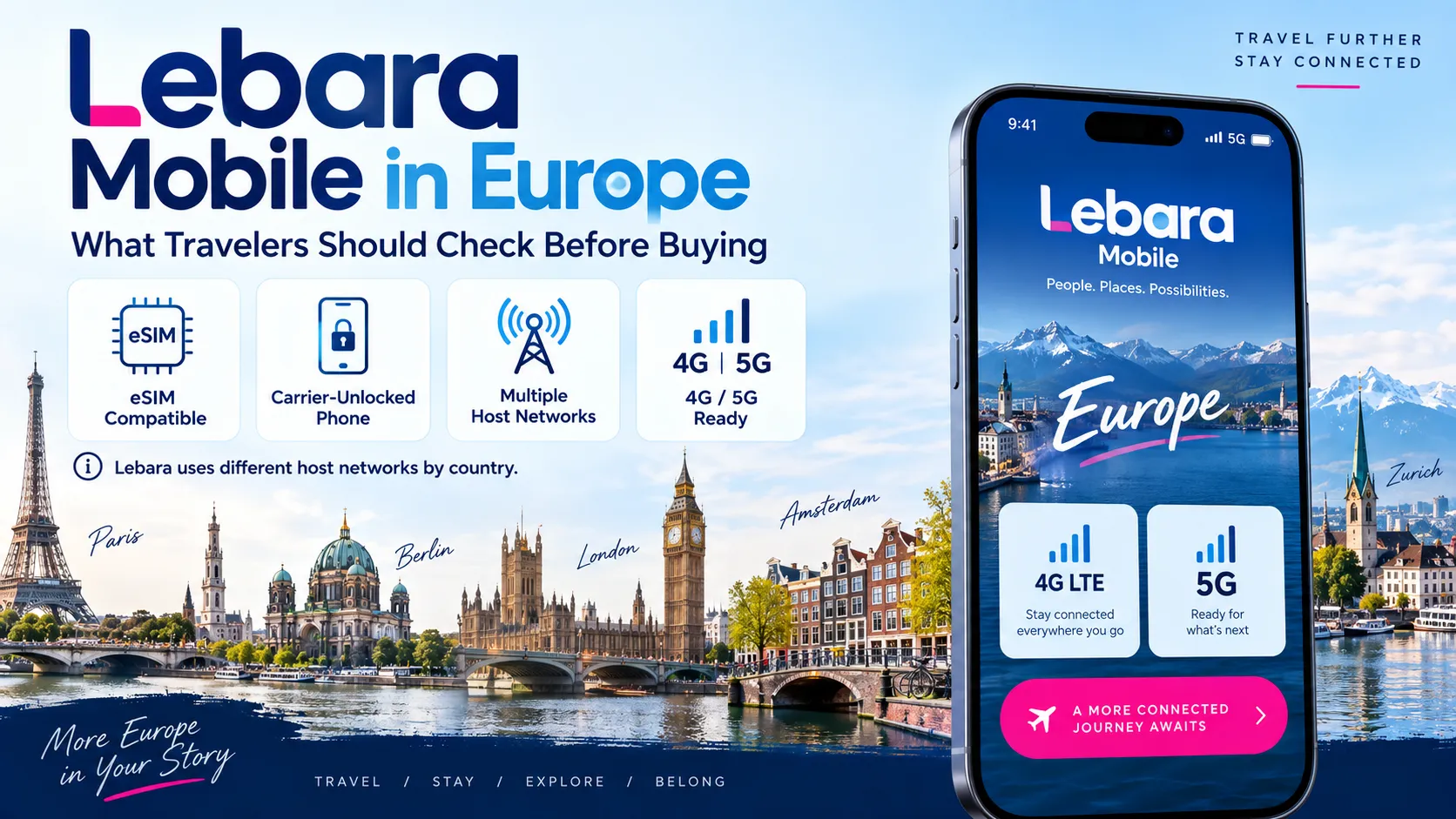
There are two separate questions:
Can your phone install an eSIM?
And:
Can your exact phone model connect effectively to the host network used by that Lebara plan?
You need both.
Apple’s current European carrier-support information, for example, lists features such as LTE, 5G and eSIM for major Lebara host networks including SFR in France and O2 in Germany. But that does not mean every feature available directly from a host carrier is automatically available on every Lebara MVNO plan.
Lebara France itself currently offers eSIM and runs its plans over SFR, while Lebara Germany advertises eSIM and 5G over Telefónica.
Think of eSIM compatibility as the digital-SIM part. Network compatibility is the can-this-phone-connect-to-the-local-radio-network part.
Both need to work together.
Check whether your phone supports eSIM.
How to Check If Your Phone Can Work With a Lebara-Based Europe eSIM
1. Check your exact phone model
Do not stop at “iPhone 15,” “Galaxy S24” or “Pixel 9.”
Check the exact model number and regional version. US, European, mainland Chinese and other regional variants can have different eSIM configurations or supported frequencies.
2. Confirm your phone supports eSIM
Look for Add eSIM or Add Cellular Plan in Settings, then verify your exact model using the manufacturer’s official specifications.
You can also use Twise’s eSIM compatibility guide.
3. Make sure the phone is carrier-unlocked
A carrier-locked phone may reject another eSIM even if its modem supports every relevant European network band.
If you bought your phone through a carrier, confirm its unlock status before departure.
4. Check LTE and 5G expectations
For a Europe trip, broad LTE compatibility—particularly common bands such as B1/B3/B7/B20/B28—is generally more useful than matching one isolated frequency.
If you specifically want 5G, broad Sub-6 support including n1/n3/n28/n78 gives the phone more options across European networks. Exact use still varies by country and host carrier.
5. Check the actual Lebara plan
This is especially important with Lebara.
Confirm:
- whether it is a travel eSIM or local country plan,
- which country/network the product is based on,
- data allowance,
- EU roaming allowance,
- 4G or 5G access,
- hotspot rules,
- phone number/calls/SMS,
- APN requirements,
- activation location and timing.
For example, Lebara France currently states that its domestic eSIM can only be activated from metropolitan France.
Product-page details override general network-band guidance.
Do Travelers Really Need 5G for a Europe eSIM?
Not always.
LTE can comfortably support Google Maps, WhatsApp, translation, railway apps, ride-hailing, hotel messages, email, browsing and normal social-media use.
| Traveler type | Is 5G essential? | What matters more |
| Maps + messaging | No | Stable LTE and roaming coverage |
| Social media | Usually no | Data allowance |
| Remote work | Helpful | Hotspot, data and stability |
| Video streaming | Helpful | High-speed allowance and FUP |
| Short city trip | Usually no | Easy activation and validity |
| Older phone | No | LTE bands and unlock status |
5G becomes more useful for larger uploads, intensive hotspot use, cloud work and high-quality streaming.
From a support perspective, the better first question is:
“Will this plan work with my phone, cover the countries on my trip and give me enough data?”
That is more useful than choosing solely because a product says “5G.”
Common Compatibility Mistakes Travelers Make Before Buying a Europe eSIM
1. Checking eSIM support but not carrier lock
Seeing Add eSIM does not prove that the device will accept another carrier’s profile.
2. Assuming Lebara uses one network everywhere in Europe
It does not. Lebara is an MVNO and its host network varies by market. France currently uses SFR, Germany uses Telefónica, the Netherlands uses KPN and the UK uses Vodafone.
3. Assuming 5G is required
For many tourists, LTE is enough. Band compatibility, roaming coverage, data allowance and validity may matter more.
4. Confusing data-only eSIM with local phone service
A data-only Europe eSIM does not automatically provide a European number, cellular calls or SMS.
Conversely, some local-carrier-style products do include voice and SMS. Twise currently lists both data-only Europe plans and carrier-style options, including a Lebara local Europe eSIM.
See Europe eSIM with phone number if conventional calls or SMS matter.
5. Forgetting roaming or APN settings
If the eSIM installs but has no internet, check:
- the correct data line is selected,
- Data Roaming is enabled when required,
- the APN matches the plan instructions,
- automatic network selection,
- activation status,
- whether restarting the phone is required.
Lebara Germany, for example, publishes separate APN instructions for normal and roaming use.
Twise Support Insight: “No Internet” does not automatically mean your phone lacks European network bands. Carrier lock, roaming, APN, activation and the selected data line are normally worth checking first.
What to Check Before Buying a Lebara-Connected Europe eSIM
- Exact phone model and regional variant.
- eSIM support.
- Carrier-unlocked status.
- Whether LTE is enough or you specifically want 5G.
- Hotspot requirements.
- Whether you need a European phone number.
- Which host network the plan actually uses.
- Activation timing and location requirements.
- Validity and countries included.
- Data allowance, roaming cap and fair-use rules.
When a Lebara-Based Europe eSIM Is a Good Fit
A Lebara plan can make sense for travelers with an unlocked, compatible phone who want mobile connectivity for maps, WhatsApp, translation, transport apps, hotel communication and bookings.
A local Lebara-style plan may be particularly relevant if you also want conventional phone features, but these vary by product and market.
For multi-country travel, look beyond the Lebara name. Check the roaming countries, allowance, host network, phone-number features and activation rules of the exact plan.
Twise Europe eSIM Options for Travelers
Twise offers several Europe eSIM formats, including data-only regional plans and local-carrier-style options. Its current shop also lists a Europe Local eSIM Lebara – 10 Euro Package.
For light users, focus on enough data for maps, messages and bookings.
For heavy users, compare larger allowances, hotspot support and fair-use limits.
For travelers needing a phone number or calls, check the voice/SMS specifications rather than assuming all Europe eSIMs are data-only.
For short trips, prioritize activation timing and validity. For longer or multi-country trips, compare roaming countries and usable data across the entire itinerary.
Always check the current product page before purchase because plan specifications can change.
Check Your Phone Before Choosing a Europe eSIM
Lebara network compatibility in Europe is not about finding one magic band.
Check your exact phone model, eSIM support and carrier-unlocked status, then identify the host network and roaming rules for the particular Lebara plan and countries you will visit.
Broad European LTE support—including B1/B3/B7/B20/B28—is useful, while n1/n3/n28/n78 support gives a recent phone broader 5G flexibility. But the product’s actual network access and terms matter more than a specification sheet alone.

FAQs About Lebara Network Bands and Europe eSIM Compatibility
It needs to support the relevant bands of the host network used in your destination. There is no single Europe-wide Lebara radio-band set.
No. Also check carrier lock, exact regional model, local network compatibility and the plan’s activation requirements.
Usually not. LTE is sufficient for most everyday travel tasks. Choose 5G when additional speed matters and your device, plan and local network support it.
Check the selected data line, Data Roaming, APN, network selection and activation status. Carrier lock or device compatibility may also need investigation.
Yes, internet-based apps work over mobile data. A data-only eSIM does not automatically include a local phone number or conventional SMS.
Buying before departure can give you time to confirm compatibility and read the setup instructions. However, check the exact activation rule: some local products have country-specific activation requirements.
Buying before departure can give you time to confirm compatibility and read the setup instructions. However, check the exact activation rule: some local products have country-specific activation requirements.
More Helpful Tips For Your Europe Journey
Best Apps for Travel in Europe: Maps, Trains, Translation, Payments & eSIM Setup
How to Make Calls in Europe with a Local Europe eSIM
Locking Into the Fastest eSIM Europe 5G Networks on iPhone 16 and Android Ultra Devices
Orange Network Bands Explained: What Travelers Should Check Before Buying a Europe/France eSIM
Vodafone Network Bands in Europe Explained: What Travelers Should Check Before Buying a Europe eSIM
