

 Tiếng Việt
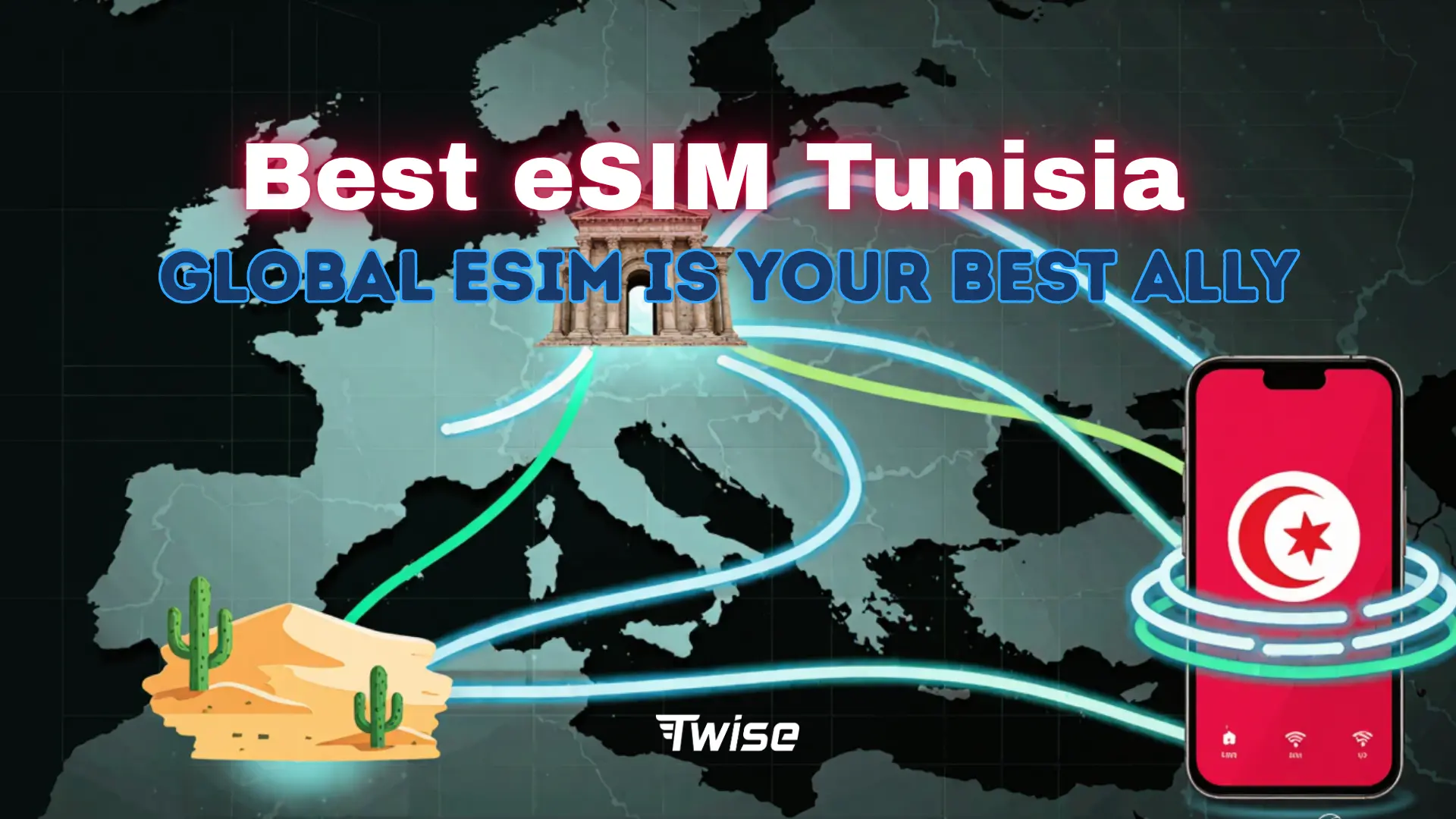
Tunisia is one of the Mediterranean’s most rewarding destinations — a country where Roman ruins brush up against Saharan dunes, and where the cobblestone medinas of ancient Carthage give way to turquoise coastlines that stretch toward Djerba. That is exactly why getting a Tunisia eSIM before you board your flight is one of the most sensible travel decisions you will make. With eSIM Tunisia solutions now available from global providers like Twise, you can skip the airport kiosk entirely, activate your data from the plane, and step off at Tunis-Carthage Airport already connected.
The problem most travelers encounter is not a lack of options — it is the friction involved in getting those options to work. Local SIM cards in Tunisia require documents, patience, and a working knowledge of French or Arabic menus. A smarter, modern solution exists, and it fits inside your phone before you even pack your bag.
The Orange Heritage: European Reliability on African Soil
When you travel internationally, network quality is everything. Twise’s Global eSIM connects you to Orange Tunisia — not an obscure regional operator, but the Tunisian arm of the global Orange Group headquartered in France. This heritage matters more than it might first appear.
Orange has built and maintained its Tunisian infrastructure to standards that closely mirror what you would expect in Western Europe. The same reliability that powers mobile networks across France, Spain, and Poland has been extended to Tunisia’s coastline, its urban centers, and — crucially — its remote southern regions.
The Coastal vs. Desert Balance
Tunisia is geographically diverse in a way that tests network infrastructure. The north and east coast — Tunis, Sousse, Hammamet, Sfax — is densely populated, heavily touristed, and well served by fast 4G LTE. On Orange Tunisia, you can expect smooth video calls, responsive navigation apps, and near-instant social media uploads throughout these urban and coastal zones.
The real differentiator comes further south. In Tozeur, Douz, or the remote villages near Matmata — where many visitors go specifically to see the iconic Star Wars filming locations — cellular coverage becomes genuinely critical. Not for Instagram, but for GPS navigation across featureless desert roads where getting lost is more than a minor inconvenience. Orange Tunisia’s infrastructure investment in these regions provides the signal stability needed for GPS to function reliably, for emergency contacts to remain reachable, and for maps to keep loading even as the landscape empties out around you.
Read more:
How to check Roaming Data Consumption on iPhone and Android
Premium International Peering
There is a technical reason why Twise chooses Orange over smaller Tunisian operators like Ooredoo Tunisia or Tunisie Telecom when serving international travelers. As a member of the global Orange Group, Orange Tunisia benefits from premium international data peering agreements — the behind-the-scenes infrastructure that determines how quickly your data packets travel between Tunisia and the servers your favorite apps live on. The practical effect is that streaming, video calling, and loading data-heavy apps (Google Maps with satellite view in the desert, for example) simply works faster and more consistently than on networks without those global connections.
The “Euro-Med” Traveler’s Logic: One eSIM for the Whole Loop
Tunisia does not exist in a travel vacuum. A large proportion of visitors arrive as part of a broader Mediterranean itinerary — a ferry crossing from Palermo or Genoa, a flight connection through Paris Charles de Gaulle, Istanbul Atatürk, or Frankfurt, or a multi-country loop that might include Morocco, Malta, or Greece.
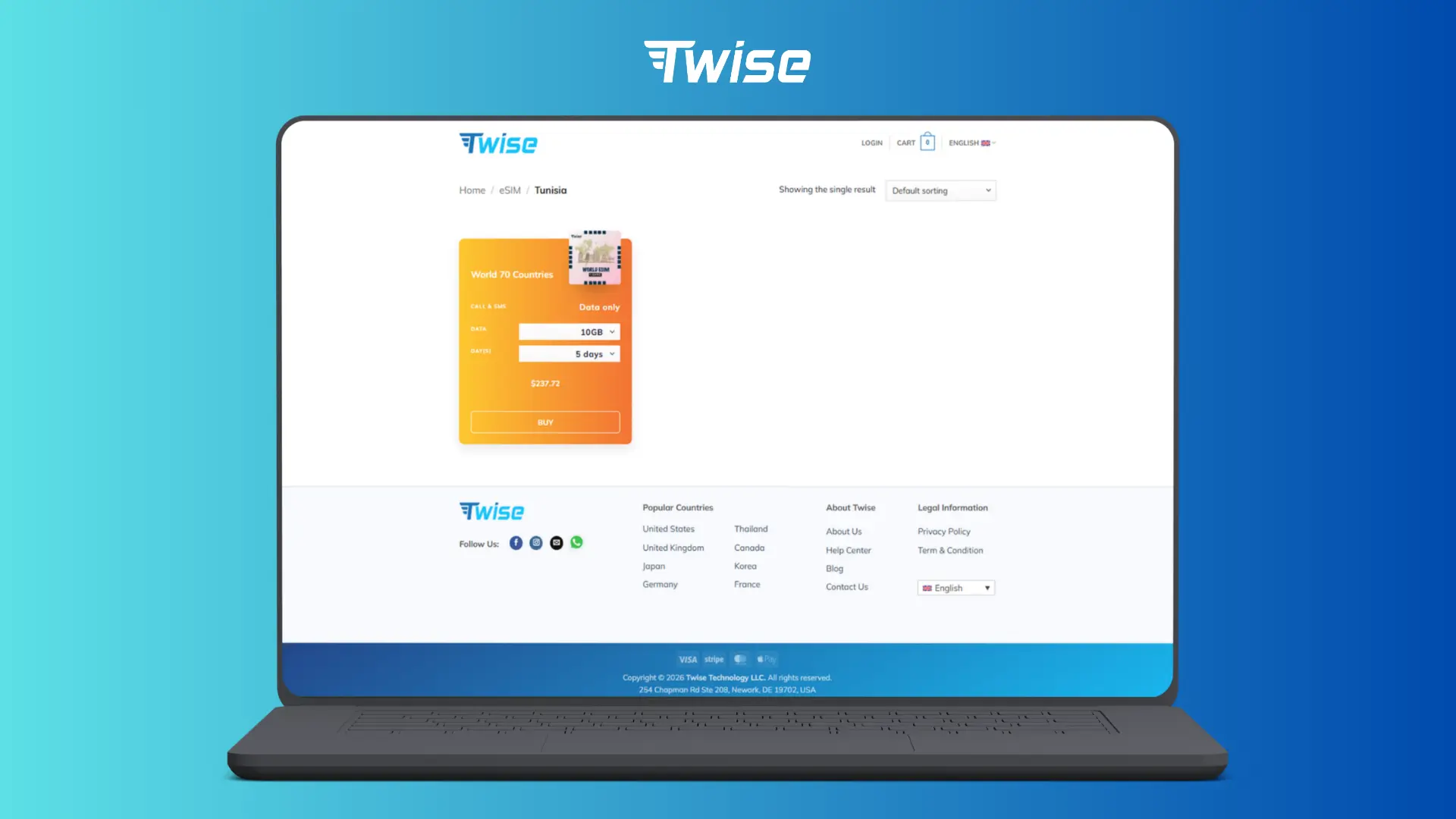
This is where the Twise Global eSIM offers an advantage that no local SIM can match: it covers 70 countries on a single plan. Your data works on the streets of Rome before you board the ferry. It works on the deck of the crossing itself. It works the moment you dock at La Goulette, Tunis’s historic port. And it keeps working when your return flight connects through Istanbul or Paris. One purchase. One activation. Zero switching between providers, zero juggling multiple SIM cards, and zero roaming surprises.
For travelers who view Tunisia as a destination within a larger journey — and many do — the Twise Global eSIM is not just convenient. It is the economically rational choice. The cost of buying a local SIM in Tunisia, another in Italy, and paying roaming fees through European airports adds up quickly. A single global plan eliminates all of that friction at a price point that routinely undercuts the total of those fragmented alternatives.
Read more:
Install eSIM on iPhone: A Step-by-Step Guide
Installing eSIM on Android Phones: A Step-by-Step Guide
Tunisia-Specific Technical Peace of Mind
Bypassing the Language Barrier
Navigating a Tunisian telecom provider’s interface — whether at a kiosk in the airport or a retail outlet in the medina — typically means working in French or Arabic. For travelers who speak neither language fluently, this creates genuine friction: uncertain top-up processes, unclear data balance displays, and no straightforward path to customer support if something goes wrong.
Twise is managed entirely in English. Your purchase, your QR code activation, your data balance, and any support interaction all happen through a clean, simple English-language interface. This alone makes the experience categorically different from managing a local Tunisian SIM as a foreign visitor.
Essential App Synergy in Tunisia
Bolt in Tunis: The ride-hailing app Bolt has effectively replaced traditional taxis for most visitors navigating Tunis, Sousse, and other major cities. Like any GPS-dependent service, Bolt’s accuracy depends heavily on the quality of your data connection. A weak or intermittent signal causes the dreaded “GPS jump” — where the app shows your location drifting several streets away from where you actually are, causing drivers to circle or give up. On the Orange network via Twise, the connection is stable enough to eliminate this problem in practice, meaning your driver sees exactly where you are and arrives without confusion.
Secure Browsing on Public Wi-Fi: Tunisia’s public Wi-Fi hotspots — in cafés, hotel lobbies, and tourist sites — are largely unencrypted. Using them for banking, email, or any service with a saved password carries real security risks. Using your Twise eSIM on Orange’s cellular network instead provides a private, secure data channel that third parties cannot intercept. This is particularly relevant for longer stays where the temptation to rely on free Wi-Fi increases.
WhatsApp, iMessage, and Telegram: Because the Twise eSIM is a data-only connection that sits alongside your original home SIM in a dual-SIM setup, your home number remains active for calls and SMS. Your contacts can still reach you normally. All your messaging apps continue to work on your familiar number. You get the best of both worlds: international data coverage without sacrificing your existing mobile identity.
A Note on Data Roaming Settings
One practical step that catches travelers off guard: when you activate a roaming eSIM like Twise, you must ensure that Data Roaming is switched ON in your phone’s settings. This is the handshake that allows the eSIM to connect to Orange Tunisia’s towers. Without it enabled, the eSIM will install correctly but produce no data. It takes ten seconds to check, but it is the single most common reason travelers think their eSIM is not working when it actually is.
Comparative Insight: The True Cost of a Local SIM
It is worth being honest about the economics. A physical SIM from a Tunisian operator like Orange, Ooredoo, or Tunisie Telecom will almost always cost less in pure data-per-dinar terms than a global eSIM plan. If price-per-gigabyte is your only metric, a local SIM wins on paper.
But price-per-gigabyte is not the full picture. Here is what the true cost of a local SIM actually includes:
Time: Getting a local SIM in Tunisia at Tunis-Carthage Airport or a city-center shop typically takes between one and two hours when you factor in queues, documentation checks, and setup assistance. That is one to two hours subtracted from your first vacation day — a day you were planning to spend at the Bardo Museum or the ruins of Carthage, not at a telecom counter.
Documentation Risk: Activating a local SIM in Tunisia requires presenting your passport and sometimes providing a local address. This means your passport data is being scanned and stored by a third-party operator under Tunisian data protection regulations — a privacy consideration that many travelers overlook entirely.
Geographic Limitation: The local SIM stops working the moment you cross into Algeria, Libya, or catch your ferry back to Italy. If you have any leg of your journey outside Tunisia, the SIM becomes a sunk cost or an inactive card in your pocket.
The Twise Global eSIM, by contrast, is purchased in under 30 seconds from anywhere in the world, requires no document sharing beyond your payment details, activates via a QR code scan, and works across 70 countries without any additional steps. For most international travelers, the real-world value of that convenience comfortably justifies the price difference.
Get Your Tunisia eSIM Before Arrival
Maximize Your Experience: Tunisia’s Digital Ecosystem
Tunisia has a vibrant and growing digital infrastructure, particularly in its northern cities, and the right connectivity setup lets you take full advantage of it.
For getting around: Bolt is the essential tool in Tunis and other major cities, and Google Maps works reliably across Tunisia — even in the south, where offline map downloads are a sensible backup for truly remote stretches. Both perform significantly better on a stable cellular connection than on the inconsistent Wi-Fi most hotels provide.
For communication: The dual-SIM approach — Twise eSIM handling all data, home SIM handling calls and SMS — means you never face the dreaded roaming bill shock on your home number. Your home operator’s rates for calls and texts from Tunisia can be eye-watering. By keeping that SIM in data-off mode and routing everything through Twise’s data connection, you keep full control over what you spend.
For exploration: Real-time navigation through the narrow streets of Sidi Bou Said, live translation of Arabic menus in a Djerba restaurant, spontaneous accommodation searches in the Matmata caves — all of these rely on data being available exactly when you need it. With a reliable eSIM already activated, they work seamlessly from day one.
Tunisia rewards the prepared traveler. Its landscapes range from one of North Africa’s most cosmopolitan capitals to some of the most dramatic desert scenery on the planet — and navigating between them comfortably requires reliable data connectivity at every stage. The choice between wrestling with a local SIM registration and arriving already connected, on a trusted global network, is increasingly obvious.
From the turquoise waters of Djerba to the ochre dunes outside Douz, from the Star Wars canyon sets of Matmata to the ancient harbor at La Goulette, the Orange network via Twise provides the signal quality and geographic reach to support every part of a Tunisian adventure. And with 70 countries covered on a single plan, your connectivity extends seamlessly to every layover, ferry crossing, and onward destination in the loop.
Tunisia is a land of genuine adventure. Don’t let connectivity be the thing that holds you back.
Ready to explore the Sahara fully connected? Get your Twise Global eSIM now — activate in 30 seconds, connect from the moment you land.

FAQs
Twise travel eSIMs can be purchased digitally without Twise requiring a local SIM-shop registration process. For applicable travel plans, no ID/KYC registration is required on Twise’s side, though requirements can differ for locally issued carrier products.
Install your Twise eSIM over stable Wi-Fi before traveling when the plan instructions allow it. Twise provides QR-code or manual installation details digitally, but activation timing can vary by plan, so check the activation policy before installing too early.
Yes, if you select a Twise global or regional plan that includes all of those destinations. Current Twise global products include Tunisia alongside Spain and the UAE, allowing supported multi-country travel without installing a new eSIM at every border.
Yes, on a compatible dual-SIM phone. You can use the Twise eSIM for travel data while keeping your regular SIM available for calls, SMS, or banking codes; consider disabling data roaming on your home line to avoid unwanted roaming charges.
More Helpful Tips for Your Tunisia Journey
- How to Call and Text Without Roaming Charges While Traveling
- Does FaceTime Use Data? How Much Data FaceTime Uses When Traveling
- How Much Does a Travel Hotspot Cost? Pocket Wi-Fi vs Phone Hotspot vs eSIM
- How Much Data Does YouTube Use? 480p, 720p, 1080p & Travel Data Tips
- How Much Data Does Spotify Use Per Hour? Travel Data Guide