


Canada eSIM Data Only: How to Choose the Right Plan
Sep
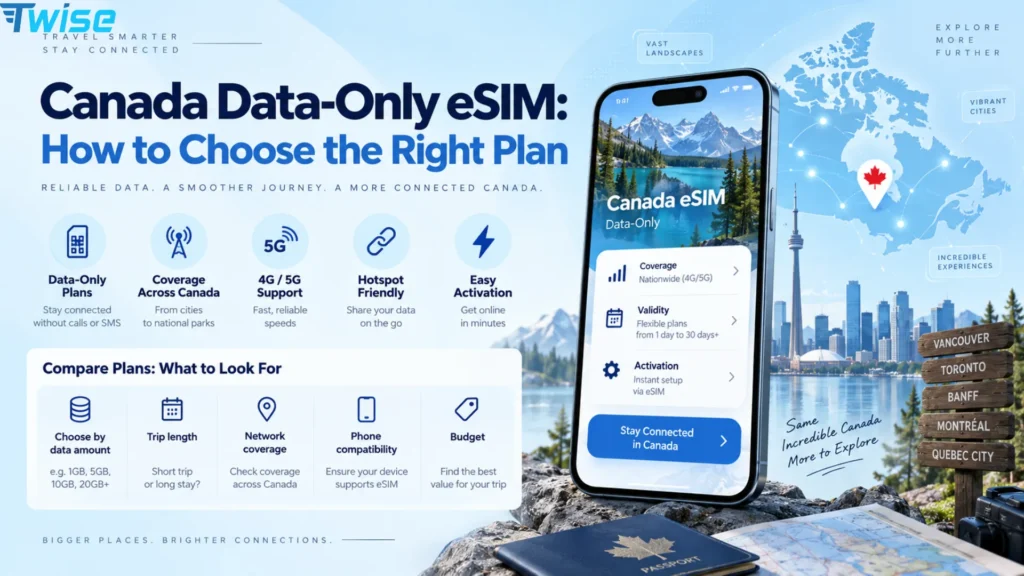
A Canada eSIM data only gives your phone mobile internet without a Canadian phone number, voice minutes or SMS. It suits travelers who mostly use apps such as maps, WhatsApp, Uber and booking tools. The right plan depends on three things: how long you stay, how much data you use, and whether you also visit the USA or Mexico. If you need a Canadian number or regular cellular calls, a local eSIM with voice and SMS is the better fit.
Quick answer
- Best for: maps, messaging apps, ride-hailing, email, booking apps
- Not included: traditional calls, SMS, a new phone number
- Choose between: daily allowance, fixed GB, or a North America plan
- Before you buy: confirm eSIM support and that your phone is carrier-unlocked
What Is a Canada Data-Only eSIM?
A data-only eSIM is a digital SIM profile you install by scanning a QR code. It gives your phone a mobile data connection through a Canadian network partner. It works as a second connectivity layer next to your home SIM, so you do not have to replace your home line.
What “data only” means. Mobile data is included. Standard carrier voice, SMS and usually a new phone number are not. Calling and messaging over the internet still work through apps like WhatsApp, FaceTime, Messenger, Signal or Teams, because those use your data connection instead of the phone network.
Can you keep your normal number? Yes. On a dual-SIM phone, use the Canada eSIM for mobile data and keep your home SIM switched on for your number. Your home carrier’s roaming charges may still apply to calls and SMS, so check its terms before you leave.
Who Should Choose a Data-Only Plan?

Tourists who mainly use apps. Google Maps or Apple Maps, translation, restaurant searches, transit and ride apps, boarding passes, accommodation apps and social media all run on data alone. For most sightseeing trips this covers nearly everything.
Travelers who keep their home SIM for banking codes. Some banks and services send verification codes by SMS to your home number. With a dual-SIM setup, that number stays reachable while the eSIM handles internet. One warning: turn off data roaming on your home line, or your phone may still use it and produce unexpected roaming charges.
When data-only is not enough. Consider a local plan with calls and SMS if you need:
- a Canadian or North American number for hotels, tours, deliveries or work
- regular cellular calls, not just app calls
- services that only send SMS to a local number
Twise also sells local eSIMs with voice and SMS for the USA, so you can compare both types on one site. See our [local eSIM plans] for options with a number. (Link to the local eSIM category page.)
How to Choose the Right Plan
1. Match validity to your trip
Compare validity separately from the total data allowance. A 5–7 day visitor, a two-week traveler and someone staying a month have different needs. Buying more GB than you can use within the validity period wastes money, and a short validity on a long trip forces you to buy twice.
2. Estimate how much data you need
| Traveler type | Typical usage | Planning range |
| Light | Maps, WhatsApp, email | 2–5 GB |
| Moderate | Social media, daily browsing | 5–10 GB |
| Heavy | Video, remote work, hotspot | 10–30 GB+ |
These are planning ranges, not guarantees. Video calls, streaming, photo uploads and hotspot use can multiply consumption quickly. If you are unsure, pick the next size up, especially for trips longer than a week.
3. Decide between daily and fixed data
Daily plans give you a fresh allowance every day. They suit short, predictable trips because you never have to ration a single bucket. Fixed plans give you a total amount to spend any way you like over the validity period. They suit travelers who use little on sightseeing days and a lot on travel days or work days.
Twise lists daily Canada/USA options of 500MB, 1GB and 2GB per day, and fixed-data options from 2GB to 30GB depending on validity.
4. Check Canada-only vs North America coverage
If your trip crosses into the USA or Mexico, compare regional plans instead of buying separate country eSIMs. One profile across borders means fewer installs and no gap in service when you cross.
5. Check hotspot, network and speed rules
Do not judge a plan by its GB number alone. Check whether tethering is allowed, whether 4G/5G is available, which network partner is used, and whether fair-use or throttling rules apply. This matters most for laptop users and anyone sharing a connection with a travel companion.
Which Plan Type Fits Your Trip?
Daily data plans fit short or predictable trips. You get a fresh allowance each day and do not have to manage one trip-wide bucket. They work well for a weekend in Toronto or a week of light navigation and messaging.
Fixed-data plans fit flexible usage. Allowances such as 2GB, 5GB, 10GB, 20GB or 30GB work best when your usage swings between quiet sightseeing days and heavier online days.
North America plans fit trips covering Canada, the USA and Mexico. One eSIM across borders is more convenient than installing a separate profile in each country.
Quick plan comparison
| Plan type | Best for | Data structure | Calls/SMS | Coverage |
| Daily Canada/USA eSIM | Short trips | Daily allowance | No | Canada + USA |
| Fixed Canada/USA eSIM | Flexible usage | Total GB | No | Canada + USA |
| Canada/USA/Mexico eSIM | North America trips | Total GB | No | Canada + USA + Mexico |
Ready to compare? See [Twise Canada eSIM plans] to compare daily and fixed-data options, receive your QR code digitally, and pick coverage that matches your Canada or North America itinerary. No store visit is needed, and it works alongside your home SIM on dual-SIM phones where supported.
View Top Twise Canada eSIM plans
Data-Only eSIM vs Roaming vs Physical SIM
| Option | Mobile data | Phone number | Setup | Keep home SIM | Best for |
| Data-only travel eSIM | Yes | Usually no | QR, digital | Yes | App-based travelers |
| Canadian physical SIM | Yes | Often yes | Store or SIM swap | Depends on device | Longer stays, local number needs |
| Home-carrier roaming | Yes | Keeps home number | Minimal | Yes | Convenience-first users |
| Local voice + data eSIM | Yes | May include number | Varies | Usually possible | Travelers needing calls/SMS |
When data-only makes more sense. You mainly need internet, you want to set up before landing, and you are happy to use app-based calling and messaging.
When roaming or a local option is better. Choose roaming if your carrier offers a good daily pass and you value zero setup. Choose a local SIM or local eSIM if you need a local number, regular cellular calls, or your phone does not support eSIM.
Compare Twise eSIM Canada Plans
Canada-Only or Regional eSIM?
Choose Canada-focused coverage if you stay entirely inside Canada and want the most data for your Canadian trip.
Choose Canada + USA for routes like Vancouver–Seattle, Toronto–New York or a cross-border road trip. One eSIM covers both sides without a second install at the border.
Choose Canada + USA + Mexico for broader North American itineraries. It gives continuous regional connectivity and fewer eSIM changes.
Before You Buy: Checklist
- Confirm your phone supports eSIM. Check your exact model and regional variant. Not every model in a device family supports eSIM.
- Make sure the phone is carrier-unlocked. An eSIM-compatible but carrier-locked phone may reject a travel eSIM.
- Check when the plan starts. Verify whether validity begins at installation, activation or first network connection, so you do not lose days before you land.
- Check hotspot and fair-use rules. Confirm tethering support and speed policies before paying if you work from a laptop.
Common Problems We See With Data-Only eSIMs
Most support cases are setup issues, not network failures. These are the ones travelers hit most often.
- “Installed but no internet.” Usually the eSIM line is on, but mobile data is still set to the home SIM, or data roaming is off for the eSIM line. Data roaming must be on for the travel eSIM itself.
- Accidental roaming on the home line. Travelers switch data to the eSIM but leave roaming enabled on the home SIM. Turn the home line’s data roaming off.
- Locked phones. Phones bought on a carrier contract can refuse a new eSIM profile.
- Installing too late. Installing over airport Wi-Fi right after landing works, but installing at home before departure is safer.
- Expecting an SMS code on the eSIM. A data-only eSIM has no number, so verification codes go to your home SIM. Keep it active.
- Hotspot surprises. Some plans limit or restrict tethering. Check before you rely on it.
How to Set Up a Twise Canada Data-Only eSIM
- Choose your plan. Pick by trip length, GB needs and countries visited.
- Install the QR code. Your QR is delivered digitally. Install it over stable Wi-Fi, following the plan’s activation instructions.
- Select the eSIM for mobile data after arrival. In your phone’s dual-SIM settings, set the travel eSIM as the mobile data line and turn on data roaming for it.
- Keep your home SIM for your number. Home-carrier charges may still apply to calls, SMS or data, depending on your provider.
Choose Based on Your Trip
Follow this order: trip length, then expected GB, then daily or fixed data, then Canada-only or regional coverage, then hotspot and network needs. If you also need a local number or regular calls, a local voice eSIM fits better than a data-only plan.
Compare Twise Canada eSIM plans before you travel. Choose daily or fixed-data options for Canada and North America, receive your eSIM digitally by QR, and keep your main SIM available on compatible dual-SIM phones. Multi-country Canada/USA/Mexico options avoid a physical SIM swap or extra installs at the border.

FAQ: Canada eSIM Data Only
No. Data-only products generally do not include a traditional phone number. Twise’s carrier-based local options may include voice and SMS, so choose those if you need a number.
Not traditional cellular calls. You can still call through WhatsApp, FaceTime, Messenger, Signal or Teams, which use the data connection. Light users (maps, messaging, email) usually plan for 2–5GB. Moderate users with social media and browsing often plan for 5–10GB. Heavy users with video, work or hotspot may need 10GB or more. Streaming, video calls and uploads raise usage substantially. Yes, on compatible dual-SIM phones. Set mobile data to the travel eSIM and check your home carrier’s roaming settings to avoid extra charges.
Yes, if the plan explicitly covers both countries. Twise offers Canada/USA and Canada/USA/Mexico data-only options for multi-country trips
More Helpful Tips For Your Canada Journey
How to Travel Cheap in Canada: Budget Transport, Food, Phone Data & City Travel Tips
Best Time to Visit Banff: Weather, Crowds, Maps & Mobile Data Tips
Essential Apps to Download Before Visiting Canada: Maps, Transit, Weather, Safety & Mobile Data
Canada Prepaid eSIM With Phone Number: Options Compared
