




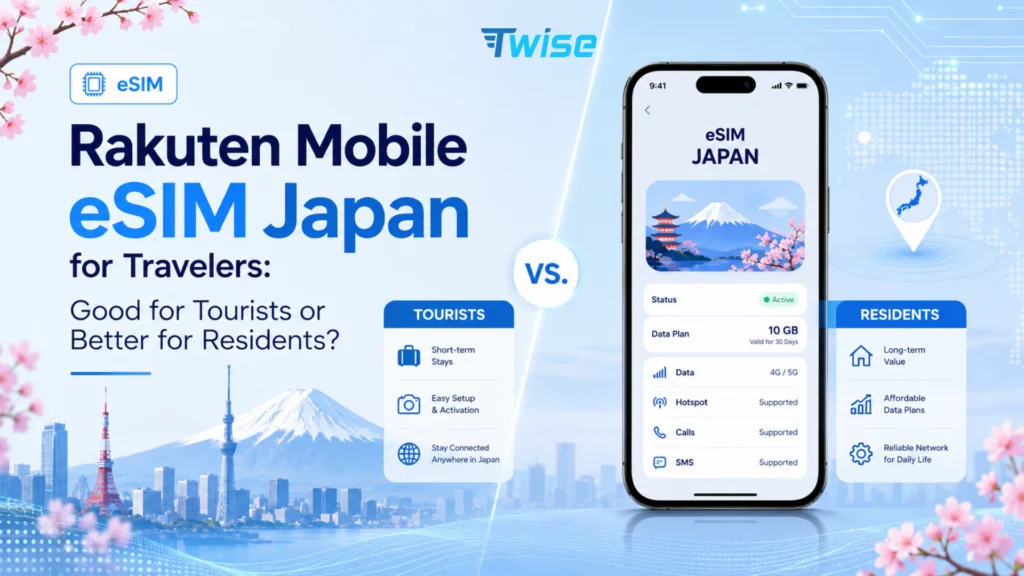
Rakuten Mobile eSIM Japan for Travelers: Good for Tourists or Better for Residents?
Aug
Rakuten Mobile eSIM can be attractive for people living in Japan who want a local mobile plan, phone number and ongoing service. For short-term tourists, however, the application and identity-verification requirements can create unnecessary setup compared with a prepaid Japan travel eSIM. Rakuten Mobile’s eKYC currently supports the Residence Card or Special Permanent Resident Certificate as identification documents for foreign nationals.
Rakuten Mobile eSIM is a genuine Japanese carrier service built around ongoing local mobile subscriptions, not a short-duration tourist data product. If you only need 1–2 weeks of data, maps, and messaging, a local-network travel eSIM (such as one using KDDI) will usually be simpler to buy and activate than opening a Rakuten account.
What Is Rakuten Mobile eSIM Japan?
Rakuten Mobile is a Japanese mobile carrier, and eSIM is simply one of the SIM formats it offers alongside a physical nano-SIM — not a standalone tourist product. Customers can choose eSIM on compatible devices as part of the normal application flow, with activation handled through the “my Rakuten Mobile” app.
The core offering is the Rakuten SAIKYO Plan, an ongoing monthly subscription rather than a fixed 5-, 10-, or 15-day package. Launched in 2023, it provides unlimited high-speed data at its top usage tier, along with nationwide coverage built on Rakuten’s own network plus partner-network roaming. This is the fundamental difference from a tourist eSIM: Rakuten sells a mobile-service relationship, while travel eSIMs sell prepaid, fixed-term connectivity that simply expires after the trip.
Can Foreign Tourists Get a Rakuten Mobile eSIM?
Rakuten does support foreign nationals — but “supports foreigners” is not the same as “built for short-stay tourists.” Rakuten’s own plan materials describe the service as an option for foreign residents in Japan, and its online application is document-driven rather than a simple checkout flow.
Identification required: Foreign applicants currently need a Residence Card or Special Permanent Resident Certificate to complete Rakuten’s eKYC process — documents that Japan issues to people registering as residents, not to passport-holding tourists on a short visit. Some listings mention a passport as supplementary ID, but the residence document remains the anchor requirement for the digital verification route. This means an ordinary tourist arriving on a 90-day visa-exempt stay typically cannot complete the same frictionless online sign-up that a prepaid travel eSIM offers.
For a 1–2 week Japan trip focused on Maps, translation apps, LINE, train apps and general browsing, going through a resident-oriented mobile contract adds friction that most travelers don’t need to accept.
Rakuten Mobile eSIM Plans: What Travelers Should Know
The standard SAIKYO Plan uses usage-based monthly pricing rather than a selectable tourist duration. Current tiers run roughly ¥1,078/month for up to 3GB, ¥2,178/month from over 3GB to 20GB, and ¥3,278/month above 20GB, with the top tier offering unlimited high-speed data.
Important 2026 update: readers may find older reviews mentioning a separate data-only Rakuten SIM. Rakuten suspended new applications for the “Rakuten SAIKYO Plan (Data Type)” from March 5, 2026, while the regular SAIKYO Plan remains open. Older competitor content that still treats the data-only plan as generally purchasable is now out of date — worth flagging if you’re comparing sources.
Rakuten’s voice functionality runs through its Rakuten Link app: domestic calls made through the app are free under standard terms, while calls made outside the app or internationally are charged separately. This is a meaningful feature for residents but adds complexity a short-term, data-focused traveler usually doesn’t need.
Rakuten Mobile eSIM Setup: Is It Tourist-Friendly?
The process is a genuine mobile-service application, not a “select country, pay, scan QR” tourist flow:
- Complete the mobile application through Rakuten’s site or app — choosing a plan and SIM type.
- Pass identity verification (eKYC) by submitting the required Residence Card or Special Permanent Resident Certificate, plus a Japanese address and payment method.
- Activate the eSIM digitally once the application is approved. Rakuten states eligible eSIM-compatible devices can be activated in a few simple steps once eKYC is verified.
The key point: a technically fast digital activation step doesn’t remove the underlying eligibility and ID requirements that come before it. Speed of activation and simplicity of eligibility are two different things.
Rakuten Mobile eSIM: Pros and Cons for Travelers
| Aspect | Detail |
| Genuine local carrier | Real Japanese mobile subscription with unlimited-data tier |
| Ongoing service | No fixed expiry — suits longer stays or residence |
| Phone number & calling | Available through Rakuten Link and standard service |
| ID/account requirement | Residence Card or Special Permanent Resident Certificate needed for eKYC |
| Application model | Monthly subscription, not a selectable tourist duration |
| Best fit | Foreign residents, students, workers, longer-term stays |
Rakuten Mobile isn’t “bad for tourists” — its product model is simply built to solve a different problem: ongoing Japanese mobile service, not short-trip connectivity.
Rakuten Mobile vs Twise Local KDDI eSIM
| Feature | Rakuten Mobile eSIM | Twise Local KDDI eSIM |
| Product model | Japanese mobile plan | Prepaid tourist eSIM |
| Best fit | Residents / longer-term users | Short-term travelers |
| Foreign applicant verification | Required (eKYC) | No KYC on eligible travel plan |
| Documentation needed | Residence-related documents | Not required for travel plan |
| Japanese cellular number | Available with eligible service | No — data-only |
| Japan local network | Rakuten Mobile | KDDI |
| QR / digital setup | Yes, after application approval | Yes, immediately after purchase |
| Fixed tourist duration | Not the primary model | Yes |
| Keep home SIM | Yes on dual-SIM devices | Yes on dual-SIM devices |
| Multi-country option | Not the main purpose | Available via Twise regional plans |
Rakuten’s foreign-national eKYC currently supports the Residence Card and Special Permanent Resident Certificate, while Twise’s KDDI travel eSIM is a data-only, digitally delivered product with QR activation and no residency documentation involved.
Where Rakuten makes more sense: anyone establishing ongoing connectivity in Japan — students, workers, or new residents who want an actual local phone number and long-term account.
Where Twise KDDI makes more sense: international tourists who mainly need reliable local-network data and want to skip resident-style account setup entirely.
Staying in Japan temporarily and mainly need mobile data? Compare Twise Local KDDI eSIM plans for a no-KYC setup with instant QR delivery, ready before you even land.
View Top Japan Prepaid eSIMs Here
Rakuten Network vs KDDI: What Should Tourists Actually Compare?
Don’t decide purely on carrier brand recognition. What matters more:
- Your itinerary — check official coverage for the specific cities and regions you’re visiting, especially outside Tokyo, Osaka, and Kyoto.
- Plan structure over peak speed — a clear validity period, hotspot support, and a transparent data policy tend to matter more day-to-day than a theoretical top network speed.
Neither network is universally “better” for every trip — the more defensible comparison is traveler suitability and setup simplicity, not blanket network superiority claims.
Rakuten Mobile vs Other Ways to Get Data in Japan
| Option | Japanese number | ID/account setup | Keep home SIM | Physical hardware | Best for |
| Rakuten Mobile | Yes, with eligible service | Higher (residence docs) | Yes, dual-SIM | No (eSIM) | Residents / long stays |
| Twise Local KDDI eSIM | No | Low / no-KYC on eligible plan | Yes | No | Tourists needing data |
| Physical tourist SIM | Product-dependent | Varies | Requires SIM swap | SIM card | Non-eSIM devices |
| Pocket Wi-Fi | No | Rental process | Yes | Router | Groups / multiple devices |
| Home carrier roaming | Home number | Existing account | Yes | No | Minimal-setup travelers |
The real question isn’t “which option wins” — it’s whether you actually need a Japanese mobile account, or just internet access during a temporary visit. For most short trips, the latter is what people are looking for.
Which Option Fits Your Japan Trip?
- 5–10 day tourist trip: compare prepaid local-network travel eSIMs rather than opening a resident-style Rakuten account.
- 2–4 week trip with heavy data use: a travel eSIM can still work well — check high-speed allowances, unlimited-data policies, and hotspot terms.
- Studying or working in Japan: Rakuten becomes far more relevant once you’re genuinely establishing residence and need ongoing local service.
- Need a Japanese phone number: Rakuten (or another genuine local voice/SMS plan) is worth considering — Twise’s KDDI travel product is data-only and doesn’t provide cellular calls or SMS.
- Japan plus Korea or other Asian stops: a regional travel eSIM is the more natural fit than opening Japan-specific local service.
Why Twise Local KDDI Can Be Simpler for Tourists
Once you understand what Rakuten actually requires, the practical contrast becomes clear:
- No-KYC setup on eligible travel plans avoids a resident-style identity application.
- Instant QR delivery lets you prepare the eSIM before you even leave home.
- Dual-SIM compatibility keeps your home line active alongside the Japan data line.
- Japan-focused local data without opening a Japanese monthly mobile account.
- Regional plans available when Japan is only part of a wider trip.
Twise‘s current KDDI travel eSIM is data-only, delivered digitally with a defined QR-installation validity window.
Only visiting Japan temporarily? Compare Twise Local KDDI eSIM options for tourist-focused data — no Rakuten-style resident account required.
What to Check Before Choosing
Before starting either process, confirm: how long you’re actually staying (holiday vs. residence/study/work); whether you need a real Japanese phone number; whether you can meet Rakuten’s ID requirements as a foreign applicant; whether your phone is eSIM-compatible and carrier-unlocked; and whether you’ll be leaving Japan during the same trip, which may make a regional eSIM more useful than a Japan-only product.
Rakuten Mobile eSIM or Twise KDDI: Which Should Travelers Choose?
- Short-term tourist mainly needing data → a prepaid travel eSIM such as Twise Local KDDI is likely the simpler category.
- Foreign resident, student, or worker needing ongoing service → Rakuten Mobile is worth serious consideration.
- Need a Japanese cellular number → compare Rakuten or another genuine local voice/SMS plan; a data-only travel eSIM won’t provide one.
- Traveling beyond Japan → a regional eSIM is usually the more convenient cross-border option.

FAQ About Rakuten Mobile eSIM Japan
Rakuten does support foreign applicants, but its current application process and documentation are built primarily for people establishing Japanese mobile service, not for a simple passport-only tourist data purchase.
Rakuten’s current eKYC for foreign nationals supports the Residence Card or Special Permanent Resident Certificate as identification; other verification routes are subject to Rakuten’s current policies.
The standard SAIKYO Plan’s top tier offers unlimited high-speed data, though normal fair-use and network conditions still apply during peak periods.
No — Rakuten suspended new applications for the SAIKYO Plan (Data Type) from March 5, 2026; the regular SAIKYO Plan remains available for new sign-ups.
There’s no universal winner. Rakuten fits people who need ongoing Japanese mobile service; a KDDI-based travel eSIM fits tourists who mainly need reliable short-term data without an account application.
More useful tips for your journey to Japan
- Why Many Travelers Choose eSIM for Japan Trips in 2026
- Best Japan eSIMs in 2026: How to Get Them + Full Comparisons
- Japan Wireless eSIM Review: eSIM, Pocket Wi-Fi or Better Alternative?
- Best eSIM Japan 10 Days for Tourists: How Much Data Do You Really Need?
