

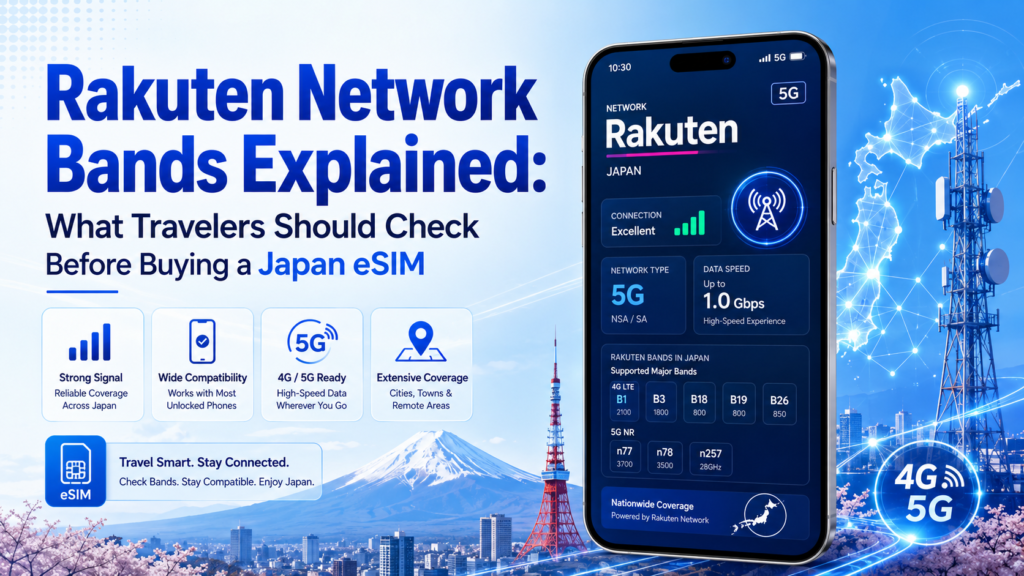
Rakuten Network Bands Explained: What Travelers Should Check Before Buying a Japan eSIM
Sep
If you are buying a Japan eSIM that connects through Rakuten Mobile, your phone needs more than eSIM support. It should also be carrier-unlocked and compatible with the network technologies used by the selected plan.
Most recent mainstream iPhones, Samsung Galaxy flagships, and Google Pixel phones support a broad range of LTE and 5G frequencies. However, older devices, regional variants, imported phones, and carrier-locked models should be checked more carefully. Rakuten Mobile itself warns that compatibility can vary for devices bought outside Japan or from other carriers.
This guide explains Rakuten Mobile’s network-band background, the difference between eSIM and radio compatibility, and what travelers should verify before choosing a Japan eSIM.
Already checked your phone? Compare Japan eSIM plans.
What Are Network Bands and Why Do They Matter?
Mobile networks transmit data over different portions of radio spectrum called frequency bands. Your phone’s modem and antennas need to support the relevant network technology and frequencies to communicate effectively with the carrier.
That creates an important distinction:
eSIM support means your phone can store and use a digital SIM profile. Network-band support means your phone’s hardware can connect to the mobile frequencies used by the carrier.
A device can therefore support eSIM but still have weaker network compatibility if its regional model lacks useful LTE or 5G bands. This is why checking only the phone family—such as “Galaxy S series” or “Pixel”—is not always enough.
Rakuten Mobile also publishes model-specific frequency information for devices it sells and cautions that even when a device supports a particular frequency, operation on another network is not automatically guaranteed.
Twise note: Travelers frequently check whether the phone has an “Add eSIM” button but forget the carrier lock or regional model. A non-connecting eSIM can also be caused by the wrong mobile-data line, disabled data roaming, APN settings, manual network selection, incomplete activation, or carrier lock rather than missing network bands. Twise therefore asks customers to confirm that their device is both eSIM-compatible and network-unlocked.
Rakuten Network Bands: What Travelers Should Know
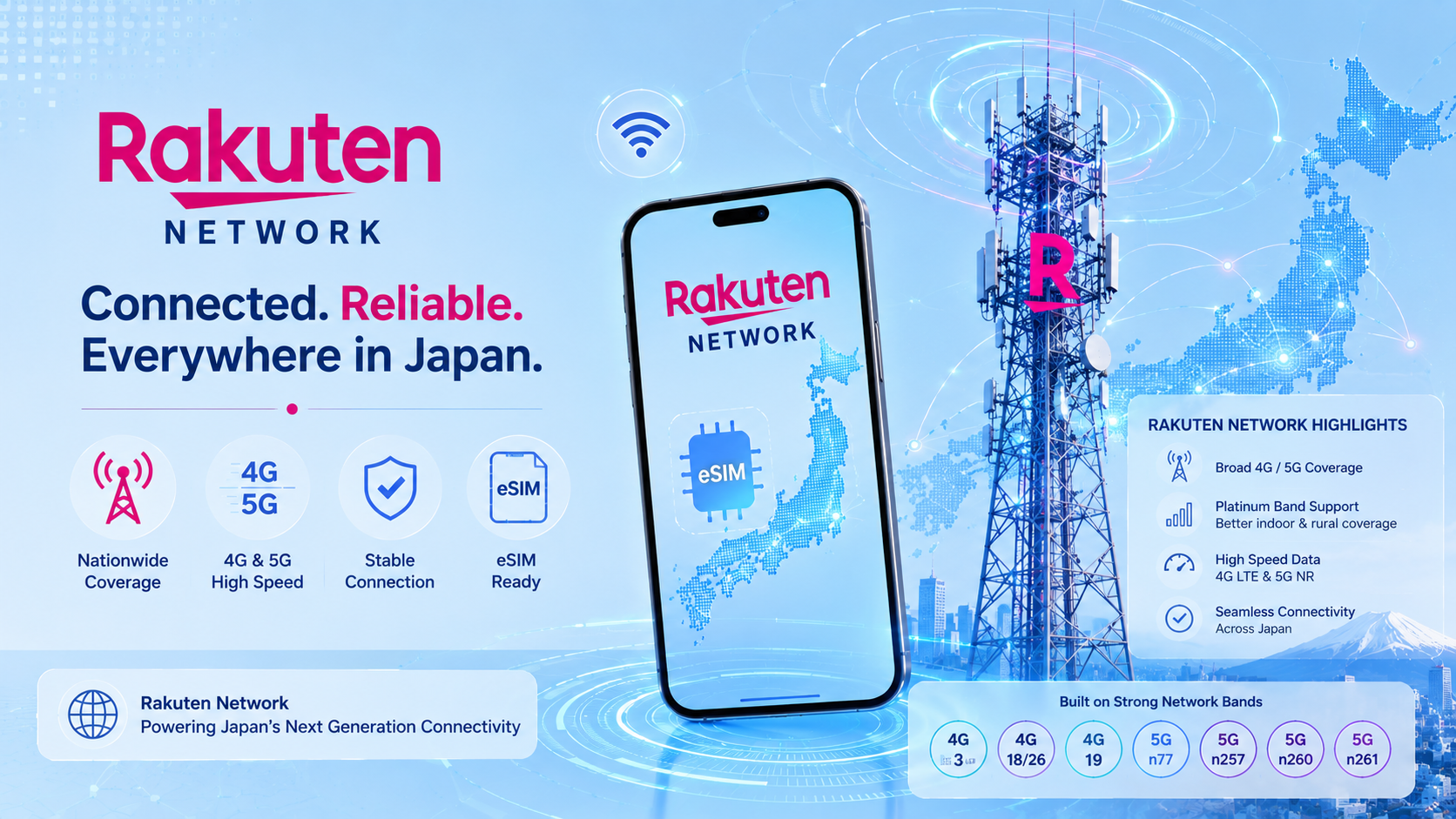
Rakuten Mobile’s network has changed significantly since its launch, so frequency information should be treated as technical background rather than a live engineering database.
Rakuten says its nationwide mobile network was originally built using the 1.7 GHz spectrum layer. In June 2024, it launched commercial service on newly allocated 700 MHz “platinum band” spectrum, initially expanding from areas where additional coverage was needed.
For 5G, Rakuten’s corporate history records allocations of 3.7 GHz and 28 GHz spectrum in 2019. It also records an additional 1.7 GHz 5G allocation in 2021 for areas excluding Tokyo, Nagoya, and Osaka.
Rakuten device documentation gives additional technical context. For example, the Rakuten BIG specification identifies 5G n77 at 3.8 GHz and n257 at 28 GHz, while its LTE support includes Band 3 and Band 28 among many other bands supported by that particular device. This device specification is useful for understanding band terminology, but it should not be interpreted as a list of every frequency currently available to every Rakuten subscriber or travel eSIM.
| Network layer | What travelers should understand |
| LTE/4G | Rakuten’s own network was historically built around its 1.7 GHz allocation. Device specifications commonly identify the related LTE capability as Band 3. |
| 700 MHz / lower-frequency LTE | Rakuten launched commercial 700 MHz “platinum band” service in June 2024. Lower frequencies generally provide different propagation characteristics and can help extend usable coverage into harder-to-reach locations. |
| 5G Sub-6 | Rakuten received 3.7 GHz spectrum for 5G and has continued expanding its Sub-6 network. Device documentation identifies n77 on compatible Rakuten devices. |
| 5G mmWave | Rakuten was also allocated 28 GHz spectrum; compatible devices may identify this as n257. Availability and device support are more limited than ordinary LTE or Sub-6 5G. |
| Carrier aggregation / advanced radio features | Modern networks and phones can combine radio resources and use technologies such as multiple antennas. The combinations available depend on the exact device, location and network configuration. |
Rakuten’s network continued developing after those original allocations. For example, the carrier reported major expansion of its Sub-6 5G footprint in the Kanto region during 2024 and said similar optimization was being extended to other regions.
Travelers should therefore verify current network and product details before purchase rather than treating an older frequency announcement as a permanent coverage map.
Supporting one Rakuten-related band also does not mean a phone will work perfectly. Performance depends on the exact model, network conditions, location, plan type, provisioning, software and which network resources the selected eSIM is actually permitted to use.
eSIM Compatibility and Rakuten Network Compatibility Are Not the Same
There are two separate questions:
Can the phone install the digital SIM?
And:
Can this exact phone model connect effectively to the network used by the plan?
Both matter.
Apple currently lists Rakuten Mobile among Japanese carriers supporting eSIM, LTE and 5G, along with features such as Personal Hotspot and VoLTE on supported iPhones and plans. Apple’s carrier documentation also makes clear that feature availability depends on the compatible carrier service and device.
That does not mean every travel eSIM using Rakuten infrastructure automatically receives the same features as a domestic Rakuten Mobile subscription.
Before buying, check:
- The exact phone model and regional version.
- Carrier-lock status.
- eSIM support.
- Relevant network support.
- Activation requirements.
- The selected plan’s actual network and included features.
Think of eSIM as the digital-SIM part of the connection. Network compatibility is the can-this-phone-connect-well-to-this-radio-network part. A successful trip setup needs both.
You can check whether your phone supports eSIM before purchasing.
How to Check If Your Phone Can Work with a Rakuten-Based Japan eSIM
1. Check Your Exact Phone Model
Do not rely only on names such as “iPhone,” “Galaxy S24,” or “Pixel.”
Check the exact model number and country or regional variant. Different versions can have different radio configurations or eSIM capabilities.
Rakuten’s own BYOD checker warns that devices purchased overseas may not have the same verified compatibility as domestic models.
2. Confirm Your Phone Supports eSIM
Look in the settings for Add eSIM, Add Cellular Plan, or a similar option.
Then confirm the model on the manufacturer’s specification page. Google, for example, notes that eSIM support varies significantly on some older Pixel generations and variants.
You can also review Twise’s eSIM compatibility guide.
3. Make Sure Your Phone Is Carrier-Unlocked
A locked phone may reject another carrier’s eSIM even if the hardware fully supports eSIM.
If you bought your phone through a mobile carrier, verify its unlock status before departure. When uncertain, ask your home carrier rather than assuming an international eSIM will bypass the restriction.
4. Check Your 4G/LTE and 5G Expectations
You do not automatically need 5G for a Japan trip.
LTE is generally sufficient for Google Maps, LINE, WhatsApp, translation, train searches, ride-hailing, browsing and booking apps.
5G becomes more useful for heavy downloads, large cloud transfers, high-quality streaming or intensive hotspot use. However, an LTE-only eSIM should never be presented as 5G simply because the phone supports 5G.
5. Check the Selected eSIM Plan’s Network and Terms
Not every Japan eSIM uses Rakuten Mobile.
Check the product page for the actual network, data allowance, speed policy, validity, hotspot rules and activation timing. Also confirm whether the plan is data-only or includes conventional calls, SMS or a Japanese phone number.
Product-page details override general information in this guide.
Do Travelers Really Need 5G for a Japan eSIM?
Not always.
Most tourists can complete ordinary travel tasks comfortably over LTE. Compatibility, usable coverage, data allowance and plan rules often matter more than maximum speed.
| Traveler type | Is 5G essential? | What matters more |
| Maps + messaging | No | Stable connection and compatibility |
| Social media | Usually no | Data allowance |
| Remote work | Helpful | Hotspot, stability and enough high-speed data |
| Video streaming | Helpful | Speed policy and data allowance |
| Short trip | Usually no | Easy setup and correct validity |
| Older phone user | No | LTE support and unlock status |
Rakuten itself explains that higher-frequency 5G spectrum can offer greater capacity but generally has different propagation characteristics than lower frequencies. In practical travel use, seeing “5G” on a specification sheet is therefore only one part of the buying decision.
From Twise’s support perspective, the better first question is:
“Will this work with my phone, cover my trip, and give me enough data?”
That is usually more useful than asking only whether the plan has 5G.
Common Compatibility Mistakes Travelers Make Before Buying a Japan eSIM
- Checking eSIM support but not carrier lock. A device can support eSIM technically while remaining locked to the carrier that originally sold it.
- Assuming every Japan eSIM uses Rakuten. Travel plans may connect through Rakuten, KDDI, SoftBank, Docomo or another partner arrangement. Check the individual product page.
- Assuming 5G is required. LTE is adequate for most everyday tourist activities.
- Confusing data-only eSIM with local phone service. A data eSIM does not automatically provide a Japanese number, standard calls or SMS. If those features matter, see the relevant [Japan eSIM with phone number] article.
- Forgetting post-install settings. Check the selected data line, Data Roaming requirements, APN, network selection and activation status. Restarting the phone may also be part of troubleshooting.
When Twise support receives a “my eSIM doesn’t work” message, the useful first checks are normally whether the profile installed correctly, whether the eSIM line is enabled, which SIM is selected for data, roaming/APN settings, network selection, activation status and carrier lock. Missing bands are only one possible cause.
What to Check Before Buying a Rakuten-Connected Japan eSIM
- Your exact phone model and regional variant.
- Whether the device supports eSIM.
- Whether it is carrier-unlocked.
- Whether LTE is enough or you specifically need 5G.
- Whether you need mobile hotspot.
- Whether you need a Japanese phone number.
- Which Japanese network the plan actually uses.
- When and how the eSIM activates.
- How long the plan remains valid.
- Data allowance, throttling and fair-use terms.
When a Rakuten-Based Japan eSIM Is a Good Fit
A Rakuten-based Japan eSIM can make sense when you have an unlocked, eSIM-compatible phone and want mobile data available for maps, LINE or other messaging apps, translation, ride-hailing, hotel communication, bookings and everyday browsing.
The carrier name alone should not decide the purchase, though. Check whether the selected plan matches your itinerary, device and required services.
A data-only plan, for example, may be ideal for app-based communication but unsuitable if you specifically require a Japanese number for conventional calls or SMS.
Twise Japan eSIM Options for Travelers
Twise provides Japan travel eSIM options with different data structures, validity periods and network arrangements. The useful approach is to choose according to your actual trip rather than assuming one carrier or one speed tier suits everyone.
Before purchase, check the current product page for the network, data allowance, validity, hotspot rules, speed policy, activation instructions and whether phone-number services are included.
Suggested product module:
- Best for light users: Lower daily or fixed-data options for maps, messages and occasional browsing.
- Best for heavy data: Higher-data or unlimited-style options, subject to the published speed and fair-use rules.
- Best for phone number: Show only when a current eligible Japan plan includes the required number/calling features.
- Best for short trips: Short-validity plans aligned with the actual travel dates.
- Best for longer stays: Longer-validity plans with an appropriate total or daily data allowance.
Check Your Phone Before Choosing a Japan eSIM
Rakuten network-band information is useful background, but it should not be used as a shortcut for compatibility.
Check your exact phone model, eSIM support, unlocked status and the current network details of the selected plan. Then choose the Japan eSIM that fits your data needs and itinerary instead of buying based only on a carrier name or 5G label.
FAQs About Rakuten Network Bands and Japan eSIM Compatibility
More Helpful Tips For Your Japan Journey
- KDDI Network Bands Explained: What Travelers Should Check Before Buying a Japan eSIM
- IIJmio Network Bands Explained: Japan eSIM Compatibility
- SoftBank Network Bands Explained: What Travelers Should Check Before Buying a Japan eSIM
- Docomo Network Bands Explained: What Travelers Should Check Before Buying a Japan eSIM
