

SoftBank Network Bands Explained: What Travelers Should Check Before Buying a Japan eSIM
Sep
If you are buying a Japan eSIM that connects through SoftBank, eSIM support alone is not enough. Your phone should also be carrier-unlocked and compatible with the LTE or 5G network technologies used by the specific plan (SoftBank Network Bands).
Most recent mainstream iPhones, Samsung Galaxy flagships, and Google Pixel phones support a broad range of international cellular bands. However, travelers with older phones, imported or regional variants, or carrier-locked devices should check their exact model before buying. Manufacturer specifications can vary by model and region; Google, for example, publishes different cellular band configurations for different Pixel variants.
This guide explains SoftBank’s network-band background, the difference between eSIM support and network compatibility, and what to check before choosing a Japan eSIM.
Already checked your phone? Compare Japan eSIM plans.
What Are Network Bands and Why Do They Matter?
Mobile networks communicate with phones through defined radio-frequency ranges known as bands. A phone needs hardware that supports the relevant technologies and frequencies used by the network it is trying to access.
That creates an important distinction:
eSIM support means your phone can store and use a digital SIM profile. Network-band support means your phone’s hardware can connect to the mobile frequencies used by the carrier.
The two are related, but they are not interchangeable.
For example, a phone may successfully install an eSIM while supporting fewer of the radio bands used by a network in Japan. This is especially worth checking with older devices and regional phone variants. Current Pixel specifications illustrate how LTE and 5G band support can differ between device versions.
Modern flagship phones generally offer broader multi-band support, but the exact model should still be verified rather than assuming every version of a phone family is identical.
Twise note: One of the most commonly overlooked checks is whether the phone is carrier-unlocked. A device can support eSIM and the relevant frequencies but still reject another provider’s eSIM when locked to a home carrier. A non-connecting eSIM can also be caused by installation status, Data Roaming, APN settings, the selected data line, network selection, or incomplete activation—not necessarily missing bands. Twise asks customers to verify both eSIM compatibility and network-unlocked status before purchase.
SoftBank Network Bands: What Travelers Should Know
SoftBank operates a multi-band mobile network rather than relying on one LTE or 5G frequency.
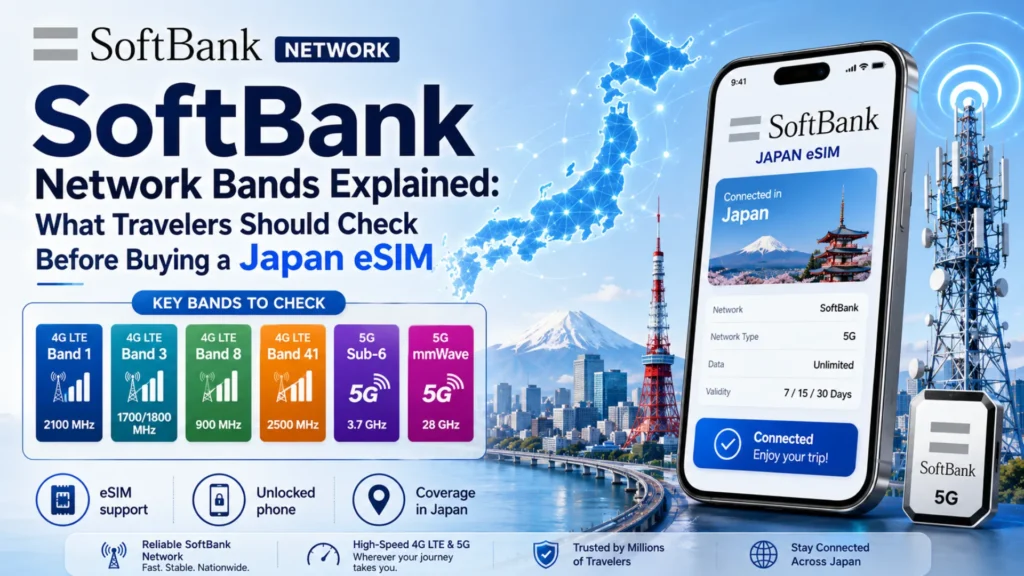
Its own technical documentation shows domestic LTE operation across several frequency layers. A current SoftBank device manual lists domestic FDD-LTE use at 2.1 GHz, 1.7 GHz, 1.5 GHz, 900 MHz, and 700 MHz, alongside TDD-LTE/AXGP at 2.5 GHz and 3.5 GHz. The same documentation maps these technologies to bands including B1, B3, B8, B11, B28, B41, and B42.
SoftBank’s frequency documentation also distinguishes frequencies used by SoftBank from additional bands that individual devices may support. This is important because a manufacturer’s long list of supported bands should not be interpreted as a list of frequencies that SoftBank necessarily operates.
For 5G, SoftBank announced in 2021 that it was using its 3.7 GHz and 28 GHz 5G spectrum while progressively introducing 5G over spectrum previously used for LTE at 700 MHz, 1.7 GHz, and 3.4 GHz.
SoftBank’s current device-frequency matrix identifies relevant 5G bands including n3 at 1.7 GHz, n28 at 700 MHz, n77 at 3.4/3.7 GHz, and n257 at 28 GHz as SoftBank-used spectrum.
| Network layer | What travelers should understand |
| LTE/4G | SoftBank has used multiple LTE layers rather than one single band. Official device documentation includes B1, B3, B8, B11 and B28 among domestic FDD-LTE frequencies. |
| 4G TDD / AXGP | SoftBank documentation also identifies 2.5 GHz B41 and 3.5 GHz B42 for its TDD-LTE/AXGP layer. |
| Lower-frequency bands | 700 MHz and 900 MHz give the network lower-frequency coverage layers. SoftBank historically described its 900 MHz allocation as its “Platinum Band” for wider coverage. |
| 5G Sub-6 | SoftBank’s technical history includes 1.7 GHz, 700 MHz, 3.4 GHz and 3.7 GHz for 5G, with n3, n28 and n77 appearing in its device-frequency documentation. |
| 5G mmWave | SoftBank has also used 28 GHz/n257. Device support and practical availability are more limited than normal LTE or Sub-6 5G and should not be assumed for a travel plan. |
| Carrier aggregation | Modern devices and networks can combine multiple carriers to increase capacity. Supporting one band does not mean the device supports every aggregation combination available on the network. |
Date checked: August 18, 2026 | Sources checked: SoftBank official network announcements, device manuals and frequency documentation; Apple and Google manufacturer documentation; Twise product and compatibility sources.
These bands should be treated as technical background rather than a live network engineering database. Spectrum deployment, supported devices, provisioning, and product access can change.
Supporting a single listed band also does not guarantee that a phone will work perfectly. Actual performance depends on the device variant, plan type, provisioning, location, congestion, signal conditions, software, and which parts of the network the selected eSIM can access.
Always check current product and network details before purchase.
eSIM Compatibility and SoftBank Network Compatibility Are Not the Same
There are two different compatibility questions.
First: Can the phone install and use an eSIM profile?
Second: Can the phone’s cellular hardware work effectively with the network used by that profile?
Both need to be considered.
Apple currently lists SoftBank in Japan as supporting eSIM, LTE and 5G on compatible iPhones, as well as features such as Personal Hotspot and VoLTE.
However, this does not mean every iPhone automatically receives 5G or every SoftBank-connected travel eSIM receives the same features as a SoftBank domestic contract. The device, carrier configuration, and individual plan still matter.
Before buying, check:
- Your exact phone model.
- Its regional variant.
- Carrier-unlocked status.
- eSIM support.
- LTE and 5G capabilities.
- The selected plan’s activation and network requirements.
Think of eSIM as the digital-SIM part and network compatibility as the can-this-phone-connect-properly-to-this-radio-network part. A working travel setup needs both.
You can check whether your phone supports eSIM before purchasing.
How to Check If Your Phone Can Work with a SoftBank-Based Japan eSIM
1. Check Your Exact Phone Model
Do not check only “iPhone,” “Galaxy S25,” or “Pixel 10.”
Find the exact model number and regional version. Phones marketed under the same family name can have differences in cellular features or frequency support. Google’s official specifications, for example, list cellular technologies and bands according to model variant.
2. Confirm Your Phone Supports eSIM
Check your phone settings for Add eSIM, Add Cellular Plan, or an equivalent SIM Manager option.
Then verify the exact model through the manufacturer’s official specifications. You can also review Twise’s eSIM compatibility guide. Twise’s own guidance reminds customers that compatibility may depend on both device model and country of origin.
3. Make Sure Your Phone Is Carrier-Unlocked
A carrier-locked phone may reject another provider’s SIM or eSIM even when its hardware is otherwise compatible.
If your device was purchased through a mobile carrier, confirm its unlock status before leaving home. Do not assume that having an “Add eSIM” button means the phone is unlocked.
4. Check Your 4G/LTE and 5G Expectations
Travelers do not always need 5G.
LTE is normally adequate for Google Maps, LINE, WhatsApp, translation, train searches, restaurant bookings, ride-hailing, email and everyday browsing.
5G is more relevant if you frequently stream high-resolution video, transfer large files, rely heavily on hotspot use, or have another speed-sensitive requirement.
Most importantly, a 5G phone does not turn an LTE-only eSIM into a 5G product. Check what the selected plan actually offers.
5. Check the Selected eSIM Plan’s Network and Terms
Not every Japan eSIM connects through SoftBank.
Twise’s current Japan catalog includes SoftBank-based plans as well as other Japan network options, so travelers should check the specific network named on the individual product rather than assuming all Japan plans work the same way.
Also check the data allowance, validity, hotspot policy, activation instructions, speed or fair-use rules, and whether the plan is data-only.
Current product-page details override general guidance in this article.
Do Travelers Really Need 5G for a Japan eSIM?
Not always.
For many visitors, LTE is more than sufficient for navigation, messaging, translation, local travel apps, browsing, email and social media.
| Traveler type | Is 5G essential? | What matters more |
| Maps + messaging | No | Reliable data and compatibility |
| Social media | Usually no | Enough high-speed data |
| Remote work | Helpful | Stability, hotspot and allowance |
| Video streaming | Helpful | High-speed quota and speed policy |
| Short trip | Usually no | Easy setup and correct validity |
| Older phone user | No | LTE compatibility and unlock status |
5G also depends on more than device hardware. SoftBank’s own 5G history shows that its network uses multiple spectrum layers rather than one universal 5G frequency.
From Twise’s support perspective, the better first question is usually:
“Will this work with my phone, cover my trip, and give me enough data?”
That is more useful than buying only because a product displays a 5G label.
Common Compatibility Mistakes Travelers Make Before Buying a Japan eSIM
- Checking eSIM support but not carrier lock. A compatible eSIM chip does not override restrictions imposed by the carrier that locked the device.
- Assuming every Japan eSIM uses SoftBank. Check the network shown on the actual product. Twise offers Japan options across different network arrangements.
- Assuming 5G is required. LTE can handle most day-to-day tourist activities without difficulty.
- Confusing data-only eSIM with local phone service. A data-only eSIM does not automatically include a Japanese telephone number, conventional calls, or SMS. Travelers who need those services can read our Japan eSIM with phone number guide. Twise’s existing Japan guidance distinguishes data-only travel products from eSIMs that include Japanese phone-number features.
- Forgetting settings after installation. The eSIM may be installed correctly but remain offline because the wrong line is selected for mobile data, Data Roaming is disabled when required, the APN is incorrect, network selection is wrong, activation is incomplete, or the phone needs restarting.
When Twise support reviews a non-working eSIM, the useful first checks are normally installation status, active data line, roaming requirement, APN, activation state, network selection, and carrier lock. Network-band incompatibility is one possibility, but it should not automatically be treated as the cause.
What to Check Before Buying a SoftBank-Connected Japan eSIM
- Your exact phone model and regional variant.
- Whether the phone supports eSIM.
- Whether the device is carrier-unlocked.
- Whether LTE is sufficient or you specifically need 5G.
- Whether you need hotspot or tethering.
- Whether you need a Japanese phone number.
- Which network the selected plan actually uses.
- Installation and activation timing.
- Plan validity.
- Data allowance, speed limits and fair-use terms.
When a SoftBank-Based Japan eSIM Is a Good Fit
A SoftBank-based Japan eSIM can be a practical option if you have an unlocked, compatible phone and mainly want mobile data available during your trip.
That data can support everyday travel tasks such as Google Maps, LINE, translation, hotel communication, transport searches, bookings, ride-hailing and browsing.
The carrier name alone does not determine whether a plan is right for you. Check the exact product for its data allowance, validity, network, speed policy and included services.
If you specifically need a Japanese phone number, standard voice calling, or SMS, confirm that those features are explicitly included rather than assuming they come with every SoftBank-connected eSIM.
Twise Japan eSIM Options for Travelers
Once you know your phone is compatible, compare Twise Japan eSIM options according to the needs of your actual trip.
Current Twise Japan listings include different network and data structures, including SoftBank-based travel options. Product information should be checked at the time of purchase because availability and plan details can change.
Suggested product module:
- Best for light users: Smaller daily or fixed-data plans for maps, messaging and occasional browsing.
- Best for heavy data: Higher-data or unlimited-style options, subject to the current speed and fair-use policy.
- Best for phone number: Display only when a qualifying plan with Japanese number/voice/SMS is available.
- Best for short trips: Short-validity plans matched closely to travel dates.
- Best for longer stays: Longer-validity options with enough total or daily data for the full stay.
Before purchase, confirm network, data allowance, validity, hotspot support, phone-number features, activation instructions and speed policy on the individual product page.
Check Compatibility Before Choosing Your Japan eSIM
SoftBank’s network-band information is useful for understanding the technical side of compatibility, but a frequency list should never replace checking the actual phone and plan.
Before buying, verify your exact phone model, eSIM support, carrier-unlocked status, and the current network details of the selected product.
Then choose the Japan eSIM according to the amount of data, validity, network and services you genuinely need.

FAQs About SoftBank Network Bands and Japan eSIM Compatibility
More Helpful Tips For Your Japan Journey
- KDDI Network Bands Explained: What Travelers Should Check Before Buying a Japan eSIM
- Rakuten Network Bands Explained: What Travelers Should Check Before Buying a Japan eSIM
- Docomo Network Bands Explained: What Travelers Should Check Before Buying a Japan eSIM
- IIJmio Network Bands Explained: Japan eSIM Compatibility
