

Top Singapore eSIM Providers | Compare Plans & Coverage
May
Changi Airport has been ranked the world’s best airport so many times the accolades have their own hall. Jewel Changi’s indoor waterfall is genuinely worth a photograph. And yet the first experience many travelers have after clearing immigration is standing in a queue at a telco kiosk, handing over a passport, and waiting for a local SIM to be manually configured — while the rest of their group has already boarded the MRT into the city. In 2025, that experience is entirely optional.
Choosing the right Singapore eSIM providers means the connection is live before you land, the registration never happens, and the same data plan that covers Marina Bay Sands also covers Kuala Lumpur, Bangkok, and Bali when your itinerary extends across the border.
Singapore’s Network Landscape: A Technical Breakdown
Singapore operates one of the densest mobile network environments in the world. The city-state’s 728 square kilometres are blanketed by three major carriers — Singtel, StarHub, and the newer SIMBA — each of which has built its infrastructure on a different strategic premise. Understanding the difference between them is the foundation for choosing the right Singapore eSIM providers for your trip.
The critical point that most comparison guides miss is this: for tourists, the relevant question is not just which carrier has the best raw speed or coverage density. Singapore’s network infrastructure is mature enough that all three carriers deliver excellent signal across the island. The meaningful differences are in how each carrier’s tourist product is structured — the registration requirements, the pricing model, the data allocation design, and crucially, what happens when you cross the Johor-Singapore Causeway into Malaysia.
Singtel and StarHub — Powerful, But “Old School” for Tourists
Singtel
Singtel is Singapore’s largest carrier and a genuine infrastructure leader — its 5G network is among the fastest in Asia, and its coverage depth in MRT stations, shopping malls, and business districts is unmatched. The problem for tourists is not Singtel’s network quality. It is Singtel’s tourist product design.
Singtel’s tourist SIM plans are structured around a legacy prepaid model that bundles local calling minutes and SMS alongside data — services that international travelers in 2025 overwhelmingly replace with WhatsApp, FaceTime, and KakaoTalk. You pay for voice minutes you will never use. And before any of that, you queue at Singtel’s Changi Airport counter and submit your passport for mandatory registration under Singapore’s Telecommunications (Registration of SIM Cards) Regulations.
StarHub
StarHub offers competitive tourist SIM packages and runs a high-quality 4G/5G network across Singapore. Its tourist products include options with larger data buckets than Singtel’s equivalent tiers, and StarHub’s coverage in the western districts of Singapore is particularly strong.
The limitations mirror Singtel’s: mandatory SIM registration with passport submission, a physical-counter or kiosk purchase process, and a product that is fundamentally designed for Singapore only. Travelers doing the popular Malaysia day trip from Singapore — Johor Bahru for food, or Kuala Lumpur via the ETS train — will find their StarHub SIM either going dark or incurring expensive international roaming charges the moment they cross the Causeway.
The Singapore SIM registration reality in 2025: Under the Telecommunications (Registration of SIM Cards) Regulations, all Singapore prepaid SIM cards — including tourist SIMs — require passport registration at the point of sale. There is no workaround for local SIM purchases. The queue at Changi’s telco counters can run 10–25 minutes during peak arrival windows. For travelers who have already travelled through two airports and want to get into the city, this is a friction point that no amount of good network coverage compensates for.
SIMBA — The Digital-First Carrier Powering Twise
SIMBA Telecom (Twise network partner)
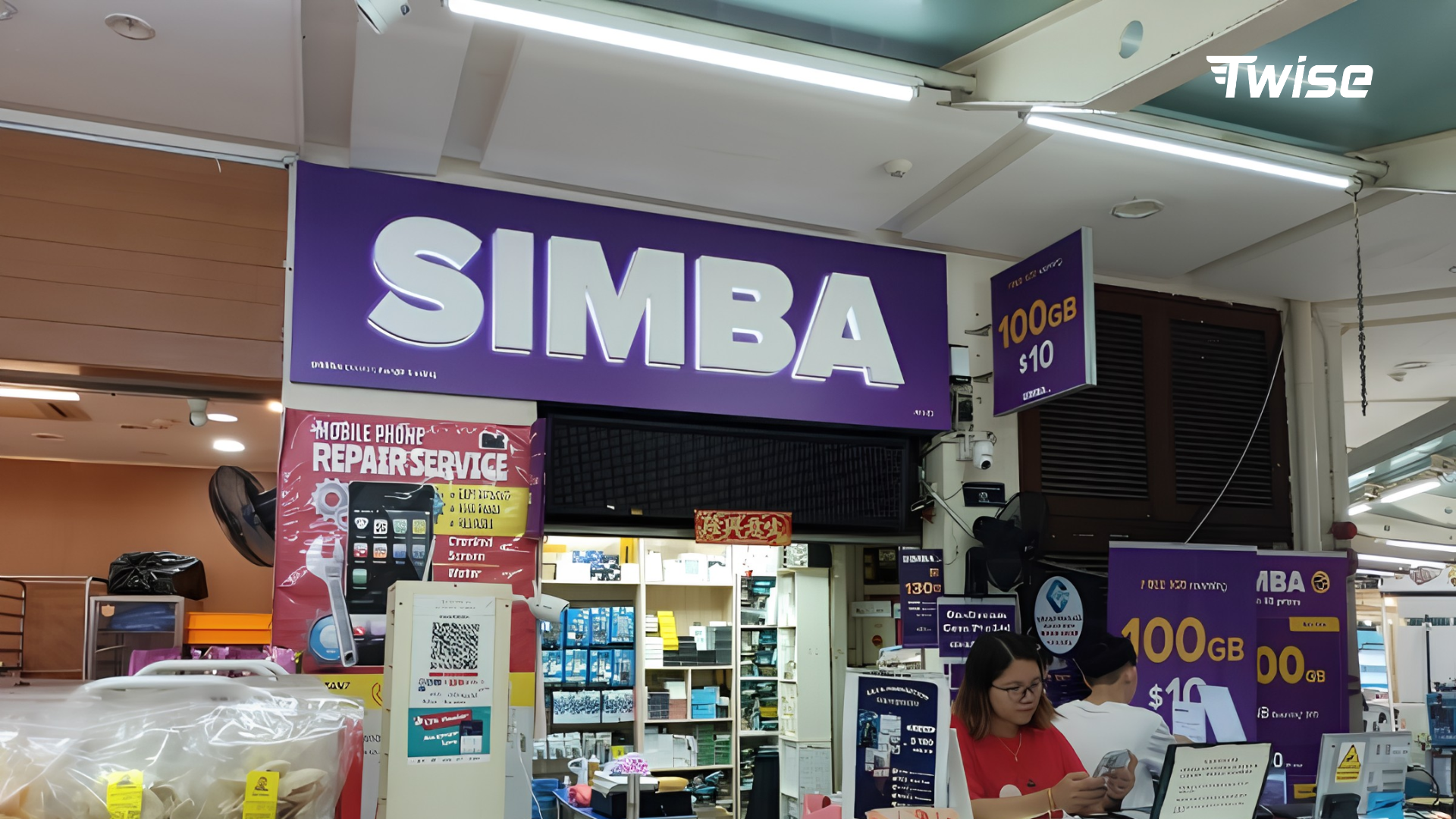
SIMBA entered Singapore’s market as a Mobile Virtual Network Operator (MVNO) running on Singtel’s underlying infrastructure — which means SIMBA customers access Singtel’s world-class tower network while benefiting from SIMBA’s fundamentally different product philosophy.
SIMBA was built from the ground up for data-first users, without the legacy architecture of local calling minutes, physical SIM counters, and paper-based registration processes. Its plans are optimised for what modern travelers actually consume: high-bandwidth mobile data for navigation, messaging, content creation, and remote work. SIMBA’s pricing model consistently delivers more data per dollar than legacy carriers, particularly for visitors who need large data allowances in a compact geography like Singapore.
For Twise customers, SIMBA’s network provides access to Singtel-quality 5G and 4G LTE across Singapore — including inside Jewel Changi, throughout the MRT network, in underground car parks at major shopping centres, and across every major tourist and business district — without any of Singtel’s tourist product friction.
3 Reasons to Choose Twise (Powered by SIMBA) Over Local SIMs
1. The No-KYC Advantage — Privacy and Instant Activation
Singapore’s mandatory SIM registration law applies to all locally-issued SIM cards — including tourist SIMs from Singtel, StarHub, and every carrier selling physical cards at Changi. As a local SIM product, your passport is submitted to a carrier’s registration database and stored. For a tourist spending three to seven days in Singapore, the privacy trade-off of submitting biometric identity data to a telecommunications company is a meaningful concern that most travelers accept only because they don’t know there is an alternative.
Twise operates on international roaming protocols rather than a locally-issued SIM profile. International roaming eSIMs fall outside Singapore’s domestic SIM registration requirements. You purchase the eSIM online with an email address and a foreign payment card. You scan the QR code at home. Your passport stays in your bag throughout the entire process — including at Changi, where you simply walk past the telco kiosk queue and board the MRT.
2. Built for the Southeast Asian Itinerary — eSIM Malaysia and Singapore in One Plan
Singapore is the most common gateway into Southeast Asia — and one of the least likely places for a tourist to stay exclusively. The most popular two-country itinerary in the region is Singapore plus Malaysia, done either as a day trip to Johor Bahru (45 minutes by bus across the Causeway) or as a longer loop through Kuala Lumpur, Penang, or Langkawi. Add Thailand, Vietnam, or Indonesia to a two-week itinerary and you have covered five countries without ever leaving the region’s most-traveled circuit.
A Singapore-only SIM card from Singtel or StarHub provides exactly zero value the moment you cross the Johor Causeway. Your data either stops or switches to expensive international roaming billed against your home carrier. The Twise multi-country eSIM changes this entirely: the same plan that delivers SIMBA-quality data in Singapore automatically switches to Celcom towers in Malaysia, TrueMove/DTAC in Thailand, Telkomsel in Indonesia, and Vinaphone in Vietnam — without any manual configuration, SIM swap, or additional purchase.
3. Right-Sized Data for Smart Spending
Singtel’s tourist SIM offerings frequently start at 100GB — a data allocation that the average tourist cannot realistically consume in a week in Singapore, where hotel Wi-Fi is universally available, Changi and most major malls offer free high-speed Wi-Fi, and the average daily tourist data use runs between 1GB and 3GB. You pay for the 97GB you never use. And you pay for the local calling minutes that your WhatsApp voice calls have rendered functionally obsolete.
Twise’s model is the opposite: plans sized to realistic tourist consumption across the actual destinations you visit, at a flat price that does not change when you cross a border. 10GB shared across five days in Singapore and Malaysia is a more honest and cost-effective product than 100GB that expires the moment you board the bus to Johor Bahru.
Built for the Real Itinerary: eSIM Singapore and Malaysia — and Beyond
The Johor-Singapore Causeway is one of the world’s busiest land border crossings — over 300,000 people cross it daily in both directions. For tourists, the crossing is typically a bus or car journey of 45 minutes to an hour, during which connectivity drops entirely on a Singapore-only local SIM. Then begins the scramble: find a Malaysian SIM at JB Sentral, queue for registration, configure the new card, and finally get back online in Johor Bahru — by which point you have likely already needed to navigate there and called your hotel.
How a Twise multi-country eSIM handles the Causeway crossing
|
Singapore SIMBA (Singtel) ↓ Causeway Auto-switching ↓ Malaysia Celcom ↓ Thailand DTAC / TrueMove ↓ Vietnam Vinaphone |
Zero manual steps required. The eSIM detects available towers and selects the correct carrier for each country automatically. No settings change. No new SIM. No registration at a border kiosk.
The Roaming IP Benefit for Multi-Country Travelers
Because Twise eSIMs operate as international roaming products rather than locally-registered SIM profiles, your data traffic routes through an international gateway in each country. This has a practical consequence beyond just coverage: your internet access behaves consistently across borders. The apps you rely on in Singapore — Google Maps, Grab, WhatsApp, Instagram — continue working identically in Johor Bahru, Kuala Lumpur, Bangkok, and beyond. No regional restriction, no configuration change, no VPN required.
For the eSIM Malaysia and Singapore use case specifically, this routing architecture eliminates the most common cross-border connectivity failure: a tourist whose Singapore data plan goes dark at the Causeway and who then discovers, in the immigration queue, that their hotel’s address is saved only in Google Maps — which no longer works without a Malaysia data connection.
Detailed Comparison: Twise vs. Local Prepaid Tourist SIMs
| Feature | Local Tourist SIM (Singtel / StarHub) | Twise Multi-Country eSIM |
| Identity check / registration | Mandatory passport scan — stored in carrier database | None — instant activation, no ID required |
| Activation process | Physical counter or kiosk — 10–25 min queue | QR code by email — scan at home, 5 min |
| Malaysia coverage (Johor / KL) | Not included — expensive roaming or no signal | Included — Celcom towers, auto-switch |
| Thailand / Vietnam / Indonesia | Not included | Included in 5-country plan |
| Local calling minutes | Bundled — pay for minutes you won’t use | Data-only — no legacy bloatware |
| Data sizing | Often 100GB+ — more than most tourists use | Right-sized plans matching actual usage |
| Hidden costs | Activation fees, airport surcharges, roaming charges | Flat transparent price — no surprises |
| Border crossing UX | Data stops — new SIM purchase required | Auto-switches — seamless continuity |
| Home number availability | Physical SIM swap — home number goes inactive | Dual SIM — home number stays active for OTPs |
| Network quality (Singapore) | Singtel / StarHub infrastructure | SIMBA on Singtel infrastructure — equivalent quality |
Read more: Top 3 Value Southeast Asia eSIM | Unlimited Data 4G/5G
Featured Plans: Singapore-Only, SG+MY Corridor, and 5-Country SEA
Twise offers three plan types that cover the full range of Singapore-based itineraries — from a city-break visitor who is staying in Singapore for five days, to a backpacker using Singapore as their entry point for a three-week Southeast Asia circuit.
| Singapore Only
Singapore eSIM — SIMBA 🇸🇬 Data-only plan on SIMBA’s network, with access to Singtel’s 5G/4G infrastructure across the island. No registration, no passport upload. Perfect for city-only visits. Best for: Short city breaks, conference travel, transit stays. No Malaysia or regional stops. |
Singapore + Malaysia (Most popular)
eSIM Singapore and Malaysia 🇸🇬 🇲🇾 Covers both countries from one data pool. Auto-switches between SIMBA in Singapore and Celcom in Malaysia — across the Causeway or the KLIA Ekspres from KL Sentral. Ideal for the region’s most popular two-country loop. Best for: JB day trips, SG+KL itineraries, business commuters on the Causeway corridor, family trips combining Singapore parks with Malaysian food trails. |
Full Southeast Asia
5-Country SEA eSIM 🇸🇬 🇲🇾 🇹🇭 🇻🇳 🇮🇩 One plan covering Singapore, Malaysia, Thailand, Vietnam, and Indonesia on Tier-1 networks: SIMBA, Celcom, TrueMove/DTAC, Vinaphone, and Telkomsel. Shared data pool, daily reset option available. Best for: Backpackers, digital nomads, multi-city business travelers, and anyone building a SEA grand tour from Singapore outward. |
Which plan is right for your itinerary? If your Singapore trip is entirely city-based with no cross-border stops: Singapore SIMBA plan. If you’re doing Johor Bahru for a day or KL for a few nights: the SG+MY corridor plan at a flat price is the cleanest option. If Singapore is your entry point for a wider Southeast Asia circuit: the 5-country plan eliminates any further connectivity decisions for the rest of your trip.
Singapore’s local telecom carriers — Singtel and StarHub — are world-class network operators. Their infrastructure is genuinely among the best in Asia. That is not the issue. The issue is that their tourist products are designed for a traveler who is staying exclusively in Singapore, is willing to queue at an airport counter and submit passport details to a carrier database, and is content to buy a new SIM at every subsequent border crossing.
That traveler profile describes a declining minority of Singapore visitors in 2025. The growing majority arrive on multi-city itineraries that include at least Malaysia, frequently Thailand, and often two or three additional Southeast Asian countries. They navigate with their phone. They communicate over data-based apps. They want connectivity that follows their itinerary rather than forcing their itinerary to accommodate connectivity.
A Twise SIMBA-powered eSIM serves this traveler profile with a clarity that no local Singapore SIM can match. Singtel-equivalent network quality in Singapore, Celcom in Malaysia, Tier-1 carriers across the region — delivered via a QR code that installs in five minutes at home, requires no passport submission to any carrier, and costs less than the combined price of the local SIMs it replaces.
If you want local calling minutes you will not use, a mandatory registration queue at Changi, and a data plan that goes dark the moment you board the bus to Johor Bahru — the Singtel and StarHub tourist SIM counters are clearly signposted in every terminal. If you want the alternative: the eSIM is already installed before you get on the plane.
Pre-departure checklist for Singapore eSIM travelers: (1) Purchase and install your Twise eSIM at home over Wi-Fi. (2) Enable Data Roaming in your phone settings — required for the roaming eSIM to connect to Singapore towers. (3) Keep your home physical SIM active in dual-SIM mode for banking OTPs and calls. (4) Download offline Google Maps for Singapore and Malaysia before departure. (5) Walk straight through Changi’s telco kiosk queue. You’re already connected.
Don’t get stuck at the border. Plan your multi-country trip with Twise. Singapore. Malaysia. Thailand. Vietnam. Indonesia. One eSIM, Tier-1 networks, zero registration queues — from Changi to Kuala Lumpur to Koh Samui. Explore Twise Singapore & Sea Plans.
