




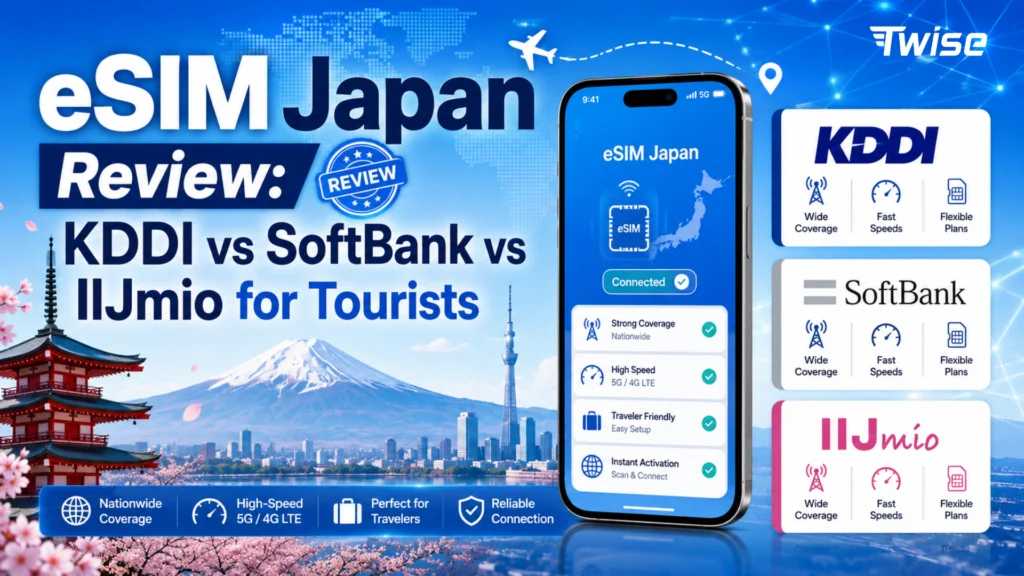
eSIM Japan Review: KDDI vs SoftBank vs IIJmio for Tourists
Sep
There’s no single Japan eSIM that fits every traveler. This eSIM Japan review compares the three networks tourists actually encounter — KDDI, SoftBank, and IIJmio (Docomo) — plus the data models sold on top of them: unlimited, daily-reset, and fixed-total.
Quick starting point:
- KDDI unlimited — consider for heavy daily data use.
- SoftBank daily — consider for predictable, moderate daily usage.
- IIJmio fixed data — consider if you’d rather buy one total allowance and use it however you like.
- Regional Asia eSIM — consider if Japan is one stop on a multi-country trip.
None of these is universally “best” — the right pick depends on your usage pattern more than the carrier logo.
The First Question: Network or Data Plan?
Tourists often spend more time debating KDDI vs. SoftBank vs. IIJmio than deciding between unlimited, daily, and fixed data — but the data model usually matters more to your actual experience. A heavy streamer on the “wrong” network with unlimited data will likely have a better trip than a heavy streamer on the “right” network with a 3GB fixed plan that runs out on day four. Use the network comparison below to check compatibility and route coverage, but decide your data model first.
How We Compare Japan eSIM Plans
This review evaluates plans on five criteria: network access and route (which network the eSIM uses, and how performance can vary by location, congestion, and device); data allowance and fair-use rules (fixed GB, daily high-speed allowances, or unlimited — without assuming all “unlimited” products behave the same); hotspot support (tethering matters if you’re sharing a connection across a laptop or tablet); activation and setup (QR delivery, timing, and whether passport/ID steps apply); and value for trip type (matched to traveler need, not just the cheapest sticker price).
KDDI, SoftBank, and IIJmio at a Glance
| eSIM type | Data model | Good fit for | Main trade-off |
| KDDI unlimited | Unlimited/high-data, fair-use applies | Heavy users, longer daily sessions | Usually costs more than small fixed plans |
| SoftBank daily | Daily high-speed allowance, then reduced speed | Predictable, moderate use | Daily cap resets, doesn’t roll over |
| IIJmio fixed data | Total GB allowance (Docomo network) | Travelers who can estimate usage | Data can run out before the trip ends |
| Regional Asia eSIM | Fixed/daily, multi-country | Japan + other Asian stops | Less Japan-specific optimization |
KDDI-based plans suit travelers who stream, upload constantly, make video calls, or work remotely and don’t want to track a data meter. The trade-off: unlimited data is often unnecessary cost for light users, and you should still confirm hotspot terms and fair-use thresholds before buying — “unlimited” plans generally still carry a fair-use policy, even if the ceiling is high. Best considered by heavy-data users prioritizing unlimited-style connectivity.
SoftBank daily plans work on a simpler model: a set high-speed allowance refreshes every 24 hours, which makes budgeting predictable for short and medium trips. They suit navigation, translation, social media, and messaging rather than extreme hotspot or streaming use. Check what happens after the daily allowance is used, when the reset actually happens, and whether hotspot is included — these details vary by seller even within “SoftBank eSIM” listings. Best considered by travelers who want dependable, predictable daily usage. For the deeper carrier trade-offs, see our dedicated [SoftBank vs. KDDI unlimited comparison].
IIJmio (Docomo-network) fixed-data plans give you one total allowance — often 10GB, 20GB, or 30GB, with some packages up to 50GB — to spend across your whole trip rather than a fresh daily reset. This suits travelers who know roughly how much data they use and want the flexibility to use more on some days and less on others. The main risk is exhausting the total early on a longer trip, so check top-up or replacement options before you rely on it for a 2+ week itinerary. Best considered by users who want predictable, controlled total usage rather than a daily meter.
Unlimited vs. Daily vs. Fixed Data: Which Is Better?
This decision usually matters more than the network name.
- Unlimited data fits heavy use — streaming, frequent uploads, video calling, or travelers who simply don’t want to monitor remaining GB.
- Daily data fits travelers who want a predictable amount of fresh high-speed data every day and don’t mind it resetting rather than rolling over.
- Fixed data fits people who can estimate total consumption and want the freedom to spend it unevenly — more on a heavy sightseeing day, less on a quiet one.
| Factor | Unlimited | Daily Data | Fixed Data |
| Data tracking | Minimal | Daily allowance | Total GB |
| Heavy usage | Strong fit | Depends on allowance | Can exhaust quickly |
| Light usage | May be excessive cost | Good | Good |
| Streaming | Stronger fit | Moderate | Data-intensive |
| Trip flexibility | High | Predictable | High |
| Budget traveler | Depends on price | Often suitable | Often suitable |
There’s no universal ranking here — match the model to how you actually use your phone, not to which one sounds most generous.
Which Japan eSIM Should You Choose for Your Trip?
5–7 day first trip to Tokyo and Osaka: a moderate daily allowance or a small fixed-data package usually covers maps, messaging, and normal social media use without overpaying for unlimited.
10–14 day multi-city trip: a larger fixed-data package or an unlimited plan becomes more convenient once you’re juggling multiple cities, transit apps, and more photo/video uploads.
Remote work or heavy hotspot use: prioritize unlimited or high-data options, but verify tethering terms specifically — a plan can be unlimited on the phone and still restrict or throttle hotspot separately.
Light data users: if you’re mainly on maps, messages, and occasional browsing, unlimited data is probably unnecessary — a fixed or daily plan will usually cost less for the same experience.
Japan plus Korea or other Asian countries: rather than buying and re-installing a separate country-specific eSIM at each border, a regional Asia eSIM can carry your connectivity across the whole itinerary. Compare Asia eSIM plans if Japan is one stop among several.
eSIM vs. Physical SIM, Pocket Wi-Fi, and Roaming
| Option | Setup before arrival | Keep home SIM | Shared devices | Local number | Best fit |
| Japan eSIM | Yes | Yes, on compatible phones | Hotspot-dependent | Usually no | Most data-focused tourists |
| Physical SIM | Usually purchase/collect | Requires SIM swap | Hotspot-dependent | Product-dependent | Travelers who prefer a physical card |
| Pocket Wi-Fi | Reserve/rent | Yes | Strong for groups | No | Families, multiple devices |
| Home roaming | Usually automatic | Yes | Carrier-dependent | Home number | Maximum convenience, higher cost |
| Regional eSIM | Yes | Yes | Plan-dependent | Usually no | Multi-country travel |
An eSIM isn’t automatically the right choice for everyone. It’s not ideal if your phone is carrier-locked or lacks eSIM support, if your group needs several devices connected at once (Pocket Wi-Fi tends to fit better there), or if you specifically need a Japanese phone number — data-only eSIMs, which cover most tourist products, don’t include one. If a local number matters to you, compare [voice-enabled options like Mobal] instead of a data-only eSIM.
What We’d Check Before Buying Any Japan eSIM
- Carrier-unlocked and eSIM-compatible phone — verify both before you pay, not after.
- Data model and fair-use policy — confirm whether “unlimited” means unrestricted high-speed use or has a specific daily threshold.
- Activation timing — check when validity actually starts so the plan doesn’t burn days before your trip begins.
- Hotspot support — verify separately if a laptop or tablet will rely on the connection.
- Calls, SMS, and a Japanese number — most Japan travel eSIMs are data-only; if you need a local number, that’s a different product category entirely.
Twise Japan eSIM Plans: How the Options Compare
Mapped against the categories above, Twise’s current Japan catalog covers all three data models on real domestic networks: KDDI unlimited 4G/5G for heavy users, a SoftBank daily plan (500MB–3GB/day) for predictable moderate use, and IIJmio/Docomo fixed-data options (10–30GB, with larger packages available) for travelers who prefer a total allowance.
Travelers consider Twise for a few practical reasons: instant QR delivery after checkout, no Japanese ID or KYC required for eligible data plans, dual-SIM compatibility so your home number stays active, and regional Asia eSIM options for multi-country trips. Rather than picking one “best” product, Twise’s range is built so the data model — not the marketing label — determines what you buy.
Compare Japan eSIM Plans Before You Buy
Choose based on how you actually use data, not on which network sounds most familiar. KDDI unlimited plans make sense for heavier users, SoftBank daily plans simplify predictable everyday usage, and IIJmio fixed-data options give you control over one total allowance. If no single-country plan fits your itinerary, compare regional options as well.

FAQ: Japan eSIM Reviews and Comparisons
KDDI-based unlimited plans tend to suit high-data users, SoftBank daily plans suit predictable moderate use, and IIJmio fixed-data options suit travelers who know their total data needs in advance. None is universally better — it depends on usage.
It’s most valuable for streaming, remote work, frequent video uploads, and heavy hotspot use. Lighter users — mostly maps, messaging, and occasional browsing — often save money with a fixed or daily-data plan instead.
It depends on usage pattern rather than trip length alone. Maps and messaging use relatively little; social media, video calls, streaming, and hotspot sharing use considerably more per day.
Most tourist-focused travel eSIMs, including common data-only options, do not include a phone number. Travelers who specifically need Japanese voice or SMS should compare local-number products separately rather than assume a standard data eSIM covers it.
Pre-trip purchase and installation can simplify arrival, since you can activate as soon as you land. Just confirm when your specific plan’s validity clock actually starts so you don’t lose days before your trip begins.
More useful tips for your journey to Japan
- Japan eSIM 10GB vs 20GB vs Unlimited: Which Is Enough?
- Japan eSIM Cost: What Travelers Should Expect to Pay
- Japan eSIM for Heavy Data Users: Hotspot, Video, Maps and Social Apps
- Japan eSIM for Light Users: Maps, Messaging and Translation Only
