




Japan eSIM 10GB vs 20GB vs Unlimited: Which Is Enough?
Aug
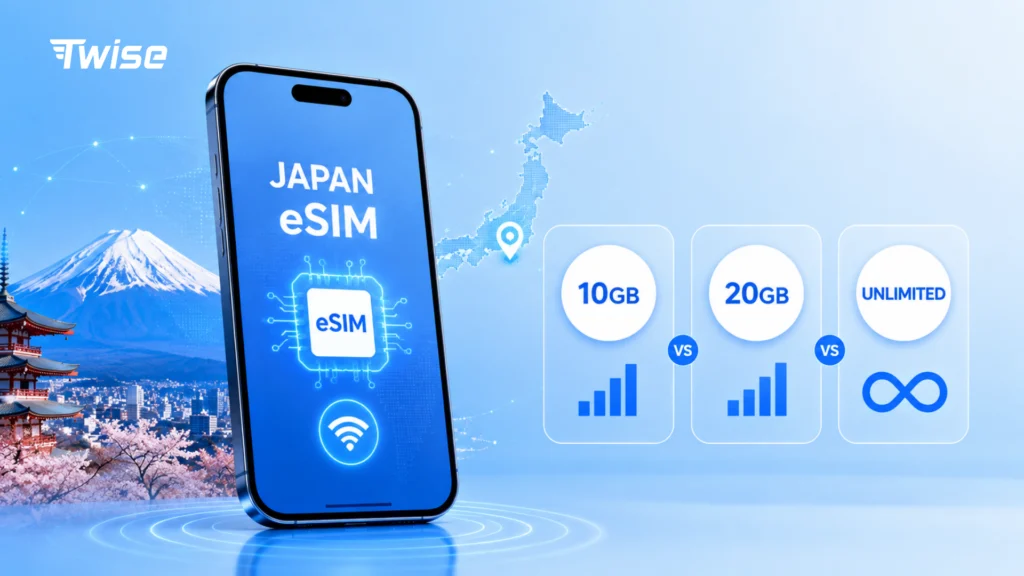
Choosing between a Japan eSIM 10GB, 20GB, or unlimited plan comes down to two things: how many days you’re traveling and how you actually use your phone day to day. Light users doing maps, translation, and messaging usually fit comfortably inside 10GB. Daily social media, photo uploads, and constant navigation push most travelers toward 20GB. Streaming, hotspot use, remote work, or simply not wanting to track a data counter are the cases where an unlimited or high-volume plan earns its higher price.
Trip length matters just as much as total GB. A 10GB plan used over 7 days behaves very differently from the same 10GB stretched across 30 days — the same allowance can feel generous on a short trip and tight on a long one.
| Usage pattern | Better starting point |
| Maps, translation, messaging, occasional social media | 10GB |
| Daily social media, photo uploads, frequent navigation | 20GB |
| Streaming, hotspot, video calls, remote work | Unlimited / high-volume |
Which Plan Fits Your Usage: Japan eSIM 10GB, 20GB or Unlimited
Choose 10GB if your phone is mainly a travel tool. If most of your data goes to Google Maps, translation apps, train schedule lookups, messaging, and email — with heavier tasks like uploading large photo batches or watching video handled on hotel Wi-Fi — 10GB is usually enough for a week-long trip and often stretches further. This is the plan for travelers who check their phone constantly but don’t treat it as their main entertainment or work device while abroad.
Choose 20GB if you’re on social media every day. Travelers who navigate constantly between neighborhoods, browse frequently, upload photos throughout the day, and scroll Instagram or TikTok need more headroom than 10GB gives without close monitoring. 20GB is the practical middle ground — generous enough for daily active use, though a habit of watching full-length videos or livestreaming can still burn through it faster than expected.
Choose unlimited if you don’t want to think about a data counter. Video streaming away from Wi-Fi, hotspotting a laptop or tablet, remote work video calls, or simply preferring not to monitor usage are all legitimate reasons to pay more for an unlimited or high-volume plan. None of these require justification — convenience itself is a valid reason to buy up.
One caution worth repeating: paying for unlimited adds little real value if you’re back at the hotel most evenings and only use cellular data for maps and messaging during the day. Bigger isn’t automatically better — it’s better for a specific usage pattern, and matching that pattern honestly is what actually saves money.
What Actually Uses Your Data in Japan
Most travelers underestimate how unevenly different activities consume data, which is why “10GB sounds like a lot” isn’t a useful way to decide.
Navigation itself is lighter than people expect — a single Google Maps route doesn’t use much. What adds up is the repetition: searching new routes in every neighborhood, loading place photos and reviews, and re-checking train times throughout a multi-city itinerary.
Text-based messaging (LINE, WhatsApp, iMessage, email) is genuinely light. The moment you start exchanging photos, voice messages, or short videos in those same apps, usage climbs quickly without feeling any different to use.
Social feeds are the most common reason a self-described “moderate user” runs out early. Instagram Reels and TikTok autoplay short-form video continuously — scrolling for 20 minutes on a train can use more data than an entire day of navigation.
Streaming (YouTube, Netflix) is the clearest and most predictable reason to move up from 10–20GB toward a larger or unlimited plan. There’s little ambiguity here: sustained video is the single biggest per-hour data cost of any common travel activity.
Video calls and remote work — Zoom, Google Meet, cloud file syncs, Slack — are harder to predict than streaming because usage varies by call quality and file size, which is exactly why remote workers tend to prefer unlimited over calculating a fixed allowance.
Automatic cloud backup is the easiest one to overlook. Google Photos or iCloud syncing large batches of travel photos in the background can quietly consume a meaningful chunk of a fixed allowance unless it’s restricted to Wi-Fi.
| Activity | Typical data impact |
| Maps / train navigation | Light per use, adds up over a multi-city trip |
| Messaging apps (text only) | Light |
| Messaging apps (photos/video) | Moderate |
| Social feeds (Instagram, TikTok) | Moderate to heavy |
| Streaming (YouTube, Netflix) | Heavy |
| Video calls / remote work | Unpredictable, often heavy |
| Auto photo/cloud backup | Easy to overlook, can be heavy |
10GB vs 20GB by Trip Length and Itinerary
Tokyo + Kyoto + Osaka, 7 days. This is the most common first-time itinerary, and 10GB covers it well for travelers who lean on hotel Wi-Fi in the evenings and use cellular mainly for maps, translation, and messaging between cities. Travelers who post to social media daily or upload photos constantly should lean toward 20GB instead — the extra buffer removes the need to think about it.
10–14 days across multiple cities. At this length, 20GB becomes the more comfortable default rather than the upgrade option. 10GB can still work, but it requires more deliberate Wi-Fi use, especially for anything involving photo or video uploads, since there’s less daily buffer to absorb an unusually data-heavy day.
3–4 weeks in Japan. Longer stays change the math: 20GB can still work for genuinely light, Wi-Fi-reliant users, but most travelers on a trip this long are better served comparing 20GB against 30–50GB fixed plans or unlimited, based on how much they rely on hotel Wi-Fi versus cellular data day to day. Our 30-day Japan eSIM guide breaks this down further for extended stays.
Remote work or content-creator trips. For travelers uploading content, joining video calls, or working from cafés between sightseeing, prioritize high-volume or unlimited plans with confirmed hotspot support over the lowest upfront price — running out of data mid-workday costs more in lost time than the plan upgrade would have.
Japan plus Korea or other Asian countries. If Japan is one stop on a longer regional trip, evaluate total data needs across the whole itinerary rather than country by country. A regional Asia eSIM can offer continuity across borders, though coverage and allowances vary by plan, so it’s worth checking against buying separate country-specific eSIMs.
For a two-week trip specifically, our 14-day Japan eSIM guide compares fixed-capacity providers in more detail.
When Is Unlimited Actually Worth It?
Unlimited isn’t automatically the smarter buy — it earns its price in specific situations, and it’s worth being honest about which one applies to you:
You stream video off Wi-Fi. Frequent YouTube, TikTok, or Netflix use during commutes or downtime is the single biggest reason fixed-data plans run short before a trip ends.
You need a hotspot for a laptop or second device. Tethering drains data fast, and this is one of the strongest real-world reasons to consider higher-volume or unlimited service — just confirm hotspot use is permitted under the specific plan’s terms before assuming it’s included.
You’re working remotely during the trip. Video meetings, cloud file transfers, and work sessions that vary in length and intensity are hard to size against a fixed cap, which is exactly the kind of unpredictability unlimited is built for.
You’d simply rather not track usage. That convenience has genuine value even when it isn’t the mathematically cheapest option — not every purchase decision needs to optimize for cost per GB.
“Unlimited” Doesn’t Always Mean the Same Thing
Before buying an unlimited Japan eSIM, check what “unlimited” actually includes — the word alone doesn’t guarantee uncapped high-speed data. Many travel eSIM providers apply a fair-use policy (FUP) that throttles speeds after a relatively low daily threshold, sometimes as little as 1GB per day, dropping speeds to a crawl for the rest of that day. Others set the threshold high enough that ordinary heavy use — streaming, navigation, social media — rarely triggers it at all.
Before buying, check three things specifically:
- The FUP threshold, if one exists — some providers disclose it, others bury it in fine print
- The post-threshold speed — a drop to a few hundred Kbps can make maps and messaging frustrating, not just streaming
- Whether hotspot/tethering is included under that specific plan’s terms, since some unlimited plans restrict or exclude it
Don’t compare “unlimited” and “20GB” by the label alone — compare the actual usable high-speed allowance and price against your real daily habits. Twise‘s own KDDI Unlimited plans operate under a fair-use policy with a high threshold rather than the aggressive low-cap throttling common among some travel eSIM resellers, but “high threshold” still isn’t the same as “no policy at all” — it’s worth confirming the current terms on the product page before you rely on it for a data-heavy day.
Twise Japan Plans, Matched to Usage
| Twise plan | Best for | Data options | Main tradeoff |
| Softbank Daily Plan | Light, budget-conscious users | 500MB–3GB/day | Predictable cost, but requires daily monitoring |
| Standard Fixed Data (Docomo network via IIJmio) | Moderate to heavy users with a predictable itinerary | 3GB–50GB fixed | Pick the tier that matches trip length, not just the lowest price |
| KDDI Unlimited 4G/5G | Heavy or unpredictable users, remote workers, content creators | Unlimited 4G or Unlimited 5G | Higher price point; confirm hotspot terms and current FUP details |
Not sure where you land? Compare Twise Japan eSIM options by expected data use rather than defaulting to the biggest plan available — no-KYC setup, QR code delivery within minutes, and dual-SIM convenience apply across all tiers, and a regional Asia eSIM is worth considering if Japan is one stop on a longer trip.
Make Your Data Last Longer
Whether you land on 10GB or 20GB, a few settings changes stretch the allowance meaningfully further: turn off automatic cloud photo and video backup on cellular data, download offline maps and any key content before you need it rather than mid-sightseeing, check which apps are using background data and restrict the heaviest ones, and save large downloads — app updates, big photo batches, movie downloads — for hotel Wi-Fi rather than cellular.
Quick Decision Recap
- Mostly maps, translation, and messaging → 10GB is likely enough
- Daily social media, uploads, and active phone use → 20GB is the stronger middle ground
- Streaming, hotspot, remote work, or unpredictable use → compare unlimited/high-volume
- Multiple countries on one trip → calculate total data needed across the whole itinerary before choosing a country-specific plan

FAQs
For most travelers using navigation, translation, messaging, and light-to-moderate social media, yes. Twise’s Softbank daily plans and smaller fixed-data tiers cover this well if you’re not streaming video heavily off Wi-Fi.
Generally yes for active but not extreme use. Twise’s standard fixed-data plans go up to 50GB on the same network, so if 20GB feels tight partway through the trip, stepping up a tier is straightforward rather than needing to switch providers.
Hotspot support depends on the specific plan, and it’s one of the details worth confirming before purchase if tethering is a priority — it isn’t automatically included on every tier.
If your usage is predictable and moderate, a fixed 20GB (or stepping up to 30–50GB) plan is usually the better value per dollar. Unlimited buys convenience and headroom for unpredictable days rather than being the cheapest option on paper.
More useful tips for your journey to Japan
