



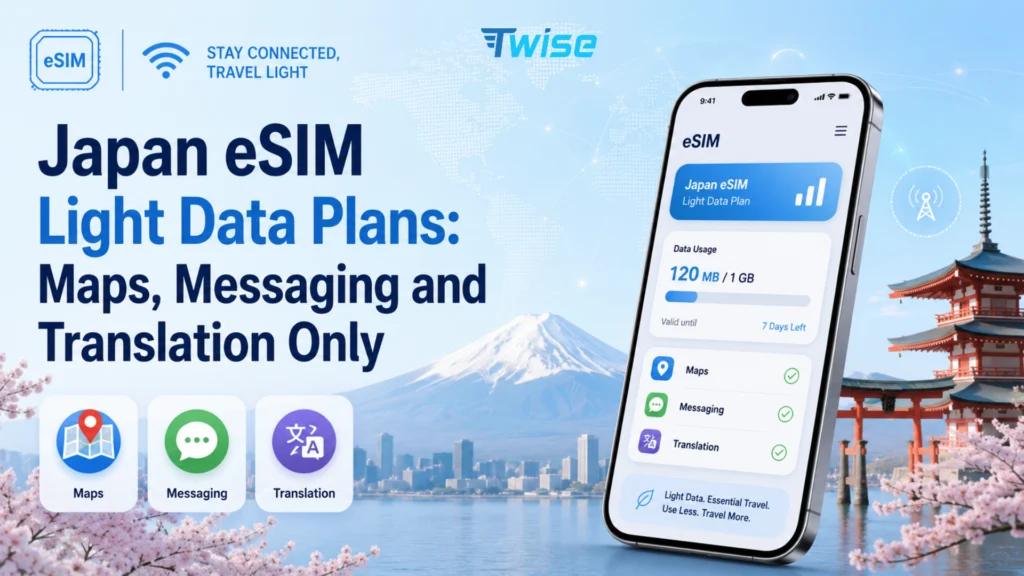
Japan eSIM Light Data Plans: Maps, Messaging and Translation Only
Sep
If your Japan trip mostly means navigation, train searches, messaging, translation, and occasional browsing, you likely don’t need unlimited data — a smaller fixed or daily-data plan is the right category to compare Japan eSIM Light data.
| Travel behavior | Starting data range to compare |
| Maps + messaging + translation | 3–5GB |
| Same use + light social browsing | Around 5GB |
| Longer trip with daily navigation | 5–10GB |
| Video/social-heavy use | Consider a larger plan |
What Counts as Light Data Use in Japan?
“Light” usage centers on a handful of everyday tasks rather than continuous streaming:
- Google Maps and train navigation — route searches, station directions, and walking navigation. Heavy place-browsing (scrolling reviews, photos) adds more than a quick route check.
- LINE, WhatsApp, iMessage, and email — text messaging is genuinely light; sending lots of photos or videos, or making video calls, changes the profile.
- Translation apps — text translation and occasional camera translation are light; keep an offline language pack as backup in case of no signal.
- Light web browsing — train times, attraction info, restaurant searches, and booking confirmations, as distinct from video-heavy browsing.
Are You Really a Light User?
Before buying the smallest plan, check whether your habits actually fit:
- You’re a light user if you rely on hotel Wi-Fi for downloads and media, and mainly use cellular data while walking, on trains, or communicating away from your accommodation.
- Social video changes the calculation — regular TikTok, Reels, or YouTube feeds can make a small-data plan run out fast.
- Photo backup can quietly break your plan — automatic iCloud or Google Photos uploads over cellular can drain a light-data allowance without you noticing.
- Hotspot use isn’t really “light.” If you plan to tether a laptop, see our [Japan eSIM hotspot guide for laptop users] instead — that changes the data math entirely.
3GB vs 5GB vs 10GB: Which Is Better for Japan eSIM Light Data Users?
For a genuinely light user — someone leaning on hotel Wi-Fi and using cellular mainly for maps, messages, and translation — 3GB typically fits a short 3–5 day city trip, and 5GB gives more breathing room across a full week or 10–14 days. That said, these figures assume disciplined, Wi-Fi-supplemented use: our [guide on how much data a 10-day Japan trip needs] found that travelers who default to 3–5GB for a full 10-day trip without watching usage often run out early once maps, translation, transit apps, and social media add up. The difference comes down to habits, not trip length alone — if you’re not sure which camp you’re in, the checklist above is the faster way to tell.
| Data allowance | Better for | Main advantage | Main risk |
| 3GB | Very light/short-trip user | Lower cost, less waste | Little buffer |
| 5GB | Typical light user | Better balance of price and flexibility | Heavy social use can consume it |
| 10GB | Light user wanting extra buffer | Less monitoring | May be unnecessary for Wi-Fi-heavy travelers |
| Unlimited | Heavy/unpredictable use | Maximum headroom | Usually overkill for this audience |
Choose 3GB if your trip is short and Wi-Fi is easy to access. Choose 5GB if you want some margin without paying for a lot of unused data. Choose 10GB if you’d rather not think about every MB, even if you expect to use less. If your actual habits already look closer to “medium” or “heavy” use, our [10GB vs 20GB vs Unlimited comparison] picks up from here.
Fixed Data vs Daily Data for Light Use
Beyond total size, structure matters — a trip-wide pool behaves differently from a daily reset:
| Plan type | Best for | Advantage | Limitation |
| 3–5GB fixed | Uneven usage | Use more on busy days | Must watch total allowance |
| 500MB/day | Consistently light use | Fresh allowance each day | Busy sightseeing day may hit limit |
| 1GB/day | Light-to-moderate use | More daily breathing room | May pay for unused daily data |
| 10GB fixed | Light user wanting buffer | Flexible trip-wide pool | Higher upfront cost |
Fixed data suits trips where some days are much busier than others — you draw more on a heavy sightseeing day and less when you’re mostly on hotel Wi-Fi. Daily data is easier to budget since you always know you’re starting fresh, but it doesn’t carry over unused data, so don’t buy a daily plan if you expect several near-zero-usage days.
How Trip Length Changes the Best Light-Data Plan
“5GB” isn’t equally right for every trip length:
- 3–5 days in Tokyo or Osaka — a smaller fixed package (around 3GB) is often enough when the trip is short and concentrated in one city.
- 7 days across Tokyo, Kyoto, and Osaka — compare 3–5GB for disciplined light use against 5–10GB if you want more margin while moving between cities.
- 10–14 days around Japan — 5–10GB or a small daily plan becomes more valuable even if your daily behavior stays light, simply because more days means more total navigation and messaging.
- 3–4 weeks — a small fixed package can become restrictive at this length; it’s worth comparing longer-duration plans instead of stretching a light-data package.
Can Hotel and Public Wi-Fi Let You Buy Less Data?
Yes, to a point — this is the core cost-saving strategy for light users, but it has limits:
- Use Wi-Fi for downloads and streaming — reserve hotel or café Wi-Fi for app updates, video streaming, cloud backup, and downloading large media.
- Keep cellular data for “on the move” moments — maps, station directions, hotel messages, translation, and booking access when you’re away from Wi-Fi.
- Keep an offline backup anyway — downloaded maps, accommodation details, and booking screenshots are worth having even with an active eSIM, in case of weak signal.
Twise Japan eSIM Options for Light Users
Twise’s Japan lineup covers both structures light users compare:
- Small fixed-data plans — Twise’s IIJmio/Docomo line starts at 3GB and scales up to 5GB, 8GB, 10GB, and beyond, so you can pick a pool sized to your trip rather than jumping straight to a large bundle.
- Small daily-data plans — Twise’s SoftBank daily plan starts at 500MB/day (with 1GB, 2GB, and 3GB/day options), and does support hotspot/tethering — though for a genuinely light-data trip, tethering isn’t the point of this plan.
- Don’t automatically buy unlimited — Twise’s larger and unlimited options solve a different problem (heavy, unpredictable use) and are usually unnecessary if you only need maps, messaging, and translation.
Only need essential travel apps? Compare Twise Japan eSIM plans starting with the smallest allowance that fits your trip, rather than paying for unlimited data you won’t use.
| Option | Small-data friendly | Setup before Japan | Keep home SIM | Physical pickup | Multi-country option | Best for |
| Twise Japan eSIM | Yes | Yes | Yes, on compatible dual-SIM phones | No | Available via regional plans | Light-data tourists |
| Physical tourist SIM | Product-dependent | Sometimes | Requires SIM management | May be needed | Usually Japan-focused | Non-eSIM devices |
| Home roaming | Carrier-dependent | Usually | Yes | No | Carrier-dependent | Travelers with inexpensive roaming |
| Pocket Wi-Fi | Usually excessive for one light user | Reservation possible | Yes | Pickup/return | Rental-dependent | Groups/multiple devices |
Pocket Wi-Fi or an unlimited mobile plan can be unnecessary expense and hassle for a solo traveler who only needs essential apps, while home roaming can stay competitive if your own carrier already includes a small Japan allowance — an eSIM isn’t automatically the cheapest option for everyone.
How to Buy Without Overbuying
A few checks and habits make a small plan go further:
Before you buy:
- Check the validity window against your actual trip length, not just the GB number.
- Check if top-ups are available — a slightly smaller plan is less risky when you can top up mid-trip.
- Know what happens at zero — some plans stop working entirely, while daily plans throttle to a slower speed instead.
- Check background data settings on your phone — this matters almost as much as plan size.
- Check multi-country coverage if you’re continuing past Japan, so you’re not buying several separate small eSIMs.
To make 3–5GB last longer:
- Download offline maps for key areas in advance.
- Turn off cellular photo/video backup.
- Restrict autoplay video in social apps.
- Download translation resources before the trip.
- Save tickets and hotel details offline.
To set up your Twise eSIM: estimate your essential-app usage, choose fixed or daily light data based on how your trip is structured, then install the QR code before departure — a compatible dual-SIM phone lets you keep your home line active for calls while the Twise eSIM handles data.
Which Light-Data Plan Fits Your Traveler Type?
- Weekend or 3–5 day visitor → start around a small fixed package if you’ll lean on accommodation Wi-Fi.
- 7-day first-time tourist → 3–5GB is the main range to compare for genuinely light usage.
- 10–14 day traveler → compare 5GB against a small daily plan, or a larger fixed allowance for extra security.
- Traveler who only needs essential apps (navigation, messaging, translation) → stay in the 3–5GB range rather than buying for social/video use you don’t plan to do.
- Japan plus Korea or Taiwan → a small Asia regional eSIM can make more sense than buying several separate country eSIMs.
Only need essential travel apps? Compare Twise Japan eSIM options with no-KYC setup, digital QR delivery, dual-SIM convenience, and smaller data choices before paying for a plan you may not use.
Bottom line: 3–5 days + Wi-Fi-heavy use → compare around 3GB. One week + Maps/messages/translation → compare 3–5GB. 10–14 days + genuinely light use → start around 5GB or compare a small daily plan. Frequent social video, streaming, or hotspot use → you’re probably no longer a light user; compare 10GB, 20GB, or unlimited instead. Multi-country itinerary → consider a regional data pool.
FAQs
It can work for disciplined light use centered on maps, messages, translation, and occasional browsing — especially if heavier activities stay on Wi-Fi.
It can be a practical light-user allowance, but frequent social video or photo uploading will change that recommendation — those habits push you into a medium-data category.
There’s no single universal figure — navigation is generally lighter than streaming, but actual use varies with how many route searches and place lookups you do.
Not if you’re a genuinely light user. If you expect heavy streaming, social video, or hotspot use, an unlimited or high-volume plan is the better comparison.
It can suit maps, basic messaging, translation, and light browsing when video and large uploads are avoided. Twise’s Japan daily plans start at 500MB of high-speed data per day.
More useful tips for your journey to Japan
- Why Japan Prepaid eSIMs Are Great for Travelers – And Do They Include Phone Numbers?
- Rakuten Mobile eSIM Japan for Travelers: Good Fit or Local-Only Option?
