




Japan Local eSIM: Local Carrier Plans vs Travel eSIM for Tourists
Aug
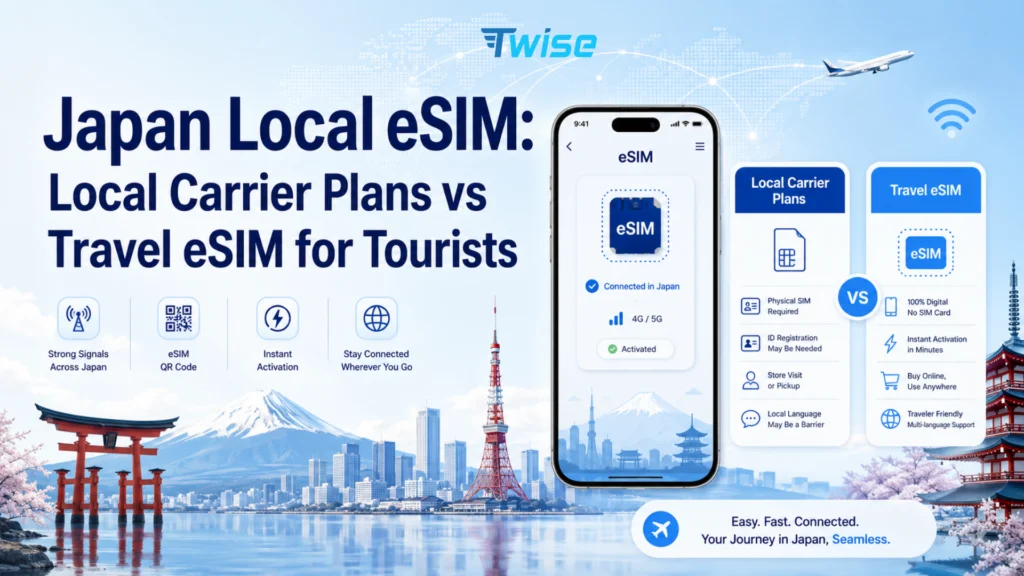
A Japan local eSIM can mean two different things: a direct eSIM contract with a Japanese carrier, or a travel eSIM that connects through a Japanese carrier’s network. For short-term tourists, the second option is usually easier to research, because it can be purchased before arrival without opening a standard Japanese mobile account.
Travelers researching this topic will run into three major network names — KDDI (au), NTT Docomo, and SoftBank — plus MVNOs like Rakuten Mobile and IIJmio that operate on top of those networks. This guide isn’t a ranking of those carriers; it’s a breakdown of what “local” actually means so you can pick the right product type for your trip.
What Does “Japan Local eSIM” Actually Mean?
The terms “local carrier,” “local network,” and “travel eSIM” get used interchangeably, but they describe different relationships with the network.
Direct local carrier eSIM means getting an eSIM through a Japanese operator’s own consumer service — inside that carrier’s standard contract and account system, usually with identity verification and a Japanese payment method.
Travel eSIM using a Japanese local network means a travel provider sells a short-term data eSIM that connects through KDDI, SoftBank, Docomo, or an MVNO riding on one of those networks — without requiring the tourist to become a standard subscriber.
The key takeaway: local network access and a direct carrier contract are not the same thing. A travel eSIM can legitimately run on the same physical KDDI or Docomo towers as a resident’s phone, while the purchasing process, KYC requirements, and account structure are completely different. Checking the underlying network separately from who sells the eSIM is the single most useful filter for this decision.
Can Tourists Buy an eSIM Directly From Japanese Carriers?
Japanese operators do support eSIM — but “supports eSIM” and “sells a tourist-ready eSIM” aren’t automatically the same product.
KDDI / au treats eSIM as part of its standard mobile-contract procedures, with a contract processing fee for new subscriptions. This is built for residents opening a normal account, not for a two-week visit.
NTT Docomo links its eSIM application and reissue process to its regular line services, and some of the online procedures are only available in Japanese — again, oriented around existing or new domestic subscribers rather than short-term visitors.
SoftBank does have a dedicated visitor product, but it’s worth reading the fine print: its official “Prepaid SIM for Travel” is a data-only physical SIM, not an eSIM, and it requires the visitor’s original passport at signup. If you’re specifically looking for an eSIM, SoftBank’s own visitor-facing product isn’t it — you’d be looking at a travel eSIM that happens to route through the SoftBank network instead.
Rakuten Mobile supports eSIM activation with a fast, app-based process, but it comes with a detail that matters more than most guides mention: Rakuten requires a Residence Card or Special Permanent Resident Certificate for identity verification. In practice, that means tourists on a short-term visa generally can’t sign up for Rakuten Mobile at all — it’s built for residents, not visitors, regardless of how eSIM-friendly the activation flow looks.
Local Carrier eSIM vs Travel eSIM: Key Differences for Tourists
| Feature | Direct Japanese carrier eSIM | Japan travel eSIM |
| Japanese network access | Yes | Often, depending on provider |
| Buy before arrival | Product-dependent | Usually |
| Passport/KYC | Often required for carrier contracts | Often not required |
| Japanese address/account requirements | May apply | Usually not |
| Japanese phone number | Often available with full mobile contracts | Usually data-only |
| Short tourist validity | Not the main product model | Common |
| QR/digital delivery | Available | Common |
| Multi-country coverage | Usually Japan only | Available with regional plans |
| Best for | Residents / long stays / local-number needs | Short-term tourists / data users |
The real difference isn’t “local vs. travel” as labels — it’s what telecom relationship you actually need. A tourist spending 7–14 days using Maps, LINE, translation apps, and train schedules has very different requirements from someone relocating to Japan for six months who needs a permanent local account.
Does a Travel eSIM Still Use a Local Japanese Network?
Yes, in many cases — but not automatically, and not identically across providers. A locally routed travel eSIM connects as a direct subscriber to a Japanese network (KDDI, SoftBank, or Docomo, often via an MVNO layer like IIJmio), which typically means more consistent performance than international roaming. That said, no provider should be assumed faster everywhere — underground metro sections, rural mountain routes, and some long-distance rail tunnels will vary by carrier regardless of routing method.
The practical step is simple: check which underlying network a travel eSIM discloses, rather than judging by the eSIM brand alone. Twise, for example, lists Japan travel eSIM plans that run directly on the KDDI network, alongside SoftBank and Docomo (via IIJmio) options — so a traveler isn’t forced to choose between “real local network access” and “easy tourist setup.”
KDDI vs SoftBank vs Docomo: A High-Level Comparison
| Network | Typical strength | Worth checking |
| KDDI (au) | Strong on mainstream tourist routes — Tokyo, Kyoto, Osaka, major rail corridors | Performance in dense underground/tunnel sections |
| SoftBank | Widely used in travel connectivity products | Actual data policy and throttling, not just the carrier name |
| Docomo | Broadest national footprint, useful for regional/rural itineraries | Current coverage on your specific route |
No single network is a universal “best” answer — compare data limits, throttling thresholds, hotspot rules, and plan validity alongside the network name itself. For carrier-specific deep dives, see Twise’s dedicated KDDI and network comparison articles here.
Do Tourists Need a Japanese Phone Number?
For most short trips, no. Data-only is enough for Maps, LINE, WhatsApp, FaceTime/iMessage, translation tools, email, and train-planning apps — nearly everything a tourist itinerary depends on runs over data, not voice/SMS.
A Japanese number may matter if you need to make local voice calls, receive SMS from a Japanese business, or use a service that specifically requires a domestic number (some restaurant reservation lines, for instance).
One distinction worth flagging clearly: a local phone number and identity verification are not the same thing. Even where a temporary Japanese number is available, it doesn’t automatically satisfy resident-oriented banking, government, or identity-verification processes that expect a registered address and residence documentation.
Japan Local eSIM vs Physical SIM vs Roaming vs Pocket Wi-Fi
| Option | Keep home SIM | Buy before arrival | Local number | Store/pickup | Multi-country | Best for |
| Local-network travel eSIM | Yes (dual-SIM phones) | Yes | Usually no | No | Yes, with suitable plans | Tourists prioritizing data |
| Direct Japanese carrier eSIM | Yes, if dual-SIM | Varies | Usually available | May require carrier process | Usually no | Residents / long stays |
| Physical tourist SIM | Requires SIM swap | Product-dependent | Sometimes | Delivery/store may apply | Usually Japan only | Non-eSIM phones |
| Home roaming | Yes | Already active | Keeps home number | No | Carrier-dependent | Travelers prioritizing simplicity |
| Pocket Wi-Fi | Yes | Reservation possible | No | Pickup/return often applies | Rental-dependent | Groups/multiple devices |
There’s no universal winner — the right choice depends on whether you value a local number, easy pre-trip setup, heavy data use, hotspot sharing, or onward multi-country travel.
View Top Japan Local eSIMs Here
Which Japan Local eSIM Setup Fits Your Trip?
5–10 day Tokyo/Kyoto/Osaka trip: a short-term local-network data eSIM is usually the simplest fit for maps, transport, translation, and messaging — no local number needed.
Heavy data or remote-work trip: prioritize actual high-speed thresholds, fair-use policy, and hotspot support over the word “unlimited” alone, since post-cap speeds vary widely between plans.
Long stay or genuine need for a Japanese number: this is where comparing a direct carrier contract or a longer-term local mobile service (with its KYC requirements) makes more sense than a short-term travel eSIM.
Japan plus Korea, Taiwan, or other destinations: a regional multi-country eSIM is often more practical than opening a Japan-only account, since it avoids re-purchasing connectivity at every border.
What to Check Before Buying a Japan Local eSIM
- Network and routing — confirm which Japanese carrier is actually used, and whether the provider discloses this clearly.
- High-speed data and throttling — distinguish a genuinely high-capacity plan from a small daily allowance that slows down after a low threshold.
- Hotspot support — matters most for laptop users or travelers sharing one connection.
- Activation and validity — check whether validity starts at installation, first network connection, or another trigger, before scanning the QR code.
- Device compatibility — confirm both eSIM support and carrier-unlocked status before paying.
Why a Local-Network Travel eSIM Can Be a Middle Ground
Once you understand both ends of the spectrum — a full Japanese carrier contract on one side, generic international roaming on the other — the appeal of a local-network travel eSIM becomes clearer: Japanese carrier-level network access without the account-opening friction of becoming a direct subscriber.
This is where Twise’s positioning is genuinely differentiated on verifiable terms, not just marketing language:
- No Japanese ID/KYC requirement on its Japan travel eSIM plans, unlike a direct carrier or Rakuten contract.
- Instant QR-code delivery rather than in-store collection or passport-based physical SIM issuance.
- Dual-SIM compatibility on supported devices, so a traveler’s home line stays active alongside the Japan eSIM.
- Direct KDDI network access, plus SoftBank and Docomo (via IIJmio) options, for travelers who want to choose by route rather than brand.
- Regional/multi-country plans available when Japan is one stop on a longer trip.
Travelers comparing options can look at Twise’s Japan eSIM plans by network, data allowance, and trip length — rather than picking based on price alone.
How to Prepare a Twise Japan eSIM Before Departure
Check your phone first — confirm eSIM support, carrier-unlocked status, and dual-SIM functionality before purchasing anything.
Choose local Japan or multi-country coverage based on your route, trip length, expected data use, and whether Japan is your only destination.
Install on reliable Wi-Fi before you fly — the QR code can typically be delivered and the profile prepared in advance, but each plan’s specific activation trigger (installation vs. first network connection) should be checked so validity doesn’t start early.
For tourists who want a Japan network eSIM without opening a standard carrier account, Twise’s local KDDI-based Japan plans support QR delivery and no-KYC setup ahead of departure.
Buy Your Japan Local eSIMs Here
Local Carrier or Travel eSIM: Which Should Tourists Choose?
- Short-term tourist, mainly needs data → a travel eSIM using a Japanese local network.
- Long stay or genuine Japanese phone-number need → compare direct carrier or local subscription options.
- Japan plus other countries → a regional eSIM for easier cross-border data continuity.
For most short trips, a local-network travel eSIM — such as Twise’s KDDI-based Japan plans — offers Japanese carrier performance with pre-trip digital setup, without the account-opening steps required by a direct carrier contract.

FAQ About Japan Local eSIM
Yes, but there are two different purchasing models: a direct carrier contract (built for residents) and a travel eSIM that uses a Japanese local network (built for short-term visitors). They aren’t interchangeable.
au/KDDI supports eSIM within its own carrier ecosystem, primarily for standard subscribers. Tourists can instead find travel eSIM products that run on the KDDI network — such as Twise’s Japan KDDI eSIM — without opening a standard au account.
It depends on what “local” means to you. Tourists who mainly need data can usually get Japanese-network access through a travel eSIM; a direct carrier plan makes more sense for longer stays or genuine phone-number needs.
Most are data-only. If you specifically need local calls or SMS, confirm this before purchase — don’t assume it’s included.
More useful tips for your journey to Japan
- Sakura Mobile Japan eSIM Review for Tourists: Setup, Coverage, Data & Alternatives
- T-Mobile in Japan vs Japan eSIM: Roaming, Coverage, Cost & Data Limits
- Is Buying an eSIM App for Japan Really Convenient? A Traveler’s Guide to Smarter Mobile Setup
- Best Apps for Travel in Japan: Maps, Translation, Train Routes, IC Cards & eSIM Setup
