

Social Media Access in China: Can Wi-Fi or eSIM Help?
Aug
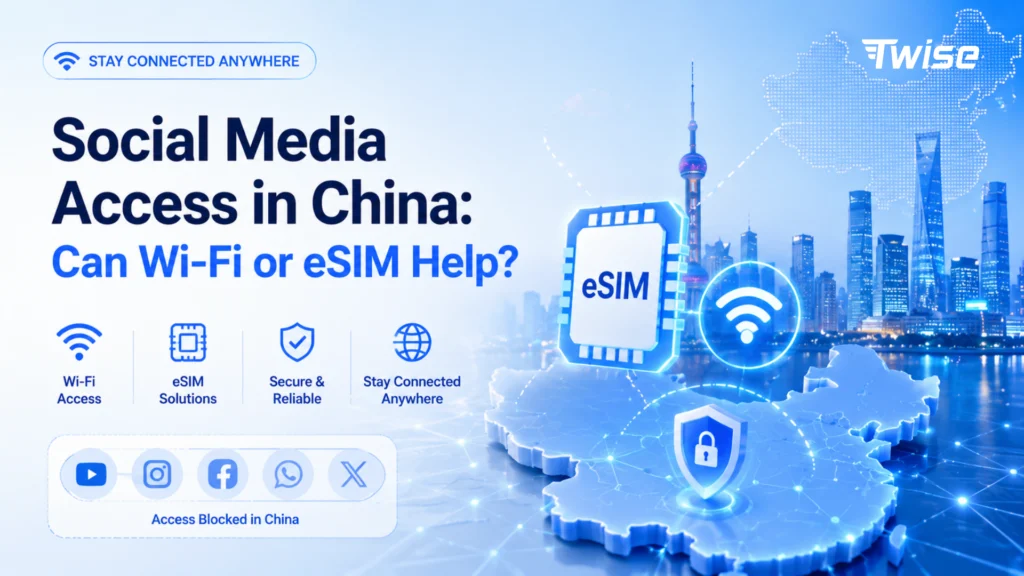
China is highly connected, but the internet may not work the way international travelers expect. You can arrive at a Shanghai hotel with fast Wi-Fi and still find that Instagram, Facebook, YouTube, or Google will not load.
That makes social media access in China less about finding Wi-Fi and more about understanding how your internet connection is routed. For travelers who depend on WhatsApp, Gmail, Instagram, or other international services, choosing the right connection before arrival can save considerable frustration.
Why Does Social Media Work Differently in China?
Mainland China controls access to many overseas websites and online services. Current UK travel guidance specifically lists Google, Facebook, YouTube, and X among services that are permanently blocked, while access to other websites can also change.
Other popular international messaging and social platforms may also be unavailable or unreliable through ordinary domestic internet connections.
This affects more than posting holiday photos. Travelers may depend on Gmail for hotel confirmations, WhatsApp for family communication, Google services for work, or YouTube and Instagram for content creation.
The important point is that Wi-Fi and mobile data are separate internet connections. Having an eSIM installed does not automatically change what happens when your phone connects to hotel Wi-Fi.
Will Hotel or Public Wi-Fi Give You Social Media Access in China?
Usually, you should not assume it will.
When your phone connects to Wi-Fi at a hotel, airport, restaurant, or café in mainland China, your internet traffic travels through that local Wi-Fi network. Your travel eSIM is not carrying the data at that moment.
Therefore, an eSIM that gives you access to certain international services over mobile data will not automatically make those services available through Chinese Wi-Fi.
This can create a confusing situation:
You use Instagram successfully while walking around Beijing with mobile data. You arrive at your hotel, your phone automatically joins Wi-Fi, and suddenly the app stops refreshing.
Nothing is necessarily wrong with your eSIM. Your phone has simply switched to a different internet route.
Can a Travel eSIM Help With Social Media Access in China?
It can, but the type of eSIM matters.
Some international travel eSIMs route mobile traffic through infrastructure outside mainland China’s domestic internet environment. Depending on the plan and routing arrangement, this can allow access to services that would normally be restricted on a domestic Chinese connection.
Twise offers selected China travel eSIM plans with international routing that can provide access to services such as Google, Facebook, Instagram, WhatsApp, and YouTube. Travelers should check the exact product before purchasing because this capability does not apply identically to every China eSIM plan.
Eligible Twise plans can also be delivered digitally by QR code, and Twise states that its China travel eSIM options do not require passport verification.
This makes it possible to prepare your mobile data before arrival rather than depending entirely on airport SIM counters or hotel Wi-Fi.
Buy Twise China eSIM using social media in China
China Wi-Fi vs Travel eSIM vs Other Options
| Connection | International social apps | Main advantage | Main limitation |
| Chinese hotel/public Wi-Fi | May be restricted | Saves mobile data | Follows the local internet environment |
| Local Chinese SIM | Restrictions normally apply | Local mobile connectivity | International services may remain inaccessible |
| Selected Twise China eSIM | Can support international services depending on plan | QR setup, no passport verification, travel-focused routing | Must verify the specific plan; some services can still have exceptions |
| Other international travel eSIMs | Depends on provider and routing | Convenient mobile data | Do not assume every eSIM bypasses restrictions |
| Home carrier roaming | Depends on carrier routing | Keep your existing mobile service | International roaming can be more expensive |
The word “eSIM” alone does not guarantee unrestricted internet. Routing is the feature travelers should check.
A Practical Setup for Social Media Users
If access to international apps matters during your trip, install your travel eSIM before departure while you still have reliable internet.
Once in China, select the travel eSIM as your cellular-data line. On many travel eSIMs, Data Roaming must also be enabled for that eSIM to connect to its partner network.
Keep Data Roaming turned off on your home SIM if you do not want it accidentally consuming expensive international data.
Then pay attention to Wi-Fi. If Instagram or another service works through your eSIM but stops after you enter a hotel, temporarily switch Wi-Fi off and test the app again using mobile data.
This simple test can tell you whether the problem is the app, the eSIM, or the Wi-Fi connection.
Prepare Your Apps Before Flying to China
Connectivity preparation should start before your flight rather than after landing.
Sign into important accounts in advance, update your apps, and make sure you can access your password manager and authentication methods. Download offline copies of essential reservations, addresses, train tickets, and maps where possible.
Travelers relying heavily on social media should also watch their data usage. Uploading reels, high-resolution photos, cloud backups, or video can consume a fixed data allowance much faster than messaging.
You can save data by postponing automatic photo backups and app updates until you are on a connection where those services work and you are comfortable using the available network.
There is another China-specific detail worth checking: individual app support can vary by plan. For example, one current Twise China Mobile daily-data product specifically notes that TikTok is not supported even though internet-based calls and other data services work.
Do not assume that “social media access” means every global app behaves identically.
What About Using a VPN in China?
A VPN is separate from both Wi-Fi and an eSIM. It changes how traffic is routed over whichever internet connection you are already using.
However, travelers should not treat a VPN as an automatic recommendation for China. UK travel guidance states that VPN and other online services need to comply with Chinese licensing requirements, while U.S. and Australian travel advisories also warn travelers about legal restrictions around services used to bypass local internet controls.
If your selected international travel eSIM already provides the access you need through its mobile-data routing, adding another service may therefore be unnecessary. Always follow current local regulations.
Stay Connected Without Depending on Hotel Wi-Fi
Finding Wi-Fi does not necessarily solve the problem of social media access in China. The connection route matters more than the Wi-Fi symbol at the top of your screen.
If losing access to WhatsApp, Google, Instagram, or other everyday travel apps would disrupt your trip, choose your connectivity before departure and verify exactly what the plan supports.

FAQ About Social Media Access in China
More Helpful Tips for Your Journey
- How Much Does a Travel Hotspot Cost? Pocket Wi-Fi vs Phone Hotspot vs eSIM
How Much Data Does YouTube Use? 480p, 720p, 1080p & Travel Data Tips
How Much Data Does Spotify Use Per Hour? Travel Data Guide - Does FaceTime Use Data? How Much Data FaceTime Uses When Traveling
- Why Does My iPhone Say SOS? Causes, Fixes & Travel eSIM Tips
