




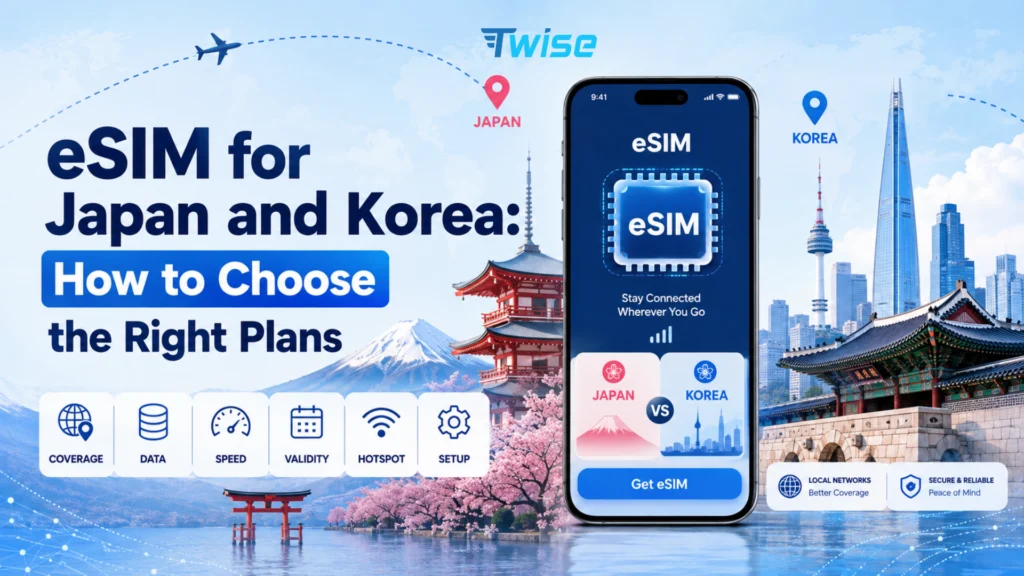
eSIM for Japan and Korea: How to Choose the Right Plans
Aug
Travelers visiting both Japan and South Korea have two workable options: use one compatible regional Asia eSIM, or buy separate country-specific eSIMs for each destination. The better choice depends on your itinerary length, how much data you actually use, whether you need a local phone number eSIM for Japan and Korea, and how much you value convenience over customization.
Quick decision summary:
- Best for convenience: one regional eSIM covering both countries.
- Best for heavier country-specific data: separate Japan and Korea plans.
- Best if you need a Korean number: check a dedicated Korean tourist voice/SMS plan instead of assuming a data-only travel eSIM includes one.
Think about the trip as it will actually happen: landing at Narita, Haneda, or Incheon, opening Google Maps or Naver Map, translating a menu, messaging your hotel, navigating a train transfer, and making sure your home carrier isn’t quietly charging you roaming fees the whole time. The right eSIM setup should disappear into the background of all of that.
One Regional eSIM vs. Separate Japan and Korea eSIMs
A regional eSIM lets you install once and keep using mobile data as you move from Japan to South Korea, without buying or reconfiguring another profile — provided the specific plan you choose explicitly lists both destinations. Twise‘s Asia and multi-country catalog includes several plans covering Japan, Korea, and other Asian destinations together, in daily, fixed, or unlimited formats.
Separate local eSIMs make more sense when one destination carries much heavier usage than the other, when you want a specific local network (KDDI or SoftBank in Japan, SKT in Korea), or when you need a specialized plan like Korea’s true unlimited SKT option. One technical trade-off worth knowing: a multi-country eSIM sometimes routes more like an international roaming connection than a fully local one, which can mean marginally higher latency in dense areas compared with a plan built directly on a single country’s domestic network. For most everyday tasks — maps, messaging, browsing — this difference is not noticeable; it matters more for things like video calls or competitive online gaming.
The quick rule: choose regional for convenience and continuity across both countries. Choose separate local plans when you want more control over network choice, data volume, or destination-specific features like an unlimited option in just one country.
What to Compare Before Buying
Before checkout, run through these six checks:
- Does the plan actually cover both countries? Don’t assume an “Asia eSIM” automatically includes both Japan and South Korea — confirm the destination list before paying.
- Local network and 4G/5G access. The provider name matters less than which local network the plan connects to, and whether your phone supports its LTE/5G bands.
- Fixed, daily, or unlimited data. Light travelers using mostly maps and messages need less than heavy users streaming or working remotely — and whenever a plan says “unlimited,” check the fair-use or throttling policy behind it.
- Hotspot and tethering rules. This matters if you’re sharing data with a laptop, a second phone, or a travel companion.
- Validity and activation timing. Confirm whether validity starts at installation, at first network connection, or another trigger, so the plan doesn’t start counting down before you land.
- Calls, SMS, and local phone numbers. Many international travel eSIMs are data-only. If you need to make restaurant reservations by phone, receive local SMS, or want a Korean number, you’ll need to specifically choose a plan that supports it.
Choosing an eSIM for the Japan Leg of Your Trip
For most tourists, a Japan data-only eSIM is enough. It covers Google Maps, LINE/WhatsApp/iMessage, translation apps, JR route searches, hotel communication, QR ticket scanning, and general browsing — the bulk of what a short-term visitor actually needs. Twise’s Japan catalog includes local KDDI data-only options (daily and unlimited) alongside broader multi-country travel plans, so the same purchase decision framework from this article applies.
You may need more than mobile data if you specifically require a Japanese phone number for reservations, deliveries, or local verification codes, or if you want conventional voice/SMS rather than app-based messaging. Verify these features before buying rather than assuming any given Japan eSIM includes them — most data-focused travel eSIMs don’t.
Compare Japan and Korea eSIM Plans Here
Choosing an eSIM for the Korea Leg of Your Trip
Korea has a particularly important distinction to get right: data-only eSIMs versus tourist plans with local voice/SMS.
Korea data-only is enough for the vast majority of tourist activity — Naver Map, KakaoMap, Papago translation, WhatsApp, hotel and tour messaging, browser searches, and transport information all run fine over data alone.
You’d need a Korean phone number if you specifically require Korean calls or SMS — for reservation calls, delivery apps, or local OTP verification. Data-only eSIMs, including Twise’s, won’t provide these; dedicated tourist telecom plans with a 010 number cover that need instead, and those often involve passport verification during signup.
On the data side, Twise‘s Korea catalog actually offers three distinct product types, and it’s worth knowing which is which before you buy: a daily plan (500MB–3GB of high-speed data per day, then a reduced speed until the next reset), a true unlimited SKT plan (unlimited 5G/4G with no daily cap, valid for 1–30 days), and a fixed-data plan (1GB–30GB for a set validity period). None of Twise’s Korea data-only products include cellular calls or SMS.
Which Plan Fits Your Japan–Korea Itinerary?
Tokyo → Kyoto → Seoul, 10–14 days: a regional eSIM is likely attractive here — usage is typically moderate across both countries, and one setup for the whole trip removes the hassle of switching profiles mid-journey.
Japan for 10 days + Korea for 3 days: compare a stronger Japan-specific plan plus a small Korea top-off against a single regional plan, rather than assuming you need two full-sized packages.
Japan for 3 days + Korea for 10 days: flip the allocation — a lighter Japan plan paired with a higher-data or unlimited Korea option usually fits this pattern better than an even split.
Heavy data, remote work, or hotspot use: check the high-speed allowance, fair-use policy, and hotspot terms separately for each country instead of choosing purely on the word “unlimited” — a plan can be generous in one country’s product line and capped in the other’s.
Regional vs. Local vs. Roaming: Full Comparison
| Option | Best for | Japan + Korea continuity | Setup | Local number | Main limitation |
| Twise regional/Asia eSIM | Multi-country trips | Yes, if both destinations are listed on the plan | One QR/profile | Usually no | Less country-specific customization |
| Separate Twise Japan + Korea eSIMs | Different usage per country | Requires switching profiles | Two plans | Usually no | More setup steps |
| Local physical SIM | Travelers needing local telecom features | No | Airport/store purchase | May be available | SIM swapping and possible ID checks |
| Home-carrier roaming | Maximum simplicity | Usually yes | Minimal | Keeps home number | Can be expensive |
| Pocket Wi-Fi | Groups, multiple devices | Rental-coverage dependent | Separate device | No | Charging, carrying, and returning the device |
Takeaway: one regional plan wins on simplicity. Separate country plans win on customization. Local telecom products are worth comparing only when voice, SMS, or a local number is genuinely essential to your trip.
Buy Your Japan and Korea eSIMs Here
Setup Before You Fly, and Why Travelers Choose Twise
Before departure: confirm your phone is carrier-unlocked and eSIM-compatible, purchase your selected plan, and install the QR profile over stable Wi-Fi ahead of time.
When you land in Japan: select the eSIM as your active mobile-data line and enable data roaming if the specific plan requires it.
When you fly from Japan to Korea: if you bought an eligible regional plan, you typically continue on the same profile without reinstalling anything. If you bought individual country plans instead, switch your data line to the Korea eSIM after landing.
Twise’s data-only travel eSIMs generally don’t require KYC or passport verification, QR codes are delivered instantly by email, and dual-SIM devices let you keep your home SIM active for calls or bank verification while the eSIM handles data. That said, a physical SIM, home-carrier roaming, or Pocket Wi-Fi can still be the better call if you specifically need a local number, have a locked or eSIM-incompatible phone, are traveling as a group needing several connected devices at once, or simply prefer getting help in person at a carrier counter.
Compare Your Japan and Korea eSIM Options Before You Fly
Traveling to both Japan and Korea? Compare Twise’s local and multi-country eSIM options before departure, choose the data plan that matches your route, install your QR code in advance, and keep your primary SIM available on compatible dual-SIM phones.

FAQs: eSIM for Japan and Korea
Yes, if the specific regional or Asia eSIM you choose explicitly lists both Japan and South Korea as covered destinations. If it doesn’t, you’ll need separate country-specific plans.
One plan generally favors convenience and a single setup. Two destination-specific plans give you more control over network choice, data volume, and validity in each country.
It depends on the product. Eligible data-only travel eSIMs, including Twise’s, typically don’t require identity verification. Local voice/SMS products with a phone number often do.
Yes, on compatible dual-SIM devices. It’s worth turning off data roaming on your home line so you don’t rack up accidental roaming charges while your eSIM handles data.
Most travel eSIMs for both countries are data-only. If you need local calls, SMS, or a phone number, verify that specifically before buying — it’s usually a separate product category.
More useful tips for your journey
- Why Japan Prepaid eSIMs Are Great for Travelers – And Do They Include Phone Numbers?
- Rakuten Mobile eSIM Japan for Travelers: Good Fit or Local-Only Option?
- Can You Install eSIM Without Activating It? iPhone Setup Guide
