




Japan eSIM Price Comparison: Budget vs Unlimited vs Local-Network Plans
Aug
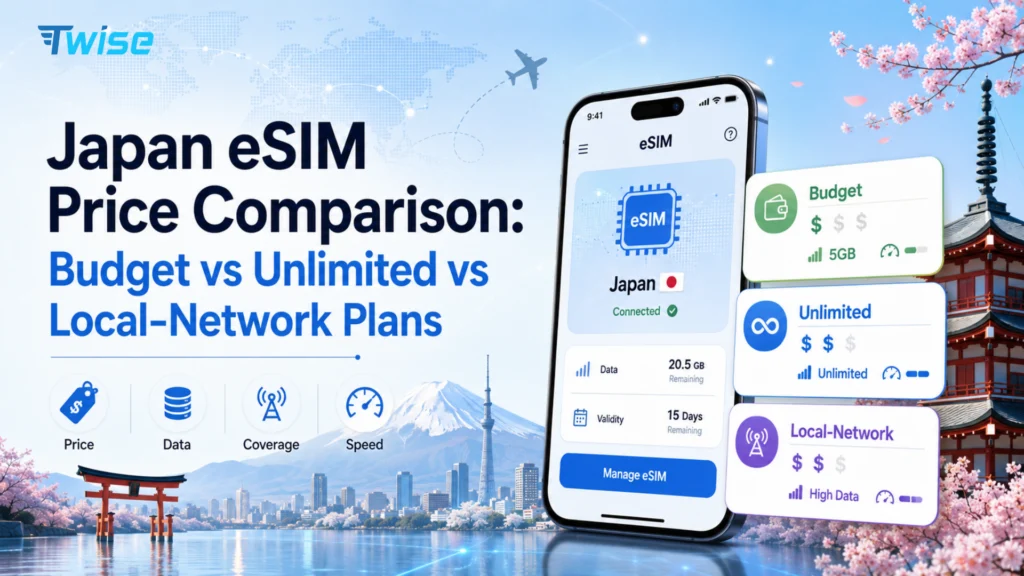
Japan eSIM price comparison by checkout price alone misses the point. What actually changes between tiers is usable high-speed data, validity, network access, hotspot policy, and convenience — the cheapest plan isn’t automatically the worst value, and the most expensive isn’t automatically the best fit.
| Price tier | Typical product style | Best for |
| Budget | Small fixed/daily data | Light users |
| Mid-range | 10–30GB fixed data | Typical active tourists |
| Premium | High-volume/unlimited | Heavy users |
| Local-network-focused | Japan-specific carrier access | Travelers prioritizing local-network options |
Twise’s Japan catalog spans all four of these structures, including local KDDI-based options — so this comparison uses real product categories rather than a generic brand roundup. For a deeper look at how to calculate actual dollar cost per day or per GB, see our [Japan eSIM cost guide] — this article focuses on which tier fits your trip, not on running the numbers.
What Are You Actually Paying for With a Japan eSIM?
A higher price can reflect several different things, not just “more data”:
- Data allowance — a small fixed package sits in a different price tier than 20GB, 50GB, or high-volume service.
- Validity — comparing two differently priced plans without checking how many days each one covers can be misleading.
- High-speed policy — the amount of usable high-speed data matters more than an “unlimited” label by itself.
- Network and routing — you may also be paying for a different underlying Japanese network or product architecture (for example, direct domestic carrier access versus a roaming-based product).
- Hotspot and other features — tethering support and similar practical features can shift the value equation for some travelers.
Japan eSIM Price Tiers: Budget, Mid-Range, Unlimited and Local Network
| Tier | Typical data model | Main advantage | Main tradeoff | Best suited to |
| Budget | Small fixed/daily data | Low upfront spend | Less buffer | Light users |
| Mid-range | 10–30GB fixed | Balance of cost/data | Requires usage estimate | Typical tourists |
| High-volume | 30–50GB | Large usable pool | Higher price | Active users |
| Unlimited | Unlimited/high-volume policy | Minimal monitoring | Premium price; fair-use terms still apply | Heavy users |
| Local-network-focused | Japan carrier/network-based | Japan-specific connectivity | Price/product varies | Travelers prioritizing local-network setup |
Compare KDDI Japan eSIM Plans Here
Budget Tier: When Is the Cheapest Option Enough?
The budget tier isn’t inferior — it’s simply sized for a specific kind of trip:
- Best for maps, messaging, and translation — travelers mainly using navigation, LINE/WhatsApp, translation, and occasional browsing.
- Best for short trips with regular Wi-Fi — hotel Wi-Fi can make a smaller cellular allowance perfectly practical.
- The main risk is buying too little — a cheap plan loses its advantage if you need to buy a second package halfway through the trip.
- When to skip this tier — streaming, hotspot use, frequent social video, or remote work are signs you belong in a higher tier.
For a full breakdown of 3GB/5GB decision-making, see our [Japan eSIM for light users guide] rather than re-deriving it here.
Mid-Range and Unlimited: When Does Paying More Make Sense?
Mid-range fixed plans (10–30GB) give most active tourists an easier way to budget: a clear trip-wide pool without paying the premium for unlimited service. This tier makes sense for daily social use, frequent photo/video uploads, longer trips, or travelers who’d rather not lean heavily on Wi-Fi. It stops being enough once sustained video, hotspot tethering, or work-style usage starts pushing past the allowance regularly — at that point, compare capacity directly in our [10GB vs 20GB vs Unlimited guide].
Unlimited/high-volume plans are really a purchase of headroom and convenience, not just “more GB”:
- Less need to track usage — valuable for heavy or unpredictable travelers who don’t want to monitor a fixed pool.
- Better fit for video and hotspot use — behavior that can exhaust a small fixed package quickly.
- Fair use still matters — check the high-speed threshold and what happens after it before paying a premium for “unlimited.”
- Poor value for Maps-and-messaging trips — a light user can pay substantially more for capacity they never touch.
Twise already has a dedicated unlimited-focused guide, so if hotspot and video use apply to you, that’s the better next stop for plan-level detail.
Local-Network Japan eSIM: Why Can the Price Be Different?
Some products are priced around access to a specific Japanese carrier network — such as KDDI — rather than being a generic international travel eSIM:
- Local network doesn’t mean physical SIM — you can get Japan-specific local-network access on an eSIM, no physical card required.
- Look at the actual product, not just the carrier name — compare data policy, validity, hotspot support, and setup alongside which network it runs on.
- Twise’s local KDDI option is one example — it combines the convenience of a digital travel-eSIM setup with direct access to a Japan-specific carrier network.
- Local doesn’t automatically mean better value — your actual itinerary and usage should decide whether paying for a particular network is worth it.
Cheap vs Unlimited vs Local-Network: What Changes as You Pay More?
| Factor | Budget travel eSIM | Mid-range fixed eSIM | Unlimited/high-volume | Local-network eSIM |
| Upfront price | Lowest | Moderate | Higher | Product-dependent |
| Data headroom | Low | Moderate/high | Highest | Depends on plan |
| Need to monitor data | Higher | Moderate | Lower | Depends on plan |
| Heavy video fit | Weak | Moderate | Strong | Plan-dependent |
| Hotspot fit | Plan-dependent | Often useful | Strong if allowed | Plan-dependent |
| Best for | Light users | Typical tourists | Heavy users | Network-conscious travelers |
Paying more should solve an actual problem — more usable data, less monitoring, hotspot support, or a preferred network — rather than just buying a more expensive-sounding label.
Price per GB vs Price per Day
For fixed plans, price per GB is the more useful comparison — but only if you’ll actually use most of the allowance; a cheap price-per-GB on a 50GB plan is a bad deal if you only need 5GB. For unlimited or high-volume plans, price per day is usually more meaningful, since there’s no simple fixed pool to divide against. For the full calculation method and real dollar ranges, see our [Japan eSIM cost guide] — that’s where the per-day and per-GB math lives; this article is about picking the right tier first.
Twise vs Other Japan Connectivity Options by Price and Value
| Option | Pricing style | Keep home SIM | Extra hardware | Local-network options | Multi-country option | Best value when |
| Twise Japan eSIM | Fixed/daily/high-volume | Yes, on compatible devices | No | Available | Available | Plan can be matched to actual usage |
| Other travel eSIM | Provider-dependent | Usually | No | Varies | Often | A specific competing plan is genuinely competitive |
| Physical Japan SIM | Fixed/prepaid | Requires SIM management | SIM card | Yes | Usually Japan-only | Device lacks eSIM support |
| Pocket Wi-Fi | Daily rental | Yes | Router | Japan connectivity | Rental-dependent | Several devices/users share one connection |
| Home roaming | Carrier pricing | Yes | No | Home-carrier arrangement | Carrier-dependent | Your home plan already includes good Japan terms |
The right comparison uses your complete trip requirement — data, validity, network, hotspot needs — not just which option shows the lowest starting price.
Compare Twise Japan eSIM plans by what you’re actually paying for — data allowance, trip length, network, and usage style — not just the lowest displayed price.
Which Tier Fits Your Trip?
- Budget traveler using hotel Wi-Fi → start with budget/small-data options rather than premium capacity.
- 7–14 day typical tourist → mid-range fixed data is the main tier to compare if you navigate and use social apps daily.
- Heavy data or remote-work traveler → compare large fixed-data and unlimited products based on hotspot, video, and work requirements.
- Traveler prioritizing a local Japanese network → compare local-network products on plan terms, not on price alone.
- Japan plus Korea, Taiwan, or other countries → compare several separate country eSIMs against one regional plan’s total cost.
When is paying more worth it? Pay more for data you’ll actually use, for hotspot or work requirements, or for the specific network setup you prefer. Don’t pay more just because “unlimited” sounds safer — plenty of Maps-and-messaging travelers get better value from a mid-range fixed plan.
How to Avoid Paying for the Wrong Tier
- Don’t buy unlimited for maps-only use — genuine light users usually get better value from a smaller plan.
- Don’t buy the cheapest package for heavy video use — repeatedly running out and buying top-ups can erase the initial savings.
- Don’t pick a local network by logo alone — compare the actual plan conditions and your itinerary.
- Don’t compare plans with different validity as if they’re equal — normalize the comparison around your actual trip length first.
Prepare Your Twise Japan eSIM After Choosing Your Tier
- Confirm your phone is compatible — check eSIM capability, carrier-lock status, and dual-SIM support before paying.
- Choose Japan-only or regional coverage — match the purchase to your full itinerary, not just Japan, if you’re traveling across Asia.
- Receive the QR digitally — digital delivery lets you prepare before arrival, following the selected plan’s activation instructions.
Twise supports eligible no-KYC activation, instant QR delivery, dual-SIM compatibility, and regional data continuity — but the best move is still choosing the smallest tier that genuinely meets your needs, not the most expensive one.
Bottom line: Maps + messaging + Wi-Fi-heavy trip → budget tier. Regular social use + 1–2 week trip → mid-range fixed data. Video + hotspot + heavy usage → high-volume/unlimited. Local-network priority → compare KDDI/other local-network options by plan terms, not name alone. Japan plus other destinations → compare the total cost of a regional plan against separate country eSIMs.
FAQs
Yes, when the allowance, validity, and your actual usage match — a budget plan sized correctly can offer better value than an oversized premium plan.
The premium is easier to justify for heavy video, hotspot, work, or unpredictable use than for travelers who mainly use maps and messaging.
It depends on the specific product — pricing varies by the actual local-network plan, allowance, and features, not by the network name alone.
Use price per GB for fixed plans, provided you’ll use most of the allowance. Use price per day for unlimited or high-volume plans, since they don’t have a simple fixed pool.
Small fixed or daily plans typically sit at the budget end, but the cheapest useful option depends on your trip length and actual data needs.
More useful tips for your journey to Japan
- Rakuten Mobile eSIM Japan for Travelers: Good Fit or Local-Only Option?
- Japan eSIM at Narita Airport: Buy Before Arrival or at the Airport?
- Japan eSIM at Haneda Airport: Setup and Arrival Data Guide
- Japan eSIM 10GB vs 20GB vs Unlimited: Which Is Enough?
- Japan eSIM Cost: What Travelers Should Expect to Pay
- Japan eSIM for Heavy Data Users: Hotspot, Video, Maps and Social Apps
- Japan eSIM for Light Users: Maps, Messaging and Translation Only
